
Haze Returns to Labuan Bajo, Reducing Visibility to 4km
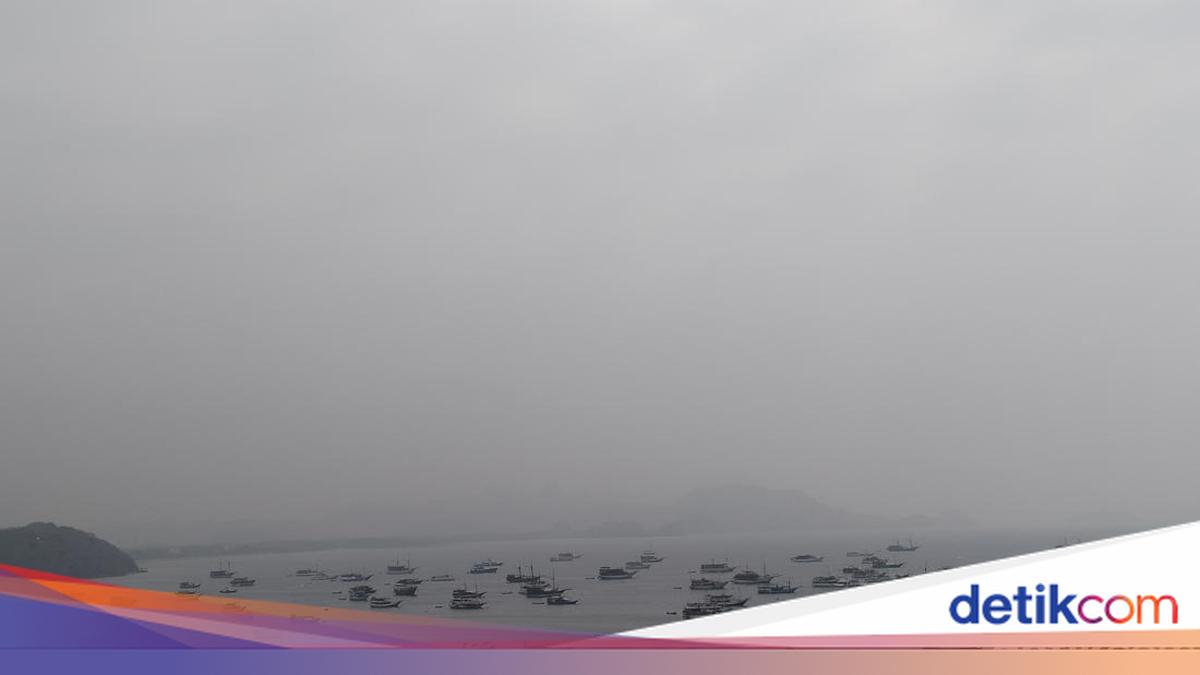
Hazy conditions returned to Labuan Bajo, West Manggarai, East Nusa Tenggara (NTT), on Monday afternoon (19 October 2026). The air looked as though ash were floating through it, making the sky appear misty.
Haze is reduced air clarity caused by small particles that obscure visibility and make the sky less clear. It often occurs when dust, smoke or water vapour accumulates in the atmosphere and blocks light.
The haze has limited visibility to about four kilometres. The Meteorology, Climatology and Geophysics Agency (BMKG) has urged sensitive groups, including children and people with respiratory conditions, to limit outdoor activities.
“We urge sensitive groups, such as children, older people and those with respiratory conditions, to limit strenuous outdoor activity when the air is smoky or dusty,” said Maria Patricia Christin Seran, head of the Komodo Meteorological Station.
“If respiratory problems arise, people are advised to consult a health professional if necessary,” she added.
Haze has also been reported elsewhere in NTT. Maria said the haze in Labuan Bajo may have come from smoke carried from forest and land fires outside the province.
“Based on our monitoring of meteorological conditions, winds in NTT are still predominantly from the east. Meteorologically, this wind pattern could transport particles from areas east of NTT. If there are sources of emissions, such as forest and land fires in the east, the resulting particles could potentially be carried by air currents into NTT,” Maria explained.
However, she stressed that further analysis is needed to determine the cause of the haze, since the particles that reduce air clarity do not come only from smoke.
“To substantiate the possibility of long-range transport, we need to analyse upper-level winds and conduct further analysis,” Maria said.
“These particles do not make the air hazy through smoke alone. They are an accumulation from various natural and human sources, including dust, emissions and fire smoke,” she added.
Maria explained that in NTT, which is surrounded by sea, aerosols can also come from sea spray, which produces salt particles that are lifted into the atmosphere.
Therefore, BMKG modelling that indicates the presence of fine particles and aerosols does not, by itself, show that the conditions are caused solely by smoke from fires.
“Identifying the source of the particles requires further analysis, while actual air-quality conditions need to be confirmed through direct measurements,” Maria said.
“I have not yet been able to access upper-air profile data from the Maumere station. That could help confirm whether a temperature inversion is trapping these particles in the lower atmosphere, up to a certain level, causing the haze as the various elements accumulate and cannot disperse into the upper atmosphere,” Maria concluded.
A Labuan Bajo resident, Sidus, said he had suspected the haze was caused by fire smoke. “Is there a fire somewhere? There’s smoke on the road,” he said.
Haze was previously reported in Labuan Bajo for about four days, from late September into early October. At the time, it was attributed to temperature inversions in the layer near the ground surface, from the surface to about 950 hPa, and in the layer between 750 hPa and 720 hPa.
Source: jawawa.id (https://jawawa.id/newsitem/haze-returns-to-labuan-bajo-reducing-visibility-to-4km-1792396230)
Originally published by detikBali (https://www.detik.com/bali/nusra/d-8713813/haze-kembali-selimuti-labuan-bajo-jarak-pandang-terbatas-4-km), translated from Indonesian