
Hashim's Daughter, Prabowo's Niece, Amazed by Drinkable Tap Water in IKN
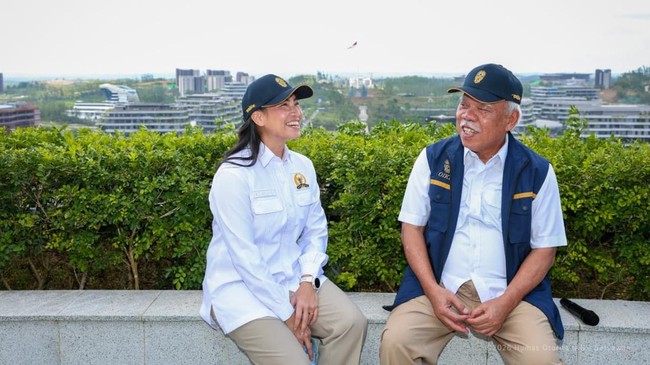
The Vice Chairperson of Commission VII of the Indonesian House of Representatives (DPR RI), Rahayu Saraswati Djojohadikusumo, recently visited the Nusantara Capital City (IKN) to observe the ongoing construction progress. One feature that particularly impressed Rahayu was the fact that tap water in IKN is directly drinkable. According to Rahayu, this level of service is comparable to developed nations in Europe.
“Even the tap water is already drinkable, making it feel as though we are in Europe,” she stated on Saturday (1/8/2026).
Rahayu explained that the drinkable quality of the water is due to the rigorous filtration process implemented at the reservoir stage. “The reason the water is drinkable is that it has been filtered; even from the reservoir, the process is truly extraordinary,” she explained.
The water supply in IKN is sourced from the Sepaku Water Supply System (SPAM Sepaku), which comprises a Water Treatment Plant (IPA) with a capacity of 300 litres per second, a 16 km transmission pipeline, a reservoir, and 22 km of distribution pipes. Phase I of SPAM Sepaku is targeted to serve the Presidential Office and Palace, the State Secretariat, the Presidential Security Force (Paspampres), the Coordinating Ministry complexes (1, 2, 3, and 4), the Amphitheatre, Gallery, Service Area, civil servant housing, ministerial residences, and other public facilities including hotels, schools, shops, and hospitals.
Technically, raw water is pumped by an intake unit to the Water Treatment Plant. The treatment process begins with an aeration unit to increase dissolved oxygen in the raw water. Subsequently, the water flows through coagulation, flocculation, and sedimentation (KFS) units, followed by filtration, ozone treatment, and Granular Activated Carbon (GAC).
The produced water, which meets potable water quality standards, is then collected in a clearwell before being pumped to the Main Reservoir via a 16 km transmission pipeline network. The use of ozone technology as a green technology is implemented at the Sepaku plant through a three-stage ozonation process. This method serves as a sterilisation technique, protects against microorganisms, removes organic substances, and protects the distribution network from corrosion and contamination, playing a vital role in ensuring the safety of drinking water in IKN.