
Hashim: Rp10,000tn of Indonesia’s Economic Activity Goes Unrecorded — Here’s Why
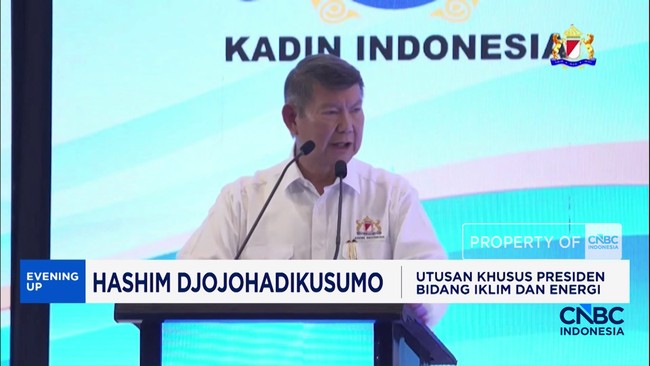
Jakarta, CNBC Indonesia — Presidential Special Envoy for Climate and Energy Hashim Djojohadikusumo has highlighted the scale of Indonesia’s economic activity that is not recorded in gross domestic product (GDP), estimating its value at Rp10,000tn. The large figure reflects the many economic transactions that are not included in official records.
Hashim said World Bank data showed that around 35–40% of Indonesia’s economic activity went unrecorded. As a result, the country’s official GDP does not fully reflect the actual level of economic activity.
“If our recorded GDP is Rp25,000tn, that figure is recognised by the IMF, the World Bank, Bank Indonesia and our government. It turns out our economy is much larger. According to the World Bank, roughly 35–40% of economic activity in Indonesia goes unrecorded,” Hashim said at the Indonesian Chamber of Commerce and Industry’s national leadership meeting.
He estimated that the unrecorded activity was equivalent to around Rp10,000tn.
“Our economy turns out to have 30–40% that goes unrecorded. That means roughly Rp10,000tn is not recorded,” he said.
Hashim explained that unrecorded economic activity does not necessarily involve illegal transactions. Some takes place in people’s everyday lives without receipts or tax records.
He cited hairdressers and massage therapists who visit people’s homes as examples. Customers pay them directly without receiving a receipt, meaning the transactions are not recorded and are not subject to value-added tax (VAT).
“I usually have a hairdresser come to my apartment once a month. He charges a fee, a wage. I pay him without a receipt. And because there is no receipt, the 11% VAT is not collected,” Hashim said.
He also gave the example of massage therapists who accept payment without issuing receipts.
According to Hashim, similar transactions take place on a large scale across society, involving individual service providers, food stalls and beauty salons. Taken together, these activities amount to a substantial sum.
“How many transactions like these are carried out by Anton and Yanti? Multiply them by hundreds of millions, and some of them include, perhaps, warung Tegal food stalls and beauty salons. All these transactions are in cash,” he said.
State revenue seen as still low
Hashim said the large volume of unrecorded activity was connected to Indonesia’s low state revenue. He said total state revenue, including taxes, excise and non-tax state revenue (PNBP), remained at around 12% of GDP.
He said this ratio was lower than in several other countries, citing Cambodia at 18%, India at 20% and Vietnam at 23%.
Hashim said the difference between Indonesia’s revenue ratio and Cambodia’s indicated significant untapped revenue potential.
“If we compare ourselves with Cambodia, a country poorer than Indonesia, the difference between 18% and 12% is 6%. Six per cent of the recorded Rp25,000tn GDP — how much is that? Rp1,500tn, isn’t it?” Hashim said.
He estimated that Indonesia could raise an additional Rp1,500tn in state revenue each year if it increased its revenue ratio to Cambodia’s level.
He said the additional revenue could even change Indonesia’s fiscal position, comparing it with the state budget deficit, which he put at around Rp500tn–Rp600tn.
“If our tax and customs officials did their jobs properly, like those in Cambodia, we should have a surplus of Rp900tn this year,” he said.
To address the issue, Hashim said the government had prepared measures to boost state revenue through digital technology and artificial intelligence (AI).
He said the government would make greater use of electronic systems to collect taxes, bringing transactions that had previously gone unrecorded into the tax system.
“Taxes will be collected electronically, through IT. AI will be used for all transactions, which will then be taxed in accordance with the applicable law,” Hashim said.
He also said the government would begin implementing digital taxation on 9 November. Under the scheme, state-owned and private banks, as well as financial technology (fintech) companies and digital commerce platforms, would be involved in collecting and remitting taxes.
“This will be implemented soon, on 9 November. All state-owned banks, private banks and fintech companies, including Shopee, Lazada, GoTo and others, must take part in collecting and remitting taxes that have not been collected so far,” he said.
Hashim said he hoped the measures would increase state revenue and strengthen the government’s fiscal capacity to fund development programmes.
He expects Indonesia’s state revenue ratio to reach Cambodia’s level within the next two to three years.
Source: jawawa.id (https://jawawa.id/newsitem/hashim-rp10-000tn-of-indonesias-economic-activity-goes-unrecorded-heres-why-1793325053)
Originally published by CNBC Indonesia (https://www.cnbcindonesia.com/news/20261030071542-4-780788/hashim-rp10000-t-kegiatan-ekonomi-ri-tak-tercatat-ini-sebabnya), translated from Indonesian