
Hashim Djojohadikusumo Explains MBG’s Role in Improving Human Resources to Nobel Laureate
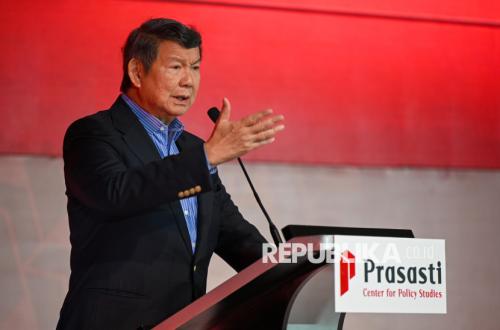
JAKARTA — Prasasti Board of Advisors member Hashim Djojohadikusumo described the Free Nutritious Meals (MBG) programme as one of the government’s efforts to improve the quality of Indonesia’s human resources, speaking in front of 2024 Nobel Economics laureate James A. Robinson. He linked nutrition to children’s ability to absorb lessons, which in turn affects the quality of human resources and productivity when they enter the workforce.
“One of the problems, and one that underpins our programme, is the Free Nutritious Meals (MBG) programme, which you may have heard about. The MBG programme is one of the flagship initiatives promised by President Prabowo during his campaign,” Hashim said at the Prasasti Indonesia Policy Forum 2026 in Jakarta on Tuesday (13 October 2026).
Hashim said the idea for MBG emerged in 2006, when President Prabowo Subianto was concerned about the nutrition and education of Indonesian children. At the time, the rate of stunting among children was high, at around 30 per cent.
He said nutritional problems did not necessarily mean that children had no food, but could also arise when the food they ate failed to meet their nutritional needs. Hashim also cited findings from a previous administration indicating that around 41 per cent of schoolchildren in Indonesia went to school without breakfast.
He said this could disrupt children’s concentration during lessons. “So you can imagine children having to attend classes for three, four or five hours on an empty stomach,” he said.
Hashim therefore believes the nutritional problem must be addressed if Indonesia is to make the most of its demographic dividend. Meeting children’s nutritional needs is expected to help them grow into a more productive generation and contribute to the economy.
He also compared the quality of education in Indonesia with that of South Korea, referring to Programme for International Student Assessment (PISA) results as one measure of the difference in educational outcomes between the two countries.
“If you look at it, Korea is almost always in the top three, or perhaps the top four. As far as I know, the last time I looked, countries such as New Zealand, Singapore, Korea and Finland were at the top. Indonesia, meanwhile, is almost always in the bottom 10 per cent, or among the worst. The last time I looked, Indonesia was ranked 62nd out of 70 countries. We [Indonesia] were ranked 62nd out of 70,” he said.
Improving the quality of human resources is therefore one area Indonesia needs to focus on to pursue faster economic growth, Hashim said.
He added that MBG was not a new policy internationally, noting that several countries had already introduced similar programmes. Indonesia, he said, was among the countries that had been late to adopt such a nutritional support policy.
Hashim thus presented MBG not merely as a programme to provide food to children, but as part of a long-term effort to improve education and the productivity of Indonesia’s workforce.
Source: jawawa.id (https://jawawa.id/newsitem/hashim-djojohadikusumo-explains-mbgs-role-in-improving-human-resources-to-nobel-laureate-1791942653)
Originally published by Republika (https://ekonomi.republika.co.id/berita/tmviji490/hashim-djojohadikusumo-jelaskan-peran-mbg-dalam-meningkatkan-kualitas-sdm-di-hadapan-peraih-nobel), translated from Indonesian