
Has the Worst Narrative Been Priced In?
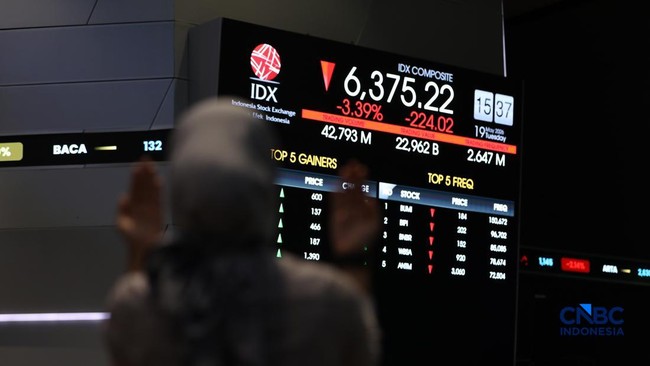
There is a painful irony that repeats in developing markets: when the exchange rate touches a new psychological level, when foreigners exit for days on end, when media commentary is full of pessimism, that is precisely the moment that is most profitable for investing. History of three large developing economies proves this forcefully and consistently.
Let us begin with Indonesia in 1997–1998. The rupiah, which was initially Rp4,850 to the US dollar, collapsed to Rp17,000, a depreciation of 73 per cent in a matter of months. Sukarno? No, Suharto fell. Riots swept the country. The IMF arrived with strict conditions. The narrative at the time was singular: Indonesia was crushed and bankrupt. Foreign capital fled, the IHSG plunged 68 per cent.
Few wanted to hold rupiah-denominated assets. Yet those investors who entered at the depths of panic enjoyed a 168 per cent rise in the following four years. Institutional reforms born from the crisis, namely an independent Bank Indonesia, fiscal decentralisation, and banking-sector restructuring, became the foundation of two decades of growth.
Two decades later, a similar story unfolded in Turkey. In the 47 days between July and August 2018, the lira lost 34 per cent of its value against the dollar. Fitch closed its Istanbul office. Moody’s and S&P trimmed the rating. Foreign financial institutions cried “Turkey is uninvestable.”
Various academic arguments subsequently uncovered findings that contradicted intuition: it was institutional foreign investors who were willing to buy during the crisis who delivered the highest returns in the following months. Borsa Istanbul (BIST) in local currency grew 479 per cent between 2010 and 2022, even outperforming almost all developing-market indices worldwide, despite the lira remaining under pressure.
Brazil completes this triad. Between 2015 and 2016, the samba nation was hit by triple shocks: two consecutive years of recession (GDP minus 3.8 per cent and minus 3.6 per cent), impeachment of President Dilma Rousseff over fiscal irregularities, and the Petrobras corruption scandal that unsettled market confidence.
The Brazilian real weakened 33 per cent. Ibovespa in January 2016 was at roughly the same level as in 1997. Yet from that nadir Ibovespa trebled in four years, a rise of around 200 per cent by January 2020, before the pandemic hit again.
Structural Pattern
There is a structural pattern common to these three cases. First, currency crises depress valuations to historical lows. Second, massive foreign outflows create liquidity that is dumped into the market at discounted prices. Third, local narrative pessimism reaches a peak.
These three case studies prove that this is a sign that almost all bad news has already been priced in. Then policy responses arrive: central-bank rate hikes, fiscal interventions, or structural reforms that become catalysts for a reversal.
Of course not all emerging-market crises end in recovery. Argentina is the dark side example: repeated defaults, an uncredible central bank, and destructive capital controls produce a permanent crisis rather than a buying opportunity. The difference lies in the fundamental institutions of that country.
At least a few questions remain: Are central banks independent enough to take painful decisions? And can the structure of external debt still be managed? And is the crisis external and cyclical, or structural and systemic?
What about Indonesia’s condition?
Here the relevance for Indonesia in 2026 becomes sharp. The rupiah had briefly touched around Rp17,700 per dollar or hit a historic low. Foreign outflows were aggressive. Local narrative deteriorated.
If we look at the structural comparative patterns above, Bank Indonesia is still perceived as able to preserve its credibility and integrity, even though doubts about governance exist in markets due to burden-sharing pressure. On 20 May 2026, Bank Indonesia raised the BI Rate to 5.25 per cent, which this move signals as policy credibility and independence.
Indonesia also remains capable of managing its external-debt structure well. The debt-to-GDP ratio in 2025 remained around 40 per cent, well below Malaysia and Thailand. The deficit target of the state budget (APBN) remains below 3 per cent of GDP.
Domestic economic problems are not structural and systemic; rather, they are largely sentiment-driven, as the government maintains the economy’s fundamentals and external uncertainties, notably tensions in the Middle East and US foreign policy.
History never repeats exactly, but it rhymes. And the rhymes most persistent in emerging markets are not those of entering when everything is bright, but those of standing firm in uncertainty with calculation, not blind courage when others are fleeing.
If investors are more patient and have a sufficiently long investment horizon, today’s conditions — though full of uncertainty — still offer opportunities as good as those seen in 2008, 2013, or 2020.
May the confidence of our stock-market participants — institutions and retail, foreign and domestic — quickly improve.