
Harvest Area Unchanged, Yet Indonesia's Rice Production Declines: How Long Will This Last?
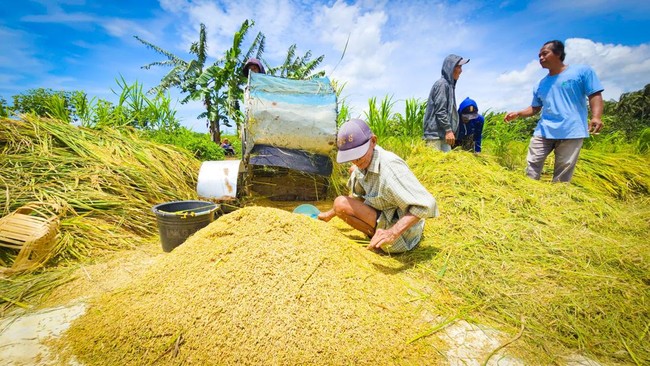
National rice production is estimated to reach 31.41 million tonnes throughout January-October 2026, a slight decrease of 0.08% compared to the 31.44 million tonnes recorded during the same period last year.
This decline in rice production aligns with the projected weakening of paddy production in the form of dried milled grain (GKG). The Central Statistics Agency (BPS) estimates that paddy production for January-October 2026 will reach 54.52 million tonnes of GKG, down 0.08% compared to the same period in 2025.
Ateng Hartono, Deputy for Distribution and Services Statistics at BPS, explained that rice production is the result of converting paddy production, while paddy production itself is determined by harvest area and productivity.
For the January-October 2026 period, the paddy harvest area is expected to reach 10.31 million hectares, an increase of only 0.01% compared to January-October 2025. This means the increase in harvest area is almost unchanged from last year, even though paddy production has actually fallen by 0.08%.
Consequently, the pressure on production is more closely related to productivity, which has not yet been able to drive production despite the relatively stable harvest area.
Rice Production Declines in July
Production pressure was already evident in July 2026. BPS estimates that the paddy harvest area in that month reached 0.93 million hectares, a 1.05% decrease compared to July 2025, which reached 0.94 million hectares.
In line with this, July 2026 paddy production is estimated at 4.75 million tonnes of GKG, a 1% drop compared to the 4.80 million tonnes of GKG in July 2025. This production is equivalent to 2.74 million tonnes of rice for public consumption, a 0.99% decrease compared to the 2.77 million tonnes achieved in July 2025.
This condition shows that when the harvest area shrinks, both paddy and rice production undergo corrections.
“In line with the harvest area overview, paddy production in July 2026 is estimated at 4.75 million tonnes of dried milled grain (GKG), experiencing a 1% decrease compared to July 2025, which was 4.80 million tonnes of GKG,” said Ateng during the BPS press conference on Tuesday (1/9/2026).
Potential for Declining Harvest in August-October
BPS also observes that rice production could remain under pressure until October 2026. Based on the results of the Area Sampling Frame (KSA) survey for July 2026, the potential harvest area for August-October 2026 is estimated at 3.07 million hectares, a 1.29% decrease compared to the same period last year.
This decrease in harvest area is accompanied by a potential paddy production estimated at only 16.18 million tonnes of GKG, a 0.92% drop compared to August-October 2025. From this amount, rice production is expected to reach 9.33 million tonnes, a 0.90% decrease compared to the same period in the previous year.
“The potential paddy production for the August-October 2026 period is estimated at 16.18 million tonnes of GKG, or a decrease of 0.15 million tonnes of GKG, representing a 0.92% decline compared to the same period last year,” he stated.
Meanwhile, KSA observations show that 36.27% of agricultural land is in the ‘standing crop’ phase, meaning it is currently planted with paddy. Additionally, 31.99% of the land is planted with non-paddy commodities, 13.19% is fallow, 11.77% has been harvested, and 6.34% is in the land preparation stage.
Of the land currently planted with paddy, the largest portion is in the generative phase at 15.78%. According to BPS, paddy plants in the generative phase generally enter the harvest stage about one month later.
“In July 2026, the majority of agricultural land was in the standing crop phase, at approximately 36.27%. Observations also show that land is being used for non-paddy crops (31.99%), is fallow (13.19%), has been harvested (11.77%), and is undergoing land preparation (6.34%),” he said.
“From the standing crop area in July 2026, the majority is in the generative phase, at 15.78%, most of which has the potential to be harvested in August 2026,” Ateng added.
This means that production developments in the coming months will depend heavily on the actual harvest from the land currently in the growth phase.
BPS emphasised that the August-October figures are still potential estimates and may change according to field conditions, including pest attacks, plant pests and diseases (OPT), flooding, drought, or changes in harvest timing.
“These potential figures are still subject to change, primarily depending on the planting conditions during the August to October 2026 period, such as pest attacks, floods, droughts, or if farmers change their harvest timing, and so on,” he explained.
As for the potential harvest for August-October 2026, Ateng noted that it remains concentrated in several major production centres. In Java, the largest potential harvests are in West Java, East Java, and Central Java. In Sumatra, the main centres are in South Sumatra, North Sumatra, Lampung, and Aceh.
In Sulawesi, the potential harvest is concentrated in South Sulawesi and Southeast Sulawesi. South Kalimantan and West Nusa Tenggara are also regions with relatively large potential harvests.
At the regency/city level, notable areas include Indramayu, Subang, Majalengka, and Karawang in West Java; Jember and Lamongan in East Java; and Cilacap and Sragen in Central Java.
In Sumatra, the key areas are Banyuasin, Central Lampung, East OKU, East Ogan Komering Ilir, and Tulang Bawang. Meanwhile, in Sulawesi, the prominent areas are Bone, Wajo, Sidenreng Rappang, Pinrang, and Luwu.
Source: jawawa.id (https://jawawa.id/newsitem/harvest-area-unchanged-yet-indonesias-rice-production-declines-how-long-will-this-last-1788245878)
Originally published by CNBC Indonesia (https://www.cnbcindonesia.com/news/20260901124449-4-763966/luas-panen-tak-berubah-produksi-beras-ri-justru-turun-sampai-kapan), translated from Indonesian