
Harsh Liquid from Insiders
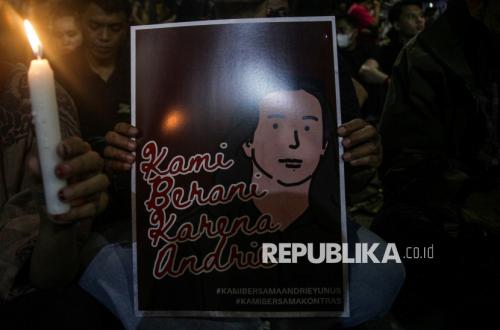
Ramadhan, a month usually filled with gentleness, was suddenly doused with the most inhumane liquid: caustic liquid. And like a classic drama of this country, the perpetrator initially appeared as a shadow. He was mysterious, but seasoned with photos clearly generated by artificial intelligence.
The story goes that on Thursday night, 12 March 2026, the usually bustling streets of Central Jakarta suddenly became the stage for a tragedy. Andrie Yunus, an activist from KontraS, was returning from a podcast at the YLBHI office. The podcast, which usually only produced heated opinions, this time seemed to invite scalding water in a far more brutal form. Two motorbikes, four people, and one heinous decision, and history was recorded in a suffocating way.
Imagine a body being doused with caustic liquid. The name “caustic liquid” alone is like a misplaced poem. Water is soft, flowing, soothing; but when given the prefix “caustic”, it turns into a cruel paradox. Visually, this liquid often appears clear, colourless, almost like innocent plain drinking water.
However, behind its transparency, it is a corrosive chemical compound, such as sulphuric acid or hydrochloric acid, that works through chemical reactions. It dissolves tissues, burns the skin, damages cells down to the deepest layers. It does not merely injure, but erases. That is why Andrie Yunus’s body was burned over 24 percent, and his corneas had to be operated on, because the liquid that appeared tame was actually fire in liquid form.
And this country, as usual, has a unique way of uncovering mysteries, not through one camera, but 86 CCTV points. As if Jakarta suddenly became the most surveilled city in the world, with 2,610 image fragments woven into a narrative of crime. From electronic ticketing recordings to citizens’ cameras that might ordinarily film cats, all spoke as facts.
Those faces finally emerged so clearly. No longer in the form of AI sketches that were too neat for criminals, but real faces that were tense, hurried, and ironically very inhumane. There lies the paradox. The most inhumane crime was committed by humans against other humans. And not just any humans, but those with ranks.
The names were then announced at a press conference broadcast live to the public. Names that were still hidden with initials emerged, from Captain NDP, Second Lieutenant SL, Second Lieutenant BHW, to Sergeant ES. Four people. Three of them officers. A bitter reality. They were not street thugs, not improvised criminals, but part of the system that should safeguard security.
At this point, the public seemed stung by an awareness sharper than the caustic liquid itself. The vile perpetrators were not “outsiders”, but insiders. Here the irony reaches its almost absurd peak. The perpetrators were not just ordinary TNI members, but from Denma BAIS — the Headquarters Detachment of the TNI’s Strategic Intelligence Agency.
BAIS itself is the brain of the country’s military intelligence. This agency is tasked with reading the signs of the times before others can even ask “what’s going on?”. They conduct strategic analysis, early threat detection, defence intelligence operations, to the safeguarding of state secrets, especially during wartime.
In short, if this country has a “sixth sense” to detect danger, BAIS is its nose. This agency is directly under the TNI Commander, led by a three-star general, and serves as a reference in reading threats from tactical to global geopolitical levels. Thus, when a small element within it is instead involved in brutal actions against civilians, the public is not just shocked, but furious.