
Harmonious Industrial Relations a Long-Term Investment for Business Sustainability
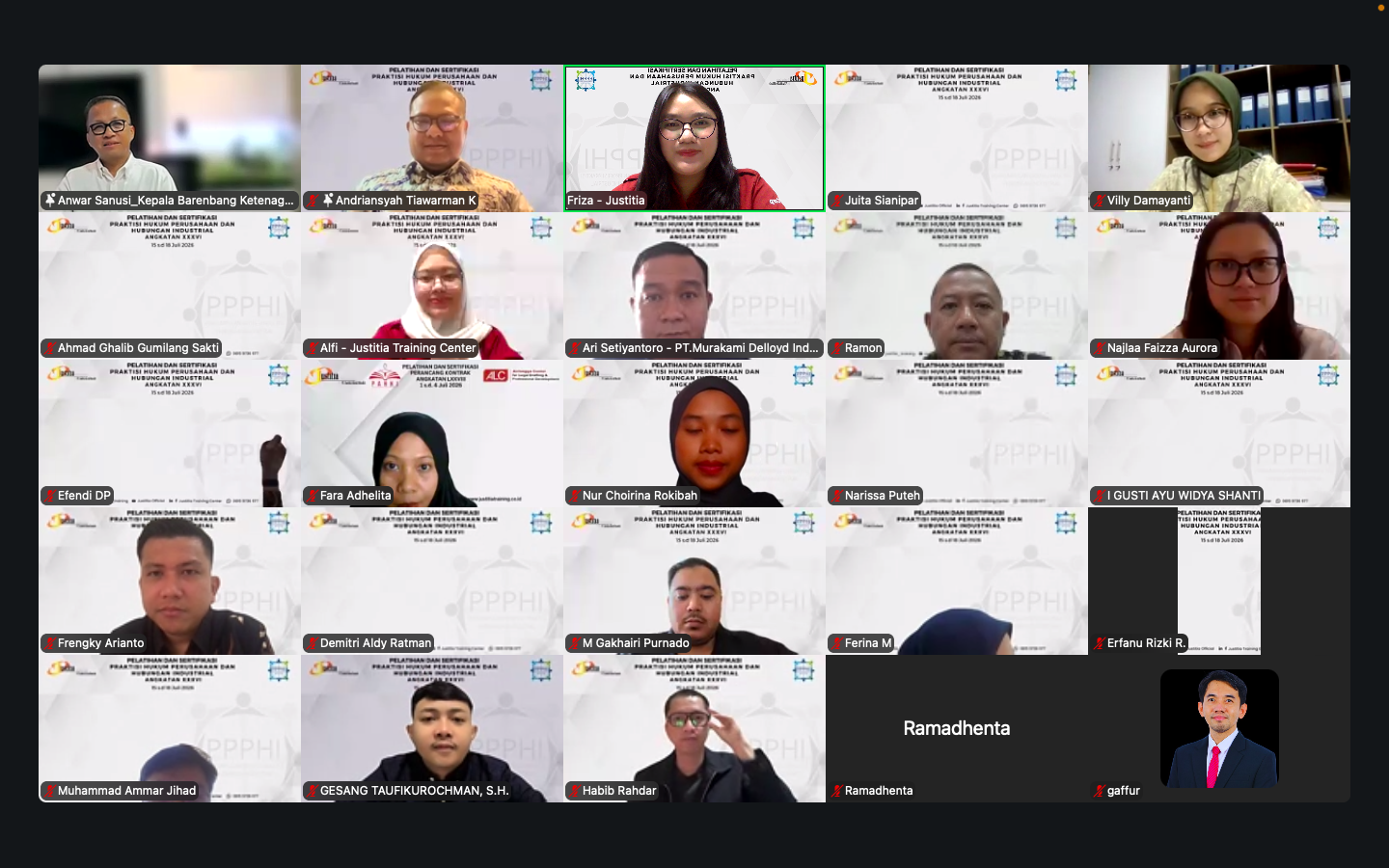
Justitia Training Center has again held the 36th batch of Corporate Legal and Industrial Relations Practitioner Training and Certification in collaboration with the Indonesian Professional Legal Association. The activity, attended by 27 participants, took place on 15–18 July 2026 as part of a commitment to improving the competence of corporate legal and industrial relations practitioners in facing regulatory challenges and workplace transformation.
In his opening remarks, Justitia Training Center President Director Andriansyah Tiawarman K. stressed that industrial relations should not only be a concern when disputes arise, but must be built from the outset as a foundation for corporate sustainability.
‘Good industrial relations are a long-term investment for the company. A conducive work environment, regulatory certainty, and proper problem-solving will have a positive impact on productivity, sustainability, and the trust of all parties involved,’ Andriansyah said.
He explained that corporate legal and industrial relations practitioners have a strategic role in ensuring all company policies, from employment agreements and company regulations to business decisions, are drafted in accordance with legal provisions to minimise potential disputes in the future.
The training not only equipped participants with an understanding of labour regulations but also practical skills through case study discussions and simulations of industrial relations problem-solving. The entire series of training was conducted online using interactive methods to maintain optimal learning quality.
The event also featured the Head of the Planning and Development Agency of the Ministry of Manpower, Prof. Drs. Anwar Sanusi, MPA., Ph.D., as a keynote speaker. In his keynote speech, he highlighted the increasingly complex challenges of industrial relations in the digital era.
According to Prof. Drs. Anwar Sanusi, there are at least five main issues that need attention: the complexity of labour regulations, wage and worker welfare issues, workplace discrimination, relations between companies and trade unions, and the impact of digital transformation, automation, and artificial intelligence (AI).
‘Digital transformation and automation, including the development of AI, cannot be avoided. On one hand, it provides convenience, but on the other hand, it presents challenges because some jobs are being replaced. Therefore, all parties must be able to adapt,’ said Prof. Drs. Anwar Sanusi.
He also revealed that global dynamics are affecting national employment conditions, including the increasing potential for layoffs. Based on Ministry of Manpower data, the number of layoffs rose from around 23,000 workers to 32,000 workers by June 2026. Additionally, up to May 2026, there were 412 recorded industrial relations disputes, dominated by disputes over rights, interests, layoffs, and disputes between trade unions.
Facing these conditions, Anwar stressed the importance of building harmonious industrial relations through constructive social dialogue between the government, employers, and workers.
‘The basic principle is to prioritise communication and dialogue. Strikes or demonstrations are the last resort when all settlement efforts fail to reach a resolution,’ he asserted.
He added that the government continues to encourage the resolution of industrial relations issues through early detection, strengthening Bipartite Cooperation Institutions, and meaningful participation in the formulation of labour regulations.
At the end of the series of activities, all participants will take a certification exam organised by LSP Justitia, which has obtained a licence from the National Professional Certification Agency. Through this assessment process, participants’ competencies will be measured based on applicable professional standards as a form of professional recognition for career development.
Through this training, Justitia Training Center hopes that participants will be able to improve their competence in managing industrial relations professionally, adaptively, and with integrity, so as to create harmonious, productive, and sustainable working relationships within the company.