
Happy Eid Travel! Nearly 1.5 Million Vehicles Have Already Left Jabotabek
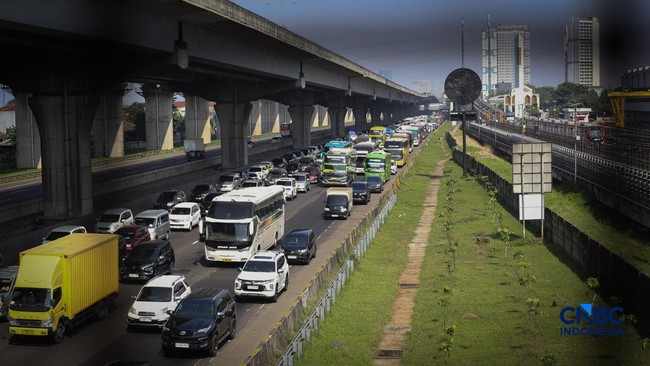
The Eid al-Fitr 2026 homecoming traffic has begun emptying the Jakarta and surrounding areas. From H-10 to H-3 of Eid al-Fitr 1447 H, nearly 1.5 million vehicles were recorded leaving the Jabotabek region.
According to data from PT Jasa Marga (Persero) Tbk, the total number of vehicles exiting Jabotabek from 11-18 March 2026 reached 1,483,703 units. This figure surged by 30.1% compared to normal traffic conditions, which average around 1.14 million vehicles.
Jasa Marga’s President Director, Rivan A. Purwantono, revealed that this number covers approximately 42% of this year’s projected homecoming total, estimated at 3.5 million vehicles by the end of the Eid holiday period.
In terms of distribution, the majority of travellers headed east. A total of 788,710 vehicles, or about 53.1%, went towards Trans Java and Bandung. Meanwhile, 402,945 vehicles, or 27.2%, headed to Merak, and 292,048 vehicles, or 19.7%, towards the Puncak area.
The most significant surge occurred on the Trans Java route. Vehicles passing through the Cikampek Utama Toll Gate reached 523,223 units, more than doubling compared to normal conditions. Meanwhile, the route to Bandung via Kalihurip Utama recorded 265,487 vehicles, up slightly by 6.8%.
For the western route to Merak, vehicle volume reached 402,945 units, an increase of 4.7%. As for the southern route to Puncak via Ciawi, it recorded 292,048 vehicles, up 3.8% from normal conditions.
The temporary peak of homecoming traffic occurred on H-3 Eid, or Wednesday, 18 March 2026. On that day, the volume of vehicles leaving Jabotabek reached 270,315 units, surging 98.3% compared to normal daily traffic. This figure was also 4.62% higher than the previous year’s peak homecoming.
To handle the surge, traffic engineering measures were implemented. Rivan stated that policies such as national one-way systems up to contraflow were applied at the discretion of the police to ensure smooth vehicle flow.
“Traffic engineering with one-way and contraflow is still ongoing through police discretion. This implementation is based on data showing significant increases in vehicle traffic volume from Jakarta towards Semarang, visual monitoring via CCTV, and reports from police officers on the ground,” Rivan said in his statement on Thursday night (19/3/2026).
On the other hand, congestion is also starting to be felt at rest areas. To anticipate build-ups, Jasa Marga is operating a total of 64 rest areas, including five functional points, and preparing alternative rest spots outside the tolls in the form of 10 petrol station locations along the Trans Java route.
According to Rivan, these additional facilities are expected to ease congestion while providing options for travellers to rest without relying on main rest areas.
“These rest areas are located not far from toll gates, so they remain easily accessible to road users. Road users can rest at alternative rest areas by utilising supporting facilities provided, including MSME tenants, toilets, and fuel pumps. After resting, road users can continue their journey through the same toll gate without additional charges, as long as there is no change in origin and destination,” Rivan explained.