
Hanung Bramantyo Promotes Muhammadiyah-Style Character Education in Adaptation of 'Children of Heaven'
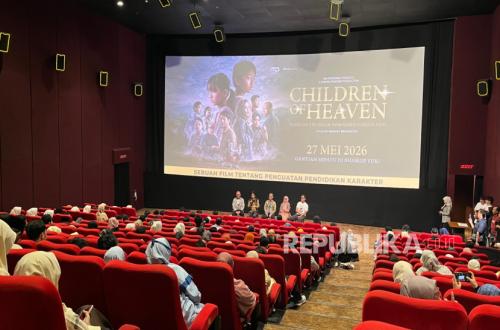
YOGYAKARTA — Director Hanung Bramantyo again presents a feature film rich in moral messages. In collaboration with MD Pictures, Hanung adapts the Iran-origin film Children of Heaven into an Indonesian version set in a Muhammadiyah school with a strong emphasis on character education.
During a screening with the Muhammadiyah Central Leadership in Yogyakarta, Hanung stated that the film is not merely for family viewing but also as a learning tool for children to avoid easily complaining when facing life’s difficulties. The film follows Ali and Zahra, siblings living under economic hardship.
But for Hanung, the main strength of the story is not simply poverty, but the mental resilience of the children in facing problems without continually blaming their circumstances.
‘As a father, when I make a film, my children cannot watch my films. Therefore, I hope this time my children, their friends, and children everywhere can watch and enjoy,’ Hanung said on Wednesday, 20 May 2026.
‘Through moments of difficulty, they do not immediately dramatise or whine. Ali and Zahra have a kind of self-defence, a defence mechanism designed not to burden their parents. Even when his shoes go missing, Ali never blames anyone, not even his father,’ he added.
Hanung said the message in the film is relevant to current social conditions, when many people are seen as quick to vent complaints on social media. According to him, Ali’s character demonstrates a different attitude by choosing to seek a way out rather than continually lamenting the situation.
Therefore, the film is hoped to serve as a lesson for today’s children to learn to understand family circumstances, especially amid tough economic conditions.
‘At the very least, do not ask for one thing that our parents cannot bear. Let us strive to solve our own problems,’ he said.
Reasons for Muhammadiyah Setting
In the version adapted, Hanung chose to place Muhammadiyah primary school as the main setting of the story, with the year set in 1988. The choice is not without reason. Besides aligning with historical context, Hanung wants to present Muhammadiyah’s educational values, which he says shaped him to this day.
As a Muhammadiyah alumnus, Hanung confesses that the values taught by his teachers throughout school were the reason he partnered with Muhammadiyah for this film project, especially regarding character education to prevent children from easily lamenting.
‘I am a Muhammadiyah alumnus. How Muhammadiyah moulded my mindset at the time to always feel ashamed to complain about circumstances. My teachers taught how not to hurry to complain, but to seek a way out. That is why I partnered with Muhammadiyah to provide full support for this positive film,’ he said.
Meanwhile, Irwan Akib, Chairman of Muhammadiyah’s Central Leadership, assessed that the film is not only important for children but also a reflection for parents in building character education at home.
‘In a family, it is not easy for a younger sibling and an older one to reconcile. That is important in my view. Ali and his sister could not be harmonious without good character education from their parents,’ he said after watching the film.
He stated that Ali’s struggle with life’s constraints demonstrates the importance of character education within the family, from honesty, responsibility, to resilience in facing problems. Although set in the 1980s to 1990s, Akib believes the film’s message remains relevant to contemporary social conditions.
Akib also invites parents and teachers to watch the film with their children to understand each role in family life and education.
‘This film truly depicts how strong character education within a family can be. In today’s world, there are many who might be in similar circumstances, though the environment differs,’ he said.
‘If necessary, have the whole family watch it together to understand one another properly. Like: what is my position as a child, what is the mother’s, what is the father’s? Similarly, for teachers, so they can truly understand the hopes of students,’ he added.
MD Pictures’ representative, Firauzi Cece, echoed similar sentiments, hoping the film can be used primarily as a tool to build character in children.
‘We hope the film can provide guidance on character development for children and help educate them to be better,’ he said.