
Halal Bihalal B57+, Arsjad Targets Indonesia's Role as Global Halal Economy Hub
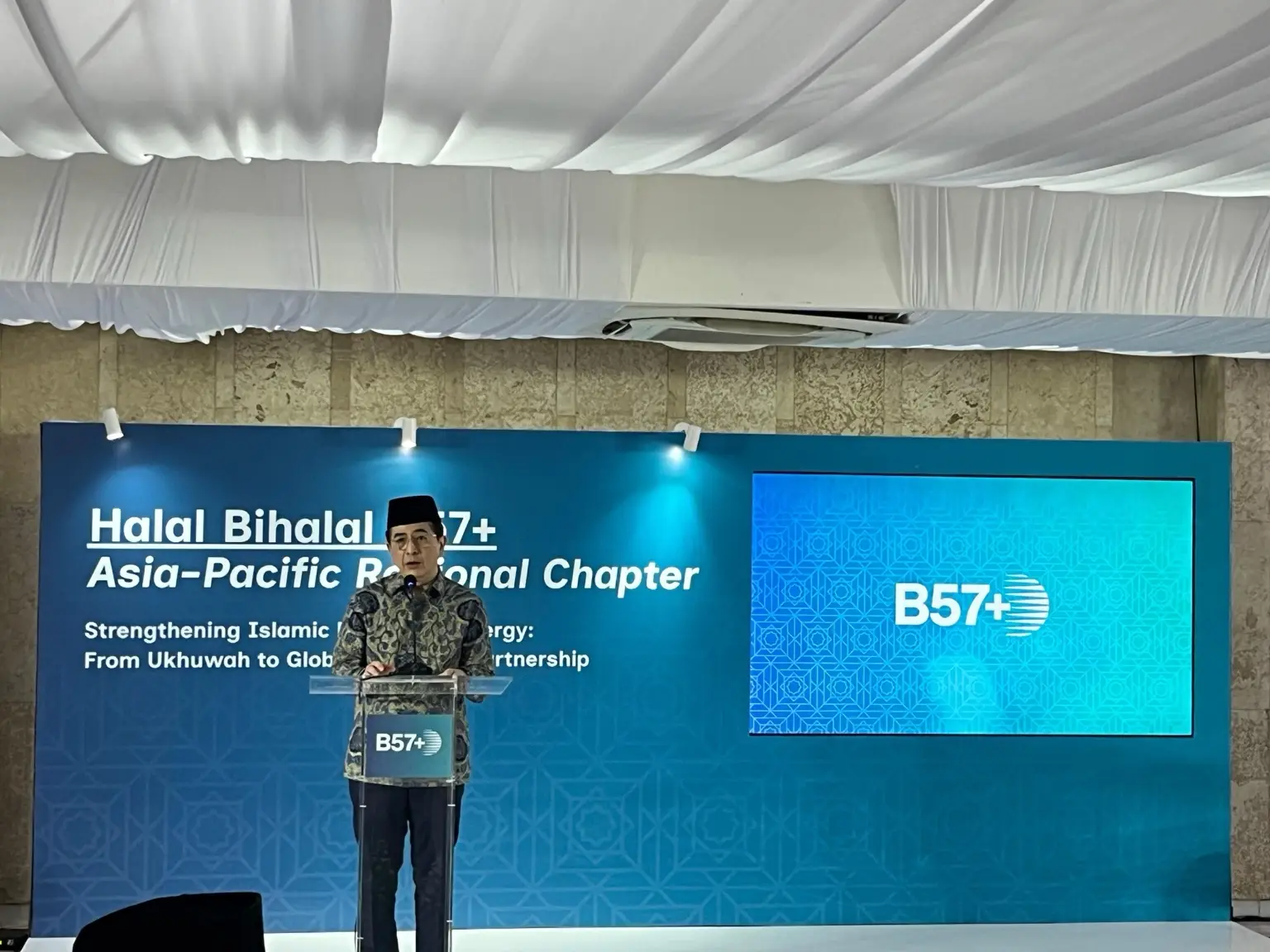
Amid global economic fragmentation and rising geopolitical uncertainties, Indonesia is encouraged to take on a new role, not just as a market but as a connector of cross-border capital flows in the Islamic economic ecosystem. The Business 57 Plus (B57+) initiative serves as the main vehicle for this ambition.
At the Halal Bihalal forum of B57+’s Asia-Pacific Regional Chapter in the Ar-Razzaq Hall of Istiqlal Mosque, Central Jakarta, B57+ Asia Pacific General Chairman Arsjad Rasjid affirmed this direction. Indonesia, he said, is positioned as a strategic node connecting the economic potential of Organisation of Islamic Cooperation (OIC) member countries with broader global partners.
“The mission is simple but ambitious: translating collective strength into shared prosperity,” Arsjad stated.
This statement is more than mere forum rhetoric. Behind it lies a significant shift in approach. While Islamic world economic cooperation has long been driven by inter-government relations, B57+ seeks to shift the centre of gravity to the private sector, or business-to-business, with a focus on more concrete trade, investment, and business connectivity.
This approach is important in at least two ways. First, it opens opportunities for capital from liquidity-rich countries like the Gulf region to enter real projects in developing nations. Second, it accelerates cross-country economic integration, which has been hindered by bureaucracy and regulatory differences.
Arsjad noted that without adequate connectivity, the global halal economy’s potential would remain just numbers on paper. “Potential without connectivity will only become numbers on paper,” he said.
This is where Indonesia aims to take its position. With a large domestic market base, a growing halal industry, and a strategic geographical location in the Asia-Pacific, Indonesia is seen to have the initial capital to become a gateway for global investment—particularly from OIC countries and non-OIC partners in the “plus” framework.
However, the ambition to become a capital hub does not come without prerequisites. In practice, the status as a connector is not determined by declarations but by the ability to execute projects and absorb investment in tangible ways. In other words, the question shifts from “is Indonesia ready” to “what projects are ready.”
So far, B57+ is still in the early stages of network formation and institutional consolidation. Plans to establish country chapters in various countries—from Southeast Asia to the Middle East and Oceania—indicate a broad expansion direction. But for market players, more relevant indicators are investment realisations: how much funding actually flows, to which sectors, and in what form.
In this context, the risk of a “paper hub” cannot be ignored. Without bankable projects, regulatory certainty, and efficient financing mechanisms, capital flows could stall at the commitment stage rather than realisation.
On the other hand, if successful, B57+ could open a new chapter in Indonesia’s investment map. Capital flows from the Middle East and OIC countries could potentially enter strategic sectors such as energy, food, and halal infrastructure—which have long faced domestic funding limitations.
For investors, B57+ is not an instant catalyst but a medium-term narrative that needs to be tested for consistency. This momentum will be relevant as long as it can be translated into concrete deals, not just collaboration forums.
The Long Road to Financial Independence
The ambition to position Indonesia as a connector of global capital flows under the B57+ framework does not depend solely on business connectivity and real projects. Behind the investment and trade flows lies a more fundamental issue: how those inter-country transactions are conducted and through what financial systems.
To date, even trade among Muslim countries remains heavily reliant on Western-dominated global financial infrastructure, including payment systems, currencies, and international banking networks. In this context, the connectivity idea promoted by B57+ will face its own limits if not accompanied by efforts to build more independent financial pathways.
This is where technology’s role becomes relevant. If Arsjad Rasjid emphasises building bridges for trade and investment, the next question is whether those bridges have independent payment and financial systems or still rely on the old architecture?
Head of the Center for Sharia Economic Development (CSED) at INDEF, Prof. Nur Hidayah, sees this challenge can be addressed through the utilisation of digital technology, particularly blockchain and sharia fintech, which have the potential to reduce dependence on existing global financial systems.
“However, the use of blockchain still requires clear regulations. There needs to be sharia standards for data protection, system security, and adequate digital literacy,” she said at the Insight Emiten webinar by KabarBursa on Friday, 17 April 2026.
The idea of building economic independence through the B57+ platform does not emerge in a vacuum. Data shows the fundamental problem in economic cooperation among Organisation of Islamic Cooperation (OIC) countries lies in their low intra-connectivity.
Based on the Organization of Islamic Cooperation (OIC) Economic Outlook 2025, intra-OIC trade in 2024 was recorded at around USD491 billion or equivalent to Rp8.297 trillion. However, its contribution to the total trade of OIC countries is only around 19.2 percent. This figure has been relatively stagnant in recent years, moving in the 18 to 20 percent range.
This means that most member countries still rely more on markets outside the region, such as Western countries and China, rather than strengthening internal trade. Yet, the target set by the OIC is to boost the share of intra-
Source: jawawa.id (https://jawawa.id/newsitem/halal-bihalal-b57-arsjad-targets-indonesias-role-as-global-halal-economy-hub-1776844327)
Originally published by kabarbursa.com (https://www.kabarbursa.com/syariah/halal-bihalal-b57-arsjad-bidik-peran-indonesia-jadi-hub-ekonomi-halal-global), translated from Indonesian