
Hajj Pilgrims Beware of Fake Nusuk Card Scams for Entering Raudhah
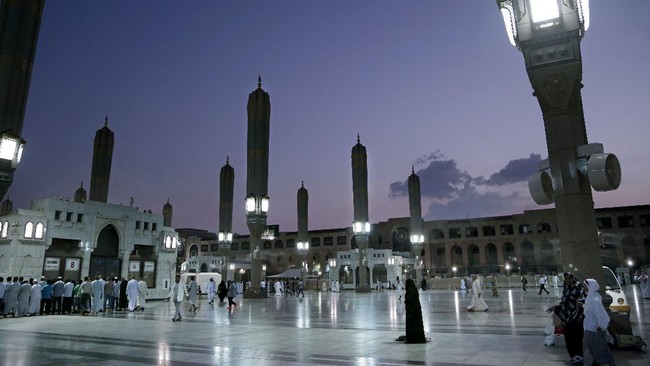
Jakarta, CNBC Indonesia - The Ministry of Hajj and Umrah (Kemenhaj) is reminding Hajj pilgrims to be wary of scams related to access to Raudhah in Masjid Nabawi.
Head of the Hajj Media Center (MCH) of the Indonesian Hajj Organising Committee (PPIH) in Saudi Arabia, Ichsan Marsha, has reminded Hajj pilgrims to be cautious of scams involving access to Raudhah in Masjid Nabawi. He stressed that access to Raudhah is free of charge and can only be obtained through official channels.
In addition, Ichsan urged pilgrims to be careful of scams involving problematic Nusuk cards. Unscrupulous individuals often send links via WhatsApp and ask pilgrims to click on them.
“Pilgrims are advised to be cautious of scams claiming that their Nusuk card is faulty, by asking them to click on a link sent to their WhatsApp. Do not trust or click on the links they send,” he emphasised.
Ichsan explained that official access to Raudhah uses a barcode system, either through the tasrih (collective permit) scheme or the Nusuk app for independent pilgrims. Anything outside this mechanism should be suspected as a scam.
Head of the Madinah Working Area (Daker) Madinah, Khalilurrahman, affirmed that facilitation for entering Raudhah is part of the official services for Indonesian Hajj pilgrims. Therefore, every pilgrim has equal rights to access the area known as the garden of paradise.
“Entry to Raudhah is free. If any party offers services and demands payment, immediately report it to the sector officials, especially the Nabawi sector,” he said on Tuesday (28/4).
He added that currently, there are many unscrupulous individuals pretending to be officials and taking advantage of the situation by demanding payments. PPIH ensures that it will not tolerate any violations, including illegal levies by any parties.
Meanwhile, Head of the Worship Guidance Section of Daker Madinah, Efrilen Hafizh, confirmed that the tasrih scheme has been prepared to accommodate all pilgrims in an orderly and scheduled manner.
“As of 28 April 2026 at 10:00 WAS, the number of approved tasrih has reached 25,564 pilgrims, with details of 12,747 male pilgrims and 12,817 female pilgrims,” he explained.
To access Raudhah, the Saudi Arabian government enforces strict rules. Pilgrims must use barcodes through the tasrih scheme for groups or the Nusuk app for independent pilgrims.
Regarding age policy, Hafizh stated that previously access was limited to up to 41 years old. However, after a memorandum of understanding (MoU) and negotiation process, the maximum age limit has now been raised to 60 years. Pilgrims above that age will still be facilitated through special mechanisms.
In its implementation, the collective tasrih barcode is held by the Nabawi Special Sector (Seksus). Worship guidance officers in each sector will coordinate pilgrims according to the established quota.
“For example, one tasrih for 150 people, so it must be ensured that all pilgrims have gathered. The barcode is not distributed freely to ensure the quota is optimally filled and not wasted during checks at the Raudhah entrance,” he said.
With this organised system, Kemenhaj through PPIH is committed to providing the best services so that all Indonesian Hajj pilgrims can worship in Raudhah safely, comfortably, and without the burden of illegal levies.