
Hajj Penalty Slaughter and Livestock Resilience
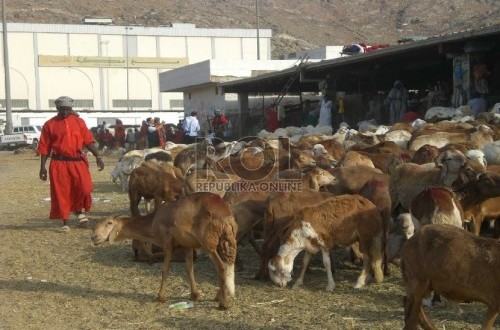
After more than 30 years, the hopes of a portion of Indonesian Muslims are about to be realised. The desire of Indonesian Muslims for the slaughter and distribution of hajj penalty sacrifices to be carried out in Indonesia will soon come to fruition.
The hajj penalty sacrifice is a fine in the form of animal slaughter (goat, cow, or camel) that must be paid by hajj pilgrims. This fine arises from performing the tamattu or qiran hajj as a form of atonement for the error.
For a long time, it has been customary for Indonesian hajj pilgrims to perform the hajj penalty by slaughtering sheep or goats in Mecca.
Based on Circular Letter of the Indonesian Ministry of Religious Affairs No. S-50/BN/2026 signed by the Director General of Hajj and Umrah Organisers, in section Number 4 regarding Hadyu in the Homeland, it states: (a) The government is preparing a Government Regulation (PP) on the Governance of Dam or Hadyu as further regulation regarding the mechanism for implementing dam for hajj pilgrims.
Point (b) While the PP has not yet been established, hajj pilgrims may still carry out the slaughter and distribution of dam animals in the homeland in accordance with applicable provisions. (c) The implementation of dam in the homeland can be carried out through BAZNAS, LAZ, Islamic organisations, KBIHU, or independently by pilgrims.
The existence of this circular letter provides the basis for the slaughter and distribution of hajj penalty sacrifices to be carried out in the Homeland starting this year. The permission for the slaughter and distribution of hajj penalty animals in Indonesia raises one question: how ready is the supply of sheep/goats in Indonesia?
Furthermore, we need to see to what extent the potential and capacity of sheep/goat farming in Indonesia can meet various needs related to Muslim worship and the fulfilment of daily food needs for Indonesian society.
At least there are three forms of Muslim worship related to the availability of sheep or goats. The three forms of worship are sacrifice, aqiqah, and hajj penalty.
According to IDEAS research, the need for sacrificial sheep/goats in 2025 is 1.1 million heads. The estimated need for aqiqah sheep/goats is 5.2 million heads. As for the hajj penalty need, it is 99 percent of 220,000 hajj pilgrims, namely 217,000 heads.
The total need for sheep/goats for Muslim worship in Indonesia in one year is 6.517 million heads. In addition to the needs for Muslim worship, sheep/goats are needed for the daily food needs of Indonesian society.
According to OECD FAO, the average consumption of goat meat in Indonesia in 2024 reaches 0.436 kg per capita per year.
If calculated for the entire Indonesian population up to 31 December 2025, which is 288,315,089 (Ministry of Home Affairs, 2026), goat meat consumption in Indonesia is 125.705 million kg or equivalent to 8.380 million heads (assuming the net meat weight of one goat is 15 kg).
Thus, the total need for sheep/goats in Indonesia per year for worship and daily food consumption is 14.877 million heads per year.
With such a large need for sheep/goats, what is the capacity of Indonesian farming to meet that need?
According to BPS, the population of sheep/goat livestock in Indonesia in 2025 is 15,824,305 heads. This means there is a surplus difference of 947,305 heads per year.
That surplus difference is certainly relatively small because the excess is only 6.3 percent of the annual need. The impact is that if there is any disruption to sheep/goat livestock production results, scarcity occurs and leads to high price increases.
In the past few years, imports of sheep/goat meat have been opened to meet domestic needs. The impact of opening the import tap for sheep and goat meat has caused prices of sheep/goats in Indonesia to plummet.
At the urging of the Indonesian Sheep and Goat Breeders Association (HPDKI), in November 2024 the government issued a policy to stop importing sheep/goat meat. Currently, the Ministry of Agriculture is striving for the export of sheep/goats, especially to ASEAN countries.
The need for self-sufficiency in sheep/goat meat (including hajj penalty) and the orientation to be able to export sheep/goats reminds us to strengthen sheep/goat farming in Indonesia.
It is time for us to strengthen local farming with quality cultivation, developing superior seeds and strengthening the supply chain (upstream-downstream) to realise food resilience derived from sheep/goat farming in Indonesia.