
Hajj Minister Emphasises Zero Tolerance for Violations and Stricter Health Assessments
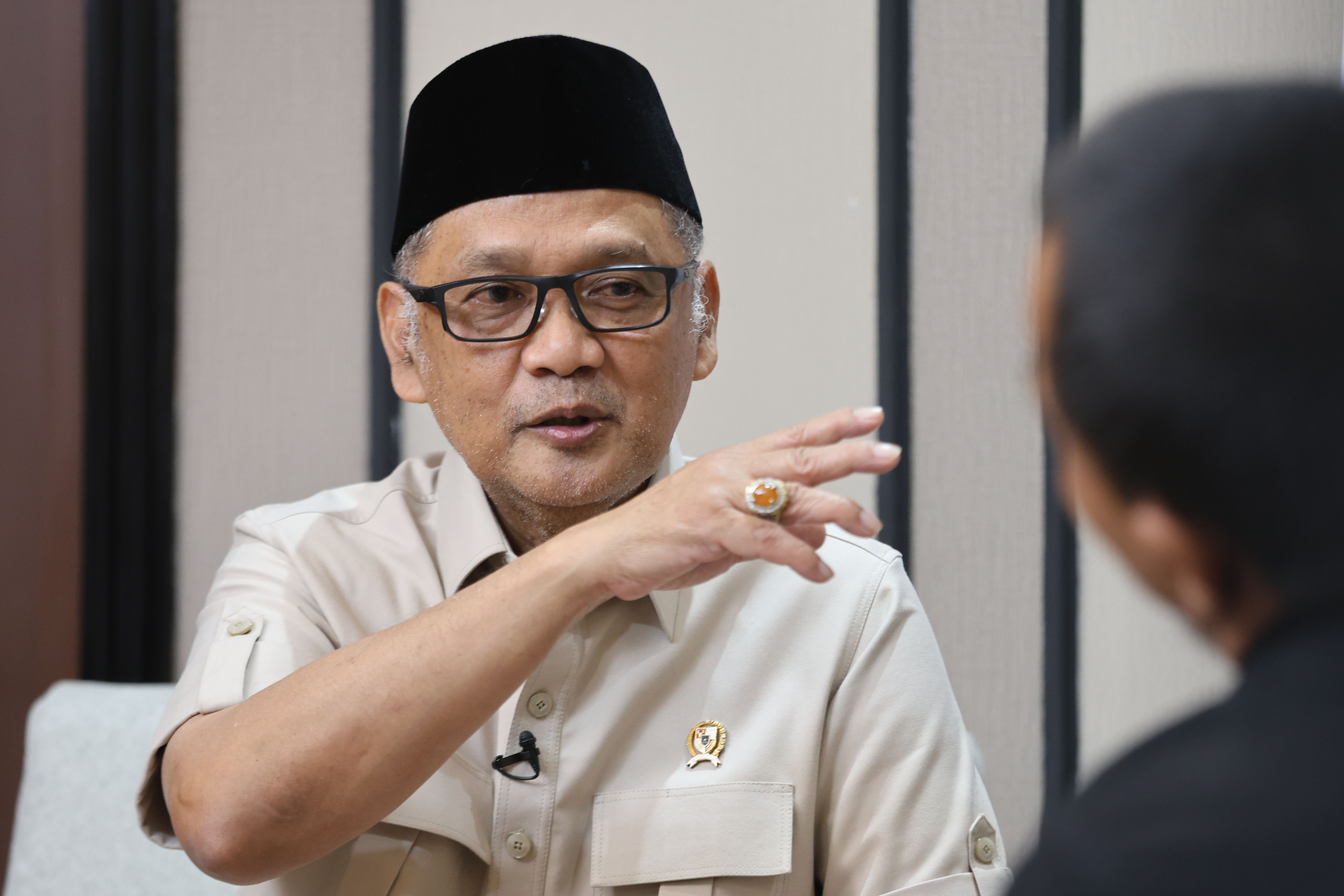
Minister of Hajj and Umrah of the Republic of Indonesia, Mochamad Irfan Yusuf, has affirmed that evaluations of hajj organisation must not stop at the preparation of administrative reports. Regular evaluations must produce strategic decisions, concrete follow-up, and systematic improvements to raise the quality of services for pilgrims in the following hajj season.
He made the remarks whilst opening the Evaluation of Strengthening Hajj Services for South Kalimantan Province and Banjarmasin Embarkation for 1447 AH/2026 CE in Banjarbaru on Thursday (9/7/2026).
“Hajj evaluation must not stop as a final report. We are not here merely to compile a report, put it on a table and be done. Evaluation must produce decisions on service improvements, a clearer division of roles, risk mitigation, cross-sector coordination, and more orderly service standards,” said the Minister.
During the 1447 AH/2026 hajj season, Banjarmasin Embarkation served 19 flight groups comprising 6,715 pilgrims and 76 officers, totalling 6,791 people. All departure and return processes were completed and properly documented.
According to the Minister, this data must be read more deeply to identify shortcomings, potential risks, and aspects of service requiring improvement. All parties involved were asked to be open in presenting evaluation results, without turning the forum into an exercise in mutual blame.
“We must open up all existing shortcomings, not to find who is at fault, but to ensure that hajj services in 2027 are far better. The figures we hold must be translated into improvements in SOPs and service systems,” he asserted.
The Minister also conveyed greetings and appreciation from President Prabowo Subianto to all parties who contributed to the success of the 2026 hajj season. The success, he said, was the result of joint work by the ministry, regional governments, health workers, embarkation officers, airlines, airport operators, immigration, KBIHU, and all service partners.
He noted that this year’s hajj organisation also received appreciation from the Saudi Arabian government. The recognition is a significant achievement, given that 2026 was the first year the Ministry of Hajj and Umrah carried out its mandate as hajj organiser.
“This is an extraordinary achievement in the first year of the Ministry of Hajj and Umrah carrying out its mandate. The ministry was only established in 2025, whilst the stages of hajj organisation were already under way. However, through hard work and the dedication of all parties, we managed to catch up and complete all stages of service,” he explained.
In the evaluation, the Minister paid special attention to pilgrims’ health. Of all pilgrims dispatched through Banjarmasin Embarkation, 4,058 were recorded as having high health risks.
He asked the ministry’s regional offices to strengthen coordination with health offices, community health centres, quarantine health offices, and referral hospitals. Health screening must map pilgrims’ conditions and risks from the outset, not merely serve as an administrative requirement for departure.
“Health screening must produce risk mapping, not just administrative completeness. We want to know from the start who carries high risks, what interventions must be made, and how assistance will be provided during the hajj,” he said.
Nationally, the pilgrim mortality rate during the 2026 hajj season was successfully reduced by around 25 per cent compared with the previous year. However, the Minister believes this achievement must continue to be improved.
He also highlighted 335 prospective pilgrims nationally — the figure reported was 345 — who arrived at hajj dormitories but had their departures postponed due to health conditions. According to him, medical unfitness should have been identified during initial screening so that pilgrims would not face disappointment upon reaching the embarkation point.
“We hope that next year there will no longer be pilgrims found unfit to depart only after arriving at the hajj dormitory. Screening must be conducted earlier, more accurately, and truly reflect the health condition of prospective pilgrims,” he said.
Beyond health, the Minister called for continued strengthening of oversight of hajj governance. Several violations related to mahram arrangements, quota transfers, and assistance for elderly pilgrims must be examined carefully.
He affirmed that the Ministry of Hajj and Umrah is committed to applying zero tolerance towards fraud, corruption, and violations in hajj organisation.
“The President asks that this ministry be a clean ministry. Therefore, if there are mistakes, we remind and correct them. But if there are violations or deliberate elements, sanctions must be imposed in accordance with the rules,” he asserted.
Closing his remarks, the Minister invited all stakeholders to convert this year’s evaluation results into a solid foundation for the 1448 AH/2027 hajj operations that are far more professional, safe, and fully oriented towards pilgrims’ welfare.
“This year’s success should be welcomed with gratitude, but it must not stop us from improving ourselves. This evaluation must become the foundation for delivering a hajj organisation that is increasingly orderly, professional, safe, and truly oriented towards pilgrims’ interests,” he said.
Source: jawawa.id (https://jawawa.id/newsitem/hajj-minister-emphasises-zero-tolerance-for-violations-and-stricter-health-assessments-1783677019)
Originally published by Media Indonesia (https://mediaindonesia.com/humaniora/909550/evaluasi-operasional-haji-menhaj-tegaskan-nol-toleransi-pelanggaran-dan-perketat-istitaah), translated from Indonesian