
Hajj Dormitories to Become Umrah Service Hubs, What Is the Concept?
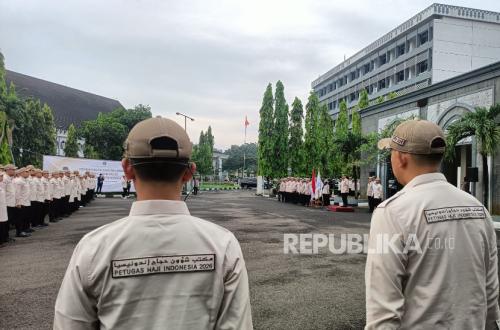
The new two-storey building has 44 rooms with a capacity of 176 people. Each room is designed to resemble a three-star hotel facility, complete with a bed, wardrobe, desk, chair, and en-suite bathroom.
The building, which stands within the Class I Hajj Dormitory complex of the Banjarmasin Embarkation in Banjarbaru, South Kalimantan, was constructed through a 2025 Sovereign Sharia Securities (SBSN) financing scheme. It was inaugurated by Minister of Hajj and Umrah Mochamad Irfan Yusuf on Friday, 10 July 2026.
However, for the man affectionately known as Gus Irfan, the greatest challenge is no longer constructing buildings. The government must ensure that every state-financed building does not sit idle after the hajj season ends.
“Hajj dormitories should not merely be centres of government budget expenditure, but should develop into sources of state revenue through optimal facility management,” said the grandson of Nahdlatul Ulama founder Hadratus Syaikh KH Hasyim Asy’ari after the inauguration.
The Banjarmasin Embarkation served 6,804 pilgrims from South Kalimantan and Central Kalimantan during the 2026 hajj season, divided into 19 flight groups. The addition of the new building is expected to increase capacity as well as comfort for pilgrims during the departure and return processes.
However, the idea put forward by Gus Irfan goes beyond the needs of a single hajj season. He wants more than 30 hajj dormitories spread across Indonesia to operate throughout the year. Hajj dormitories would not only serve as transit points for pilgrims, but would develop as service hubs for umrah pilgrims and the general public.
The idea can be placed within the broader framework of a Sovereign, Just, and Prosperous Indonesia. Sovereignty is realised through the state’s ability to manage its own service infrastructure for the faithful. Justice is reflected in the equalisation of service quality for pilgrims across various regions. Meanwhile, prosperity is built through the management of productive, transparent assets that provide economic benefits to the community.
Indonesia has more than 30 hajj dormitories with varying conditions and capacities. Of that number, around 16 dormitories function as embarkation points for pilgrim departures. Some others have the status of intermediate embarkations, transit dormitories, or supporting facilities that have not been utilised optimally.
Gus Irfan acknowledged that the Ministry of Hajj and Umrah inherited assets in non-uniform conditions. Some dormitories have adequate facilities, but there are also buildings that require improvement and maintenance because they are quite old. “Building is not an easy thing, but maintaining and maximising its use is far more difficult,” he said on Friday, 10 July 2026.
The statement also demonstrates a paradigm shift in the management of hajj dormitories. The measure of success cannot stop at the number of buildings constructed or inaugurated. The government also needs to calculate room utilisation rates, maintenance quality, state revenue generated, and the benefits felt by the community outside the hajj season.
In fact, the foundation for modernising hajj dormitory services was laid when hajj management was still under the Ministry of Religious Affairs. The Director of Domestic Hajj Services at the time, Muhammad Zain, introduced the Hajj Dormitory Accommodation Service Unit Management (Munakosah) as a digital system to speed up the placement of pilgrims in dormitory rooms.
Source: jawawa.id (https://jawawa.id/newsitem/hajj-dormitories-to-become-umrah-service-hubs-what-is-the-concept-1786931481)
Originally published by Republika (https://khazanah.republika.co.id/berita/tjkrbt451/asrama-haji-bakal-jadi-pusat-layanan-umrah-seperti-apa-konsepnya), translated from Indonesian