
Hajj Assistance in Madinah Strengthened, Focus on Elderly Pilgrims and Arbain Understanding
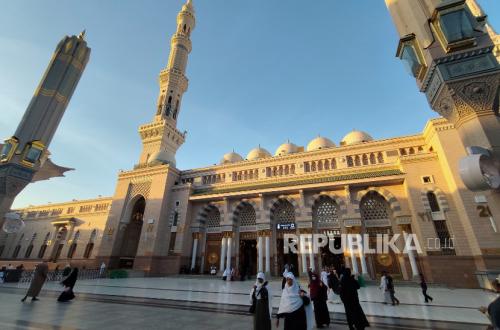
As the final days of the 2026 Hajj operational period approach, the Hajj Organising Committee (PPIH) continues to strengthen assistance for pilgrims still in Madinah. Intensive support is being provided through visitation activities to pilgrims in each flight group (kloter), with particular attention given to elderly pilgrims (lansia) and reinforcing the understanding of worship practices.
PPIH Worship Guidance Services (Bimbad) Sector 5 for the Madinah Working Area, Hj Nunung Khoiriyah, stated that visitations are a crucial instrument in Hajj service management. The Bimbad PPIH visitations serve as a means to map out various issues faced by pilgrims in each kloter.
‘Visitation is a very important matter because it is an instrument in Hajj service management. Through visitations, we can see and map out the problems within the kloter, while also providing a communication space between Hajj officers and the group leaders,’ Hj. Nunung told the Hajj Media Center (MCH) after a socialisation session for pilgrims at the Mirage Taiba Hotel.
According to Hj Nunung, the coordination carried out during visitations covers various pilgrim needs, ranging from health conditions and assistance requirements to the mechanism for entering Raudah, as well as the implementation of worship and city tours in Madinah. Nunung explained that elderly pilgrims are a group requiring extra attention while in the Holy Land.
‘Approximately 55 per cent of Indonesian Hajj pilgrims are women, and around 25 per cent are elderly. The elderly are a group that needs attention, including assistance needs and the use of wheelchairs,’ she said. She added that good coordination between kloter officers and the PPIH in Saudi Arabia will facilitate meeting pilgrims’ needs, including assistance for the elderly who will perform worship in Raudah.
Meanwhile, Worship Guide for Kloter SUB 104 Surabaya, Toha Saifuddin, reminded pilgrims of the importance of correcting their understanding regarding the Arbain worship so that it does not become a burden that forces their physical condition. He explained that most scholars understand Arbain as performing 40 prayers in the Nabawi Mosque, not strictly 40 obligatory prayer times which are identical to eight consecutive days.
‘So that pilgrims remain motivated, we choose to understand the hadith textually, which is 40 prayers. So besides the obligatory prayers, there are sunnah prayers such as dhuha, hajat, taubat, and tahajud which are expected to fulfil the meaning of the Arbain hadith,’ Toha said. He stressed that pilgrims do not need to force themselves to pursue worship targets if their physical condition does not allow it, especially amidst the extreme weather in Madinah.
‘We are indeed obliged to worship Allah, but Allah also commands us to maintain our health and physique. Worship requires a prime body condition. If the body is sick, worship will not be optimal and it is difficult to feel solemnity,’ he said. Toha also urged pilgrims to maintain their diet, increase their consumption of plain water, and manage worship activities according to their body’s capabilities. ‘If in Indonesia the water requirement is around two litres per day, here it can be more than that, around three to four litres, so that the body stays fresh and ready to worship Allah SWT,’ he said.
Source: jawawa.id (https://jawawa.id/newsitem/hajj-assistance-in-madinah-strengthened-focus-on-elderly-pilgrims-and-arbain-understanding-1782388423)
Originally published by Republika (https://khazanah.republika.co.id/berita/th6o04430/pendampingan-jamaah-di-madinah-terus-diperkuat-lansia-dan-pemahaman-arbain-jadi-perhatian-utama), translated from Indonesian