
Hajj 2026 Operations Conclude, Minister Outlines Major Challenges Ahead
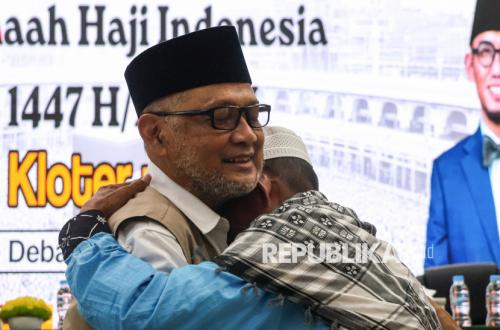
The Indonesian Minister of Hajj and Umrah, Mochamad Irfan Yusuf, officially closed the Hajj 1447 Hijri/2026 CE operations after all Indonesian pilgrims had returned to the country on Wednesday (1/7/2026). The final flight, UPG-43, landed at Sultan Hasanuddin Airport in Makassar at 17:05 WITA, carrying 242 pilgrims.
With the arrival of this group, Indonesia’s Hajj operational series for this year is declared finished. “Alhamdulillah, all Indonesian Hajj pilgrims have returned to the homeland safely. On behalf of the Ministry of Hajj and Umrah, I declare that the Hajj 1447 Hijri/2026 CE operations have officially ended,” stated the Minister, affectionately known as Gus Irfan, in a press release on Wednesday (1/7/2026).
Throughout the 2026 Hajj operations, the government deployed 527 flight groups (kloter) transporting 202,63ker6 regular pilgrims from 16 embarkation points across Indonesia. Additionally, Special Hajj Organisers (PIHK) dispatched 16,585 special Hajj pilgrims and 1,016 special Hajj officers.
This year’s Hajj administration was marked by significant challenges in serving pilgrims with diverse characteristics, including 44,247 elderly pilgrims, 170,700 high-risk pilgrims, 370 pilgrims with special needs, and 275 wheelchair users. All services, including accommodation, catering, transportation, religious guidance, and healthcare, were prepared to ensure every pilgrim could worship safely, comfortably, and with focus.
During the operations, the government distributed approximately 24.18 million food boxes, operated 15,212 inter-city Hajj buses and 11,990 ‘bus shalawat’ trips, and provided multi-layered healthcare services through medical personnel in every flight group, satellite clinics, the Indonesian Hajj Health Clinic, and partnerships with Saudi Arabian hospitals.
In terms of governance, the Ministry of Hajj and Umrah also introduced several important innovations, including the implementation of a more equitable provincial quota allocation, the reduction of Hajj costs without compromising service quality, the addition of fast-track embarkation points, the digitalisation of services, and the early settlement of various service contracts in Saudi Arabia.