
Hajar Aswad Said to Have Fallen from Heaven, Researchers Reveal Its Origins
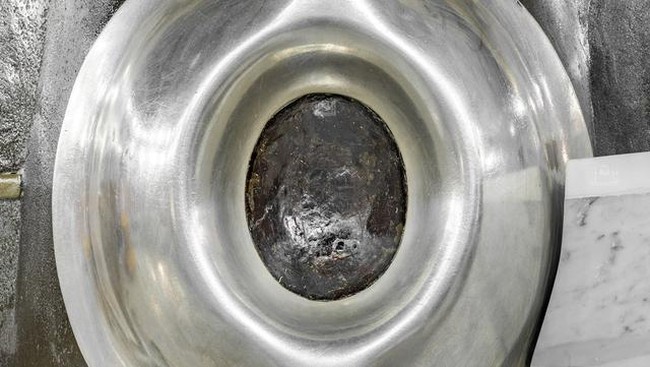
The Hajar Aswad is one of the most recognisable parts of the Kaaba in the Grand Mosque. The black stone, located in one corner of the Kaaba, is believed in Islamic tradition to have existed since the time of Prophet Ibrahim and is said to have originated from heaven.
In several traditional Islamic sources, the Hajar Aswad is described as originally being white and emitting light. However, the stone is said to have turned black after absorbing the sins of humanity on earth.
This account has also attracted attention from a scientific perspective. Scientists have sought to uncover the characteristics of the Hajar Aswad, including its colour change, the claim that it once emitted light, and the actual type of stone it is.
For a long time, scientists have proposed theories about the type of rock that makes up the Hajar Aswad. Some have suggested the stone is similar to agate. Others have theorised that the Hajar Aswad is categorised as a meteorite.
However, experts argue that classifying the Hajar Aswad as a meteor or meteorite is considered the closest match when referring to the account of the stone itself originating from heaven. Moreover, historical facts reveal traces of meteorites near the Kaaba, where the Hajar Aswad is located.
E. Thomsen, in the study “New Light on the Origin of the Holy Black Stone of the Ka’ba” (1980), recounted that in 1932 a researcher named Philby discovered a meteor impact crater at Al-Hadidah that would later be called Wabar. When measured, the crater was more than 100 metres in size. Several meteor fragments were also found around the crater and in the desert.
Broadly speaking, the meteor fragments were formed from fused sand and silica mixed with nickel. Over time, according to Thomsen, this mixture produced a white layer from within, while the exterior was encased in a black shell. This black colour resulted from nickel obtained from the explosion of nickel and iron in outer space.
Based on this observation, Thomsen stated that the characteristics of the meteor fragments match the description of the Hajar Aswad.
“For instance, the white colour emitted by the Hajar Aswad may have come from exposure of the inner core resulting from the mixture of those chemical substances,” he said.
According to him, the white layer is very fragile and does not last long. On this basis, the layer sits within the black rock that envelops it. This means the white rock is not permanent and can disappear over time, so that eventually only the black rock remains.
Therefore, the narrative about the Hajar Aswad’s colour change can indeed be explained scientifically. This means it was not caused by the absorption of human sins. Meanwhile, the white specks currently present in the Hajar Aswad are remnants of glass and sandstone.
“The meteorite is likely the same stone as the Hajar Aswad,” Thomsen wrote.
Other empirical evidence also concerns the age of the stone. Other research explains that the stone’s age matches the observational range of ancient Arabs. Most likely, the rock was brought to Mecca via a route from Oman.
However, the theory that the Hajar Aswad originated from a meteorite also has weaknesses. The researcher noted that meteorites cannot float, cannot break into small fragments, and struggle to withstand erosion.
Nevertheless, the closest theory regarding the Hajar Aswad so far is the meteorite theory, so Thomsen said “it would be more appropriate to examine material originating from a meteor.”
Source: jawawa.id (https://jawawa.id/newsitem/hajar-aswad-said-to-have-fallen-from-heaven-researchers-reveal-its-origins-1788010440)
Originally published by CNBC Indonesia (https://www.cnbcindonesia.com/tech/20260829165703-37-763329/hajar-aswad-disebut-jatuh-dari-surga-peneliti-singkap-asal-usulnya), translated from Indonesian