
Haedar Nashir Reveals Issues of Religiosity and Public Behaviour
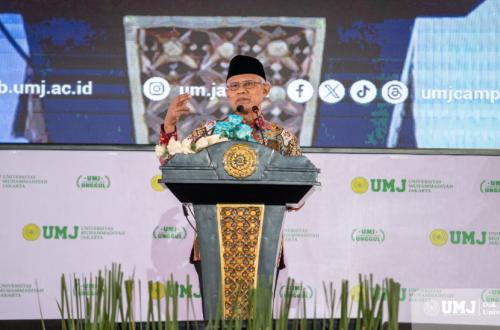
JAKARTA – The Chairman of the Central Executive Board (PP) of Muhammadiyah, Prof Dr Haedar Nashir, highlighted the problem that society’s religiosity has not been fully reflected in everyday behaviour, speaking at the 13th Muhammadiyah Day of Universitas Muhammadiyah Jakarta (UMJ). The event took place at the KH Ahmad Azhar Basyir Auditorium, Gedung Cendekia UMJ, on Saturday (5/9/2026).
Haedar cited the persistence of corruption as one indicator of this problem. He also touched on the practice of bribery, abuse of power and office, and luxurious lifestyles that can culminate in corruption.
“God is wrathful towards us who always speak, but are not consistent in carrying it out. A Muslim-majority nation, yet corruption remains rampant, even becoming massive, systematic, and structured,” Haedar said.
According to Haedar, religious values should go hand in hand with honest behaviour in life. He assessed that this problem is also evident in the way a person earns a living and uses the power they hold.
“This is the strongest indicator, meaning our religiosity is not directly proportional to our behaviour to be honest, including in seeking a livelihood that should be halal. However, when the sufficiency we achieve is still not enough and we want more, then bribery emerges, abuse of power and office, luxurious living, and it ultimately ends in corruption,” he asserted.
Beyond issues of behaviour, Haedar emphasised the need for renewal in religious life. According to him, society must continually renew its religious life so that religious values retain their function in family, community, national, and humanitarian life.
“Religion at its origin shines and sparkles. But over time it dims. Not because of the religion itself, but because of its followers,” Haedar said, quoting a message from KH Ahmad Dahlan.
Haedar also viewed low scientific awareness as a challenge to societal progress. He linked this condition to weak reading culture and critical awareness in society.
“Only one in 1,000 people enjoys reading. The impact is that we cannot possibly advance as a nation if our society still has low scientific awareness, low critical awareness, and so on,” he revealed.
Amid these various problems, Haedar stated that Muhammadiyah still enjoys positive public trust. He cited the results of a Kompas Research and Development survey in 2024 showing 91 per cent of the public place positive trust in Muhammadiyah, while a survey by the Public Policy Institute of Universitas Ahmad Dahlan Yogyakarta on millennials and Generation Z showed figures of around 91–92 per cent.
“When this survey was conducted and the results are as such, it means Muhammadiyah still holds a consistent position as a religious and social organisation that can nurture and safeguard diversity in the life of society,” Haedar explained.
Haedar stressed that this trust must be maintained while simultaneously strengthening Muhammadiyah’s missionary mission. He said Muhammadiyah’s dakwah must continue to be directed towards providing enlightenment and progress for the people, the nation, and humanity.
“Dakwah that enlightens, dakwah that educates, dakwah that empowers, dakwah that liberates, and dakwah that advances the life of the people, the nation, and universal humanity,” Haedar said.
The 13th Muhammadiyah Day was also attended by UMJ Rector Prof Dr Ma’mun Murod, MSi, the Minister of Primary and Secondary Education who is also Chair of the UMJ Board of Trustees Prof Dr Abdul Mu’ti, MEd, the Chief of Staff to the President of the Republic of Indonesia General (Ret) Prof Dr Dudung Abdurachman, SE, MM, as well as influencer and founder of Maskanul Huffaz Dr Hj Oki Setiana Dewi, SHum, MPd.