
Haedar Nashir: MSUS Projected to Become a Leading International School
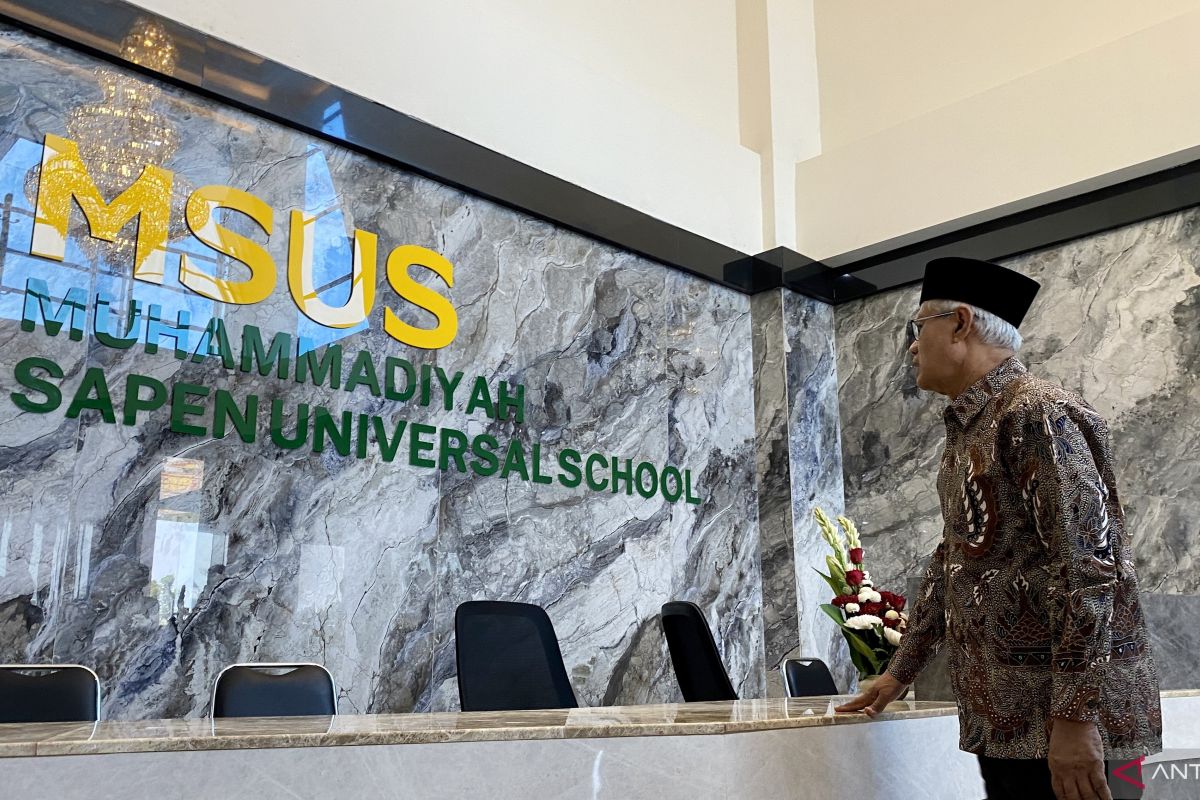
Yogyakarta (ANTARA) - The Chairman of the Central Leadership of Muhammadiyah, Haedar Nashim, projects that the Muhammadiyah Sapen Universal School (MSUS), which opens this year, will become a leading school of international standard.
“MSUS was established as a developmental link from SD Muhammadiyah Sapen, which will transition into an international class,” said Haedar during the inauguration of the MSUS Building in Tamantirto, Kasihan, Bantul, on Saturday.
According to Haedar, the presence of MSUS marks an important milestone in educational development through a holistic approach, encompassing both the development of the educational ecosystem and the provision of infrastructure.
“Until now, our components have been incomplete; therefore, in this campus, we will implement those concepts and elements holistically,” he stated.
He assessed that the education sector in Indonesia still lags relatively behind several ASEAN nations, both in terms of resources and competitiveness.
“MSUS is part of the effort to become a leading school, not only in Indonesia but also with an ASEAN and even international label,” he said.
Haedar added that the opening of MSUS is also a response to the high public interest in enrolling children at SD Muhammadiyah Sapen in Yogyakarta, which has long maintained a significant waiting list.
“The demand for SD Muhammadiyah Sapen is so high that there are waiting lists spanning years; we could not accommodate this at the original Sapen site, so we expanded here,” he explained.
He described MSUS as a transformation and expansion of SD Muhammadiyah Sapen, which has achieved various accolades to become one of the best primary schools in Indonesia.
“We are proud that among the 40 best primary schools in Indonesia released, 12 are Muhammadiyah schools, including Sapen,” he said.
Meanwhile, the Head of MSUS, Agung Rahmanto, stated that the school is being developed as a globally-oriented primary school that integrates the National Curriculum with an international approach, without abandoning Islamic values, Muhammadiyah principles, nationalism, and Indonesian culture.
“The presence of this school is expected to meet the community’s need for primary education that is adaptive to global developments while remaining strong in character building,” said Agung.
He noted that teaching and learning activities at MSUS will commence in the 2026/2027 academic year, following the Special Region of Yogyakarta (DIY) educational calendar, with the first day of school set for Monday, 13 July 2026.
In its initial operational phase, MSUS will open two levels, namely Grade 1 and Grade 3, each consisting of two parallel classes.
“In the initial operational stage, MSUS is opening two study groups, namely Grade 1 and Grade 3, each consisting of two parallel classes,” he said.
Moving forward, Agung continued, MSUS aims to have two parallel classes for every level, from Grade 1 to Grade 6, totaling 12 study groups with a capacity of 28 students per class.
“Thus, the target number of students will reach 336,” he said.
Agung explained that MSUS implements a curriculum that integrates the National Curriculum with best practices from the Cambridge Curriculum and the International Baccalaureate (IB), focusing on strengthening language, Mathematics, and Science skills through international-standard learning resources.
“The IB approach strengthens inquiry-based learning, the development of learner character, reflection skills, communication, and global perspectives,” he added.
According to him, this learning concept is expected to prepare a generation capable of competing globally without losing their identity as Muslims and Indonesian citizens.
“It can serve as a model for a leading primary school capable of integrating national education, international perspectives, technological innovation, and Islamic values into a single, high-quality, and sustainable learning ecosystem,” he concluded.