
Habitat Damage Hampers Human–Sumatran Elephant Coexistence
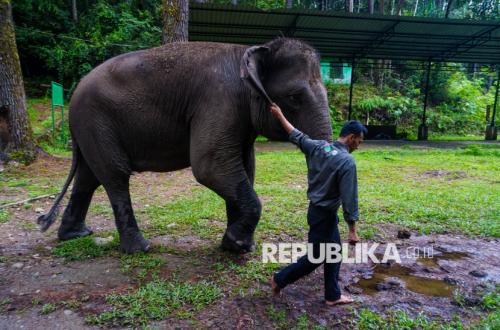
JAKARTA – Habitat loss, forest and land fires, and limited food supplies remain major challenges to the survival of Sumatran elephants. These conditions also increase the risk of negative interactions between people and elephants, meaning efforts to foster coexistence require an integrated response from multiple parties.
Belantara Foundation Executive Director Dolly Priatna said these challenges were evident in the Sugihan-Simpang Heran Landscape in Ogan Komering Ilir regency, South Sumatra. Coexistence does not mean there will be no negative interactions, he said, but rather a two-way process of adaptation between people and wildlife that requires concrete action and a fair distribution of responsibility.
Dolly made the remarks at Belantara Learning Series Episode 16, themed “Human–Sumatran Elephant Coexistence: Challenges, Innovations and Solutions”, at Pakuan University in Bogor on Wednesday, 4 November 2026. The event, organised by the Belantara Foundation with several university study programmes, was attended by 542 participants in person and online.
Based on his research, Dolly outlined eight strategic recommendations for fostering human–Sumatran elephant coexistence in the Sugihan-Simpang Heran Landscape. They include assistance and mitigation of negative interactions in priority villages, a transparent compensation mechanism, habitat restoration and ensuring food availability, as well as stronger patrols and village institutions.
Other measures include evaluating elephant deterrent technologies and translocation, increasing public education, developing data systems and coordination among stakeholders, and regularly monitoring negative interactions. Dolly said the success of coexistence depended on the involvement of government, concession-holding companies, communities, academics and conservation organisations.
“The success of coexistence between people and Sumatran elephants depends greatly on the ability of all parties — from government, concession-holding companies and communities to academics and conservation organisations — to work together to reduce the risk of negative interactions, protect public safety and ensure the survival of Sumatran elephant populations in their natural habitats,” Dolly said in a statement on Monday, 9 November 2026.
Also speaking at the event, Budi Mulyanto, head of the Ministry of Forestry’s Subdirectorate for Species and Genetic Preservation, stressed the importance of policy and cross-sector collaboration to save the population and habitat of the Sumatran elephant, which is classified as Critically Endangered. He delivered the keynote speech on behalf of Ahmad Munawir, director of species and genetic conservation at the ministry.
Budi said the government had issued Presidential Instruction No. 8 of 2026 and the 2026–2036 Sumatran and Bornean Elephant Conservation Strategy and Action Plan (SRAK). The policies provide a basis for protecting elephant populations and habitats, including addressing negative human–elephant interactions in 21 priority landscapes.
An integrated approach is needed, Budi said, including stronger data and scientific evidence, protection of corridors and habitats, early-warning systems and rapid responses to negative interactions. Law enforcement, protecting communities’ economic security through alternative livelihoods, and compensation mechanisms are also important to building coexistence.
He also emphasised a “hexa-helix” collaboration involving government, communities, academics, the private sector, the media and civil society organisations. Such broad participation is needed to ensure elephant conservation is effective and sustainable.
Donny Gunaryadi, chair of the Indonesian Elephant Conservation Forum (FKGI), also said that conserving Sumatran and Bornean elephants required an integrated approach. This should include data-based science, landscape planning, community participation, law enforcement and financial self-sufficiency.
Through the 2026–2036 Sumatran and Bornean Elephant Conservation Strategy and Action Plan and strategic investment allocations, conservation programmes aim to restore habitat connectivity, reduce negative human–elephant interactions by up to 70 per cent and eliminate the threat of poaching. The approach is expected to stabilise and increase elephant populations while safeguarding the welfare of local communities.
The 16th Belantara Learning Series was held to mark National Flora and Fauna Love Day (HCPSN) 2026, which falls on 5 November. The event’s theme was “Increase Love for Indonesia’s Flora and Fauna”, with a focus on raising public awareness of biodiversity conservation, including living alongside Sumatran elephants in their natural habitats.
The event also involved Riau University, Andalas University, Tanjungpura University and Antakusuma University as collaborators, hosting joint viewing and learning sessions. Several conservation organisations and international institutions also supported the event.
Pakuan University Graduate School Dean Sri Setyaningsih said she hoped the forum would provide a space to share knowledge, experience and ideas on solutions for human–Sumatran elephant coexistence. Other participants included Pakuan University Rector Didik Notosudjono; Alex McWilliam, regional coordinator for species and habitats at the IUCN Asia Regional Office in Bangkok; Sugiyo, landscape manager for Way Kambas at WCS-IP; and Bibhab Kumar Talukdar, founder and secretary-general of Aaranyak in India.
Source: jawawa.id (https://jawawa.id/newsitem/habitat-damage-hampers-human-sumatran-elephant-coexistence-1794214267)
Originally published by Republika (https://esgnow.republika.co.id/berita/to8305416/koeksistensi-manusia-dan-gajah-sumatra-terhambat-kerusakan-habitat), translated from Indonesian