
H-3 Before Eid: Peak Mudik Traffic, Here Are the Favourite Transportation Modes for Travellers
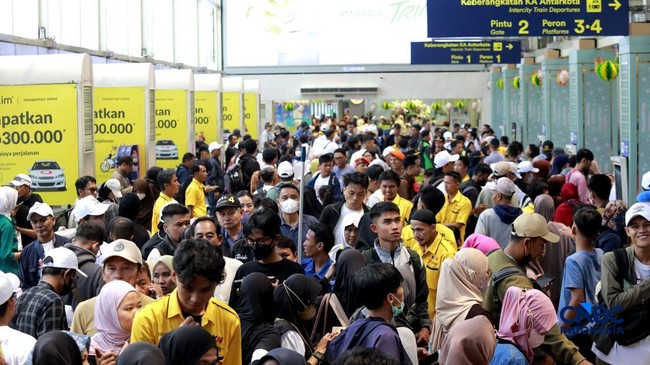
Jakarta, CNBC Indonesia — The Ministry of Transportation (Kemenhub) records that the peak of this year’s Eid mudik traffic occurred on Wednesday, 18 March 2026, or H-3 before Eid. This peak movement is distributed almost evenly across all transportation modes.
Based on data from the 2026 Integrated Lebaran Transport Centre Post, the highest number of passenger movements on H-3 was recorded across several major transportation modes.
Ferry services became the transportation mode with the most users, namely 403,883 passengers. This was followed by rail transport (intercity and regional) with 401,238 passengers, air transport (domestic and international) with 311,836 passengers, and land transport (bus and travel) with 232,016 passengers. Meanwhile, sea transport recorded its peak movement earlier on H-6 with 105,936 passengers.
Head of the Bureau of Communication and Public Information of the Ministry of Transportation, Ernita Titis Dewi, stated that this year’s movement pattern shows a strengthening tendency towards multimodality, in line with increasing connectivity and integration of national transportation services.
“The peak mudik traffic on H-3 occurred almost across all transportation modes, with the highest dominance in ferry services. This indicates that public mobility is increasingly dispersed and not focused on a single mode, but rather utilising various available transportation alternatives,” said Titis in Jakarta, in an official statement on Friday (20/3/2026).
Preliminary data from the 2026 Integrated Lebaran Transport Centre Post records that from H-8 (13 March 2026) to H-2 (19 March 2026), the number of public transport users across several modes reached 9,047,233 passengers, an increase of 10.79% compared to the same period in 2025, which was 8,166,170 passengers.
This figure includes rail transport at 2,669,314 people, up 14.05% from the previous year of 2,340,509 people. Then air transport at 1,982,987 people, up 5.18% from the previous year of 1,885,266 people.
Sea transport 739,724 people, up 6.48% from the previous year of 694,702 people, and ferry services at 2,259,469 people, up 15.54% from the previous year of 1,955,508 people. Finally, land transport (bus and travel) at 1,395,739 people, up 8.18% from the previous year of 1,290,185 people.
Furthermore, movements in and out of Jakarta via toll roads from H-8 to H-2 were monitored at 1,383,338 vehicles leaving Jakarta, up 5.27% from the previous year’s 1,314,042 vehicles. Meanwhile, vehicles entering numbered 917,512, up 11.39% from the previous year’s 823,697 vehicles.
The 2026 Integrated Lebaran Transport Centre Post monitors a total of 1,560 nodes and networks, consisting of 264 sea transport nodes, 177 terminals comprising 115 type A terminals and 62 type B terminals, 248 ferry transport nodes, 472 rail transport nodes, 257 air transport nodes, as well as 43 networks at 6 toll gates and 44 networks on arterial roads.
Furthermore, Titis emphasised that the Ministry of Transportation, together with all stakeholders, has taken various anticipatory steps to ensure the smooth and safe travel of the public during the mudik period.
“The government continues to ensure the readiness of transportation facilities and infrastructure, increased service capacity, and strengthened cross-sector coordination to anticipate the surge in passengers during the Eid mudik and return flows. Safety and comfort of service users remain the top priority,” added Titis.
The Ministry of Transportation urges the public to continue complying with safety rules, paying attention to travel schedules, and utilising official information provided to avoid congestion at certain points. With synergy between the government, transportation operators, and the public, it is hoped that the implementation of the 2026 Lebaran Transport can run safely, smoothly, and under control.