
Gypsum Use for Building Interiors More Efficient
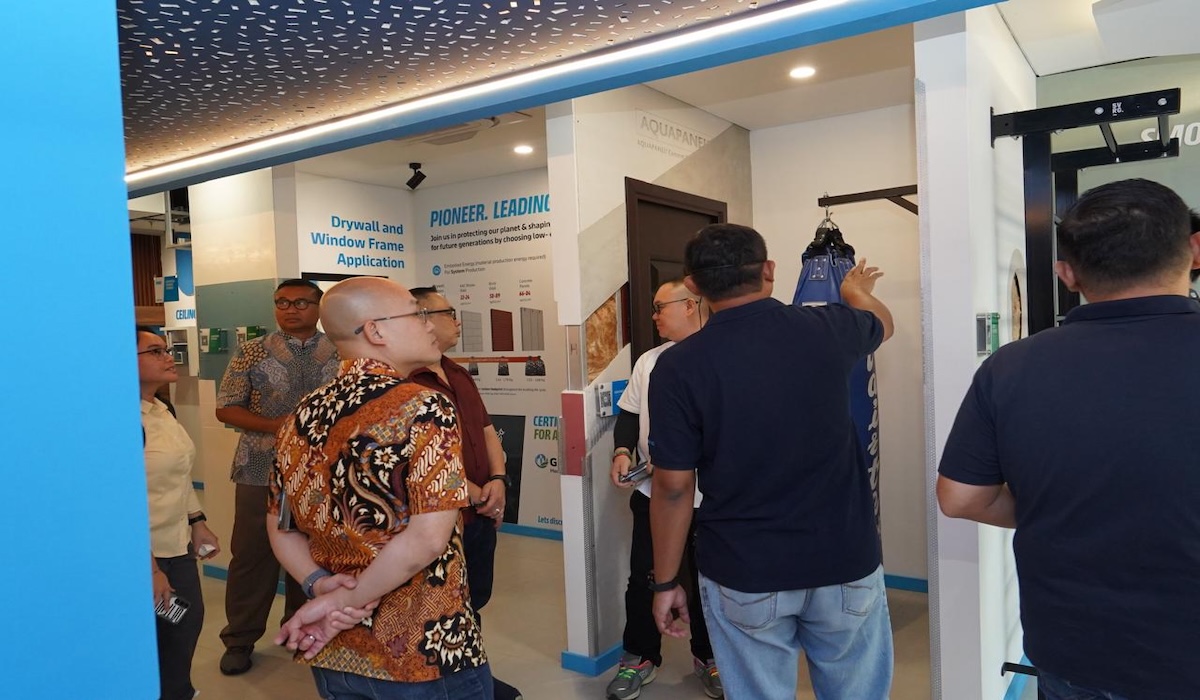
The use of gypsum boards as a material for interior partitions is expected to continue increasing in Indonesia. Besides being considered more efficient in terms of work time, the material also offers a lighter weight compared to conventional brick walls.
Marketing Communication Digital & Branding Manager Raden Krisma Hadianto said the trend of using gypsum partitions has already developed in a number of developed countries such as Japan, South Korea and Australia, particularly for multi-storey buildings. According to him, the use of gypsum in interior areas can help reduce the structural load of a building while accelerating the construction process.
“Brick walls are very heavy and require stronger foundations. If you use a gypsum partition system, the building weight becomes lighter, so the efficiency is felt especially in multi-storey buildings,” Kris said in Jakarta on Thursday (18/6).
He explained that the installation process for gypsum partitions is also relatively faster compared to brick walls. In conventional construction, wall work must still go through plastering and rendering stages that require a long drying time before painting can begin. “Meanwhile, with gypsum partitions, once installation is complete, the finishing stage can be carried out more quickly, so the overall project work time is shorter,” he said.
Despite offering a number of advantages, the use of bricks still dominates the national construction sector. According to Kris, one reason is the public perception that gypsum partitions are more fragile than brick walls. He assessed that this assumption generally arises from the use of materials that do not meet specifications. Gypsum boards used for ceilings, for example, have a different thickness from boards specifically designed for wall partitions.
“If you use the correct specifications, including the appropriate frame and board thickness, the performance can be very good. Even for acoustic and fire resistance needs,” he said.
In addition to targeting multi-storey buildings and offices, the largest market for gypsum products in Indonesia still comes from the housing sector. Home construction and renovation activities are considered a relatively stable source of demand amid the slowdown in the property sector. Kris mentioned that the retail and housing market still contributes the largest portion of sales compared to apartment, warehouse, and industrial estate projects, which tend to follow investment cycles.
On the other hand, the national gypsum industry still faces the challenge of dependence on imported raw materials. The majority of gypsum board producers in Indonesia still import their main raw materials because the quality of domestic gypsum minerals is considered not yet meeting the specifications required for gypsum board production. This condition makes the industry vulnerable to rupiah exchange rate fluctuations and changes in global logistics costs.
In an effort to broaden public understanding of gypsum materials, Knauf-Jayaboard inaugurated the Knauf-Jayaboard Experience Centre in South Jakarta. The facility combines the functions of a showroom and a training centre for architects, contractors, applicators, distributors, and homeowners who want to understand gypsum-based construction technology and systems.
Managing Director of Knauf Indonesia Ahmad Hamdani said the Knauf Experience Centre is a learning space that allows visitors to understand drywall solutions more tangibly and according to modern project needs. “Drywall is not just a partition made of frames and gypsum boards, but an integrated solution capable of delivering better room performance, from acoustics, fire resistance, moisture resistance, to design flexibility,” Ahmad said.
This facility was built together with Pandega Desain Weharima as the architectural consultant and PT Inti Indah Interindo as the fit-out contractor. Inside, visitors can explore various educational zones, ranging from the history of Knauf, an acoustic tunnel, workshop and training areas, to drywall system solutions for wet areas, fire resistance, acoustics, as well as ceiling design inspiration.
Through the Knauf Experience Centre, Knauf Indonesia hopes to encourage the transformation of the construction industry towards more efficient, precise, modern, and sustainable building methods. The Experience Centre will serve as an educational facility for various gypsum applications, from ceilings, partitions, and acoustic systems, to building materials claimed to be more efficient for modern construction needs. After Jakarta, a similar concept is planned for several other cities such as Medan, Surabaya, and Bali.