
Guterres and Foreign Minister Tata Criticise UN Security Council Veto Power
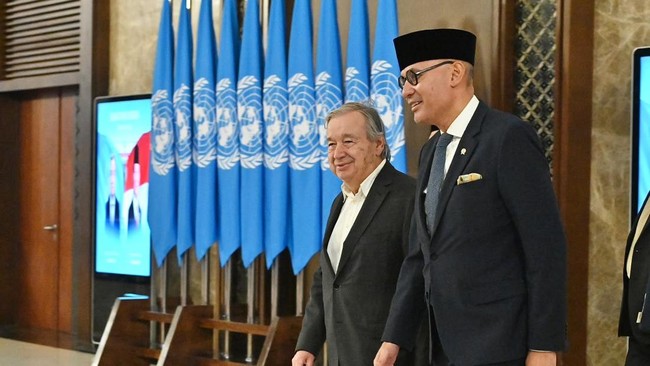
UN Secretary-General António Guterres and Indonesian Foreign Minister Arrmanatha Christiawan Nasir, known as Tata, have jointly highlighted the abuse of veto power by permanent members of the UN Security Council. They said the situation was hindering efforts to maintain world peace.
“The Security Council should be a place to seek solutions, not a place to use the veto,” Tata said at a joint press statement with Guterres at the Pancasila Building of the Ministry of Foreign Affairs in Central Jakarta on Monday (19 October 2026).
Tata stressed that UN reform was not intended to weaken the organisation, but to make it more effective and representative, and better able to deliver tangible results. Indonesia would also push for reform of the Security Council as it seeks a non-permanent seat for the 2029–30 term.
At the Foreign Policy Circle Talks forum, entitled “Eight Decades of the United Nations: What’s Next?”, held the same day, Guterres criticised the composition of the Security Council, saying it no longer reflected the world’s geopolitical realities.
He said the structure established after the Second World War had not adapted to changes in the distribution of global power.
“Does that make sense in today’s world? Is this body representative? Clearly, it is no longer representative today,” Guterres said, referring to the Council’s permanent membership.
The Security Council has five permanent members: the United States, Russia, China, the United Kingdom and France. Each has veto power to block draft substantive resolutions, including those supported by a majority of Council members. The use of this power can leave the Council deadlocked when the interests of major powers clash.
Guterres said actions by permanent members that start wars while disregarding international law further constrain the UN’s ability to fulfil its mandate to maintain global peace and security. This has intensified calls to overhaul the Security Council’s powers and mechanisms.
Reforming the Security Council is also seen as important to increasing the role of developing countries, or the Global South, in international decision-making. Guterres said he was advocating a more inclusive multilateral system, while Indonesia reaffirmed its commitment to pursuing global institutions that are fairer, more effective and better able to respond to today’s challenges.
Source: jawawa.id (https://jawawa.id/newsitem/guterres-and-foreign-minister-tata-criticise-un-security-council-veto-power-1792457427)
Originally published by CNBC Indonesia (https://www.cnbcindonesia.com/news/20261020004534-4-777668/guterres-menlu-tata-kompak-sentil-hak-veto-dk-pbb-sebut-ini), translated from Indonesian