
Gus Ipul Urges UNP Academic Community to Act as Social Protection Agents
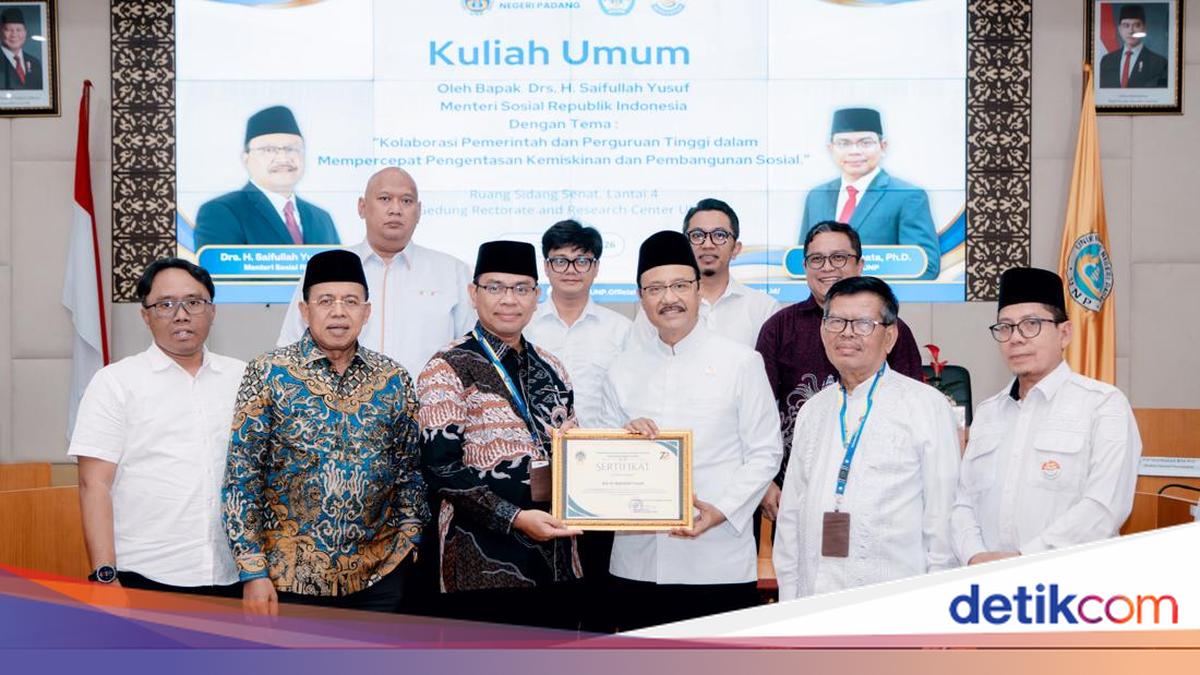
Social Affairs Minister Saifullah Yusuf (Gus I.pul) has invited the academic community of Padang State University (UNP) to play a role in expanding social protection, particularly by assisting the government in improving data accuracy and reaching populations not yet touched by social services.
Gus Ipul made this appeal during a public lecture themed ‘Collaboration between Government and Higher Education in Accelerating Poverty Alleviation and Social Development’ held at the UNP Senate Chamber, Rectorate and Research Centre Building, Padang, West Sumatra, today.
Gus Ipul arrived around 09:45 WIB accompanied by the Rector of UNP, Krismadinata, the Head of the West Sumatra Provincial Social Service, Syaifullah, and various Special Staff and Experts to the Minister of Social Affairs. Upon entering the senate room, he was welcomed by university leadership and representatives from student organisations.
The public lecture was moderated by Zikri Alhadi, a lecturer from the Department of State Administration, Faculty of Social Sciences at UNP. In his presentation, Gus Ipul discussed the mandate of Article 34 of the 1945 Constitution. He stated that social protection does not end with the distribution of aid, but also involves empowering poor families to prevent poverty from being passed down to future generations.
“The most commendable and proven path is education,” said Gus Ipul in a written statement on Wednesday (7/10/202moving 26).
He explained that the government employs three approaches to tackling poverty: reducing expenditure burdens through social assistance and protection, increasing income through empowerment, and preventing intergenerational poverty transmission through education.
The latter approach is manifested through the ‘Sekolah Rakyat’ (People’s School) programme, which is dedicated to children from poor and extremely poor families.
Gus Ipul noted that children entering Sekolah Rakyat face various challenges, ranging from school dropouts and health or psychosocial issues to other social problems. Therefore, Sekolah Rakyat integrates education, rehabilitation, and empowerment.
“Sekolah Rakyat is specifically for the poor. Therefore, there are no academic tests here. To the UNP students, you should be grateful that you have been academically selected to be here. In Sekolah Rakyat, as long as you are poor and meet the requirements, you are admitted,” said Gus Ipul.
The atmosphere of the lecture lightened several times as Gus Ipul interspersed jokes and interacted with the moderator and participants, including when discussing deciles and the digitalisation of social protection.
According to Gus Ipul, all such efforts must begin with accurate data. The government is now using the National Social and Economic Single Data (DTSEN) as a reference to sharpen the targeting of social programmes.
“If we want to be on target, the data must be accurate. That is the keyword. It is not just about data, but data that can be read, understood, and can clearly explain the objective condition of every family and individual,” said Gus Ipul.
Accurate data also helps the government identify conditions that are not visible through general figures. One such example is the decline in poverty, which has proven to be uneven between urban and rural areas.
“There is both good news and bad news. The good news is that poverty is decreasing. We always talk about decreasing poverty. But how is that decrease occurring? When we elaborate, it turns out the decrease is uneven between cities and villages,” he said.
Gus Ipul noted that of nearly 500,000 residents who moved out of poverty between September 2025 and March 2026, approximately 350,000 were in urban areas, while the figure in villages remained almost stagnant. To simplify, for every 10 people who exit poverty, about eight are in cities and only two are in villages.
“So there is an inequality in the decline of poverty between urban and rural areas. This is an example of how data can allow us to see reality more clearly and guide our interventions. Which comes first and what is needed? Which requires social protection and which requires empowerment? All of these must be interconnected,” expressed Gus Ipul.
Consequently, Gus Ipul invited the UNP academic community to assist in data updates and expanding public access to social protection.
The government has opened channels for public participation in data updating, including through the ‘Cek Bansos’ application to submit proposals and appeals. The government is also developing ‘Digital Social Protection’ for the registration and re-registration of social assistance recipients.
“I invite all lecturers, UNP leaders, and students to help us obtain accurate data. We are opening public participation. We cannot rely solely on government channels,” he said.
Gus Ipul noted that the expansion of digital services still faces challenges because not all members of the community have the same level of digital literacy. Some do not have smartphones, do not understand how to register, or lack the confidence to register themselves.
Therefore, Gus Ipul invited the UNP academic community to become ‘Social Protection Agents’ and assist the community, starting from their immediate surroundings.
“Everyone can be a Social Protection Agent. For whom? Start with those closest to you—your neighbours, your relatives. Help input the data so they can be recorded in the digital service,” said Gus Ipul.
He emphasised that Social Protection Agents only assist the community in accessing the system, not in determining eligibility for social assistance. Eligibility determination remains subject to verification and data matching, while the public also has the space to submit appeals if the results do not match factual conditions.
Gus Ipul continued that the improvement of data and the expansion of social protection must ultimately drive changes in family conditions. Social assistance serves as a safety net, which should then be followed by empowerment so that families do not remain dependent on aid.
“After receiving social assistance, they must be encouraged to become empowered, so that subsequently they become families who choose not to be dependent…”
Source: jawawa.id (https://jawawa.id/newsitem/gus-ipul-urges-unp-academic-community-to-act-as-social-protection-agents-1791377799)
Originally published by detikcom (https://news.detik.com/berita/d-8696968/gus-ipul-ajak-civitas-akademika-unp-jadi-agen-perlinsos), translated from Indonesian