
Gus Ipul Emphasises BPS as Determinant of DTSEN Deciles to Ensure Targeted Social Assistance
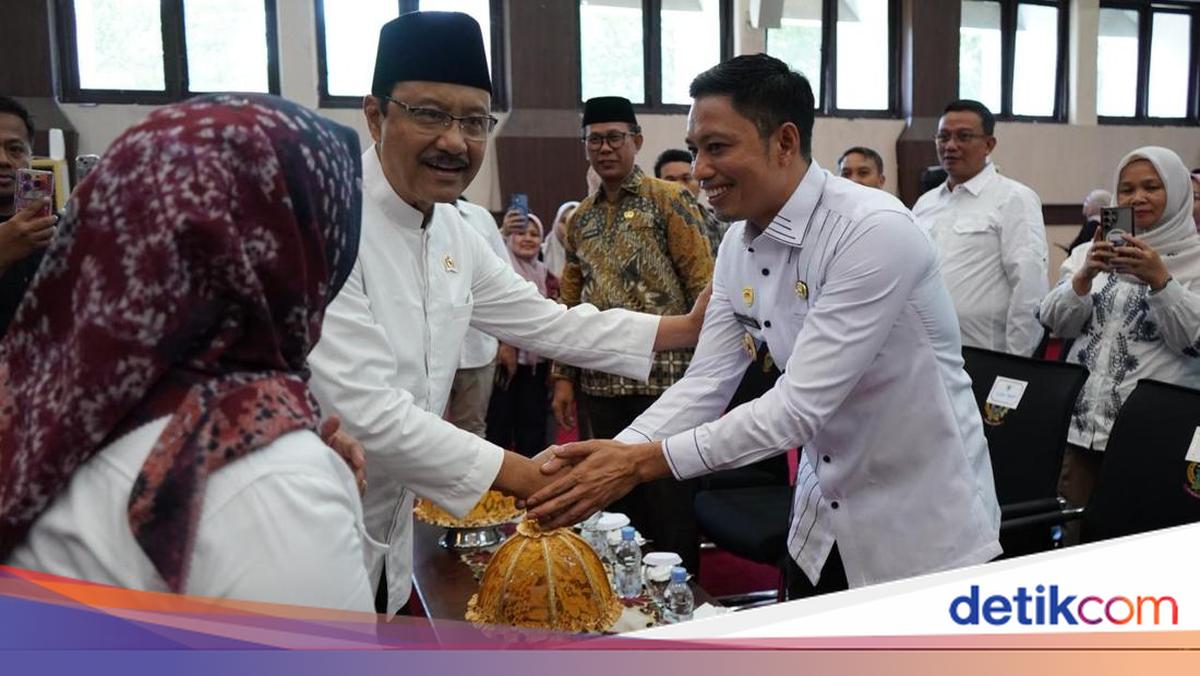
Social Affairs Minister Saifullah Yusuf (Gus Ipul) has emphasised that the determination of deciles in the National Single Social and Economic Data (DTSEN) serves as the basis for social assistance distribution and is not the authority of Programme Keluarga Harapan (PKH) companions, but rather carried out by the Central Statistics Agency (BPS). PKH companions are tasked with updating and submitting real data from residents in the field to ensure social assistance is increasingly targeted.
This was stated by Gus Ipul during the Ministry of Social Affairs’ gathering with the Provincial and Regency/City Governments across South Sulawesi, along with social pillars, at the Pola Room of the South Sulawesi Governor’s Office today.
Attendees included South Sulawesi Governor Andi Sudirman Sulaiman, Makassar Mayor Munafri Arifuddin, Maros Regent Chaidir Syam, Enrekang Regent Muhammad Yusuf Ritangnga, Soppeng Regent Sukardi Haseng, Gowa Regent Husniah Talenrang, Barru Regent Andi Ina Kartika, Bantaeng Deputy Regent, Bulukumba Deputy Regent Andi Edy Manaf, Pangkep Deputy Regent Abdul Rahman, and hundreds of social pillars.
“What I need to emphasise here now is that PKH companions (and) all of us cannot determine the DTSEN deciles. Our task is only to send data that matches the field conditions. The determinant is BPS,” said Gus Ipul in a written statement on Saturday (18/4/2026).
He explained that deciles represent a grouping into 10 levels of societal welfare that serve as a reference for various policy programmes. Decile 1 covers the 10 per cent of the population with the lowest socio-economic conditions, while decile 10 is the group of the most affluent 10 per cent. Therefore, the determination process is carried out by BPS in accordance with Presidential Instruction Number 4 of 2025.
According to Gus Ipul, there is still a misconception that PKH companions or regional heads determine the aid recipients. In reality, the task of regional governments and PKH companions is to ensure that community data is continuously updated according to the latest field conditions.
“There is a misunderstanding that the determinant might be the regent or mayor. No, the determinant is BPS,” Gus Ipul stressed.
He emphasised that DTSEN is dynamic and can change every day. Changes in residence, economic conditions, or even the passing of residents must be updated immediately to avoid mis-targeting in social assistance distribution.
“So our data changes every day. If we are late in reporting a deceased person, it means we are helping someone who is already dead,” said Gus Ipul.
He noted that government evaluations indicate there are still indications of targeting inaccuracies in several PKH and staple food assistance (bansos) programmes. Therefore, the Ministry of Social Affairs is opening opportunities for PKH companions to propose, refute, and update Beneficiary Family (KPM) data based on factual field conditions (groundcheck).
“We give PKH companions the opportunity to propose, refute, and provide their data so that it can later be corrected and improved by BPS. So it is still BPS that makes the improvements; your task is only to assist in updating,” he stated.
He hopes that synergy in data updating between the central government, regions, and the community will make social assistance increasingly targeted.
“Insya Allah, if we all do the updating, our data will be more accurate, then the social assistance and social subsidies will be targeted,” explained Gus Ipul.
Meanwhile, Andi Sudirman Sulaiman stated that the Ministry of Social Affairs’ programmes, which are increasingly targeted, also contribute to reducing poverty rates in his region.
“We report to the Minister, alhamdulillah, in South Sulawesi there has been a poverty reduction of about 0.24 per cent or 17,000 souls in 2025, and this is our first year and an extraordinary reduction has occurred immediately. Thank you, Mr Minister,” Andi concluded.
As access to DTSEN updates, the Ministry of Social Affairs is opening public participation channels through two routes: formal and participatory. In the formal route, the public can report to RT/RW to submit data updates through operators of the Next Generation Social Welfare Information System (SIKS-NG) at villages, wards, or social services offices.
Proposals are then discussed in village or ward deliberations, followed by field checks by PKH companions and social services, and then determined by the regional head.
Meanwhile, through the participatory route, the public can submit proposals or objections via the Cek Bansos application, PKH companions, Command Centre 021-171, and WhatsApp service 08877-171-171. All proposals from both routes are subsequently verified by BPS for re-ranking and periodic updates every three months.