
Guide to Updating DTSEN Decile and How to Check It at dtsen-form.bps.go.id
Following the opening of a dedicated channel for checking the National Socio-Economic Single Data (DTSEN) decile by Statistics Indonesia (BPS), complaints about decile increases have been widely emerging on social media. Fortunately, citizens who consider their decile to be inaccurate can request a data update.
According to the official BPS website, a decile is a grouping of families based on their relative level of welfare. After considering various socio-economic aspects, families are divided into 10 groups. Decile 1 is the group with the lowest relative welfare level. Conversely, decile 10 is considered to have the highest welfare. The determining indicators are highly varied, including ownership of certain goods, electricity capacity, occupation, and drinking water source.
The Ministry of Social Affairs uses the DTSEN decile as a reference for distributing social assistance (bansos). This is because only families in priority deciles are considered to meet the criteria. Therefore, accurate decile data is an important matter.
For those who feel their decile is inaccurate, here is a guide to requesting an update.
According to BPS on its official Instagram account, @bps_statistics, DTSEN decile updates can be done through the Cek Bansos app, by visiting the local village/sub-district office or social service office, or through the BPS DTSEN channel.
Update via the Cek Bansos app: Download the Cek Bansos app from the Play Store or App Store. Create an account, complete the requested data, then log in with that account. Select the ‘Profile’ menu, then ‘Request Data Update’. Fill in the available questions and submit the answers. A Social Assistance Officer will come to the house to validate the answers.
Update via village/sub-district office or social service office: Visit the local village/sub-district office or social service office. Submit a data update request. Answer the questions asked by the officer. Wait for the update data to be processed.
Update via the BPS DTSEN channel: Prepare data including the Population Identification Number (NIK), Family Card (KK) number, PLN customer ID number, a photo of the front of the house, house coordinate information, and a statement letter to be signed by the village head or sub-district head. Open the page dtsen-form.bps.go.id. Check the NIK, then select the ‘Data Update’ menu. Fill in all required fields, then click ‘Update Data’. If there are documents that do not meet the requirements, BPS will verify via mobile phone number. Follow the process until complete.
Before requesting an update, citizens should first know which decile they are in. There are three methods to check.
Check decile on Cek Bansos Kemensos: Open the Cek Bansos Kemensos site via the link https://cekbansos.kemensos.go.id. Enter the NIK and the letter code provided. If the code is unclear, select the option to get a new code. Click ‘Search Data’ or press Enter. The system will display the name, DTSEN decile, and social assistance distribution status. The social assistance information displayed includes the Sembako/BPNT Programme, PKH, and PBI-JK.
Check decile on the Cek Bansos app: Download the Cek Bansos Kemensos app via the Play Store or App Store. Open the app, then select the ‘Cek Bansos’ menu. Enter the 16-digit NIK in the available field. Click ‘Search Data’. The app will display the name, DTSEN decile, and status of six types of social assistance.
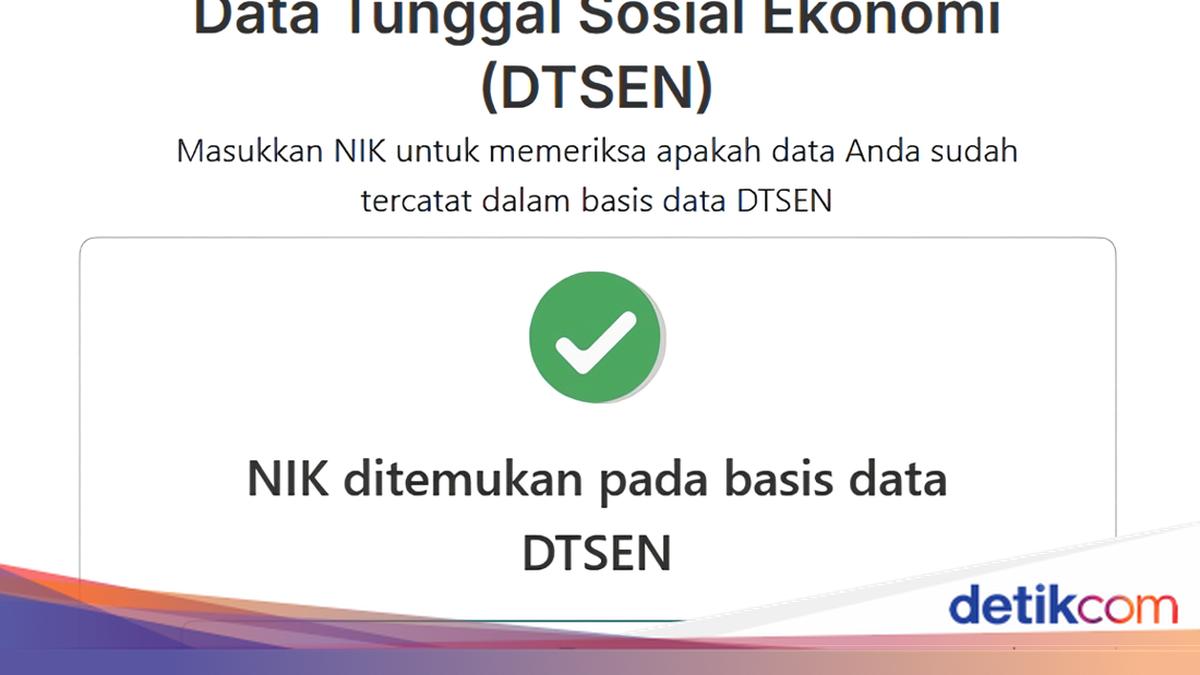
Check decile on the DTSEN BPS page: Open the site dtsen-form.bps.go.id, then select ‘Others’. Enter the NIK and captcha code. Click ‘Check Data’. If the NIK is registered, a notice will appear that the NIK was found in the DTSEN database. Close the pop-up, then select ‘Check Decile’. Enter the date of birth and captcha. Click ‘Search Data’ to view the decile information for the NIK.
Because it is still relatively new, many questions about the DTSEN decile may arise among the public. Here are some of them, complete with answers, as reported from BPS Instagram.
Can the decile change automatically? Possibly. Changes occur when there is an update to the data that forms the basis of the ranking. The latest data may come from government administrative records, updates by the government, or independent updates by the public.
How long does it take for the DTSEN decile to change? Approximately three months. Specifically, decile updates for applicants of the Indonesia Smart Programme (PIP) and the Indonesia Smart College Card (KIP-K) can be known within two weeks.
Is there a decile reference based on monthly salary? No. Salary is indeed one of the grouping indicators. However, there is no official table from BPS that informs decile grouping based on salary.
Which deciles can receive social assistance? Each type of social assistance has different recipient criteria. However, in general, people in deciles 1-4 are prioritised as recipients of social assistance, such as PKH and the Sembako Programme. Decile 5 can still be proposed as PBI-JK participants.