
Grounding the President's Directives in the Education Sector
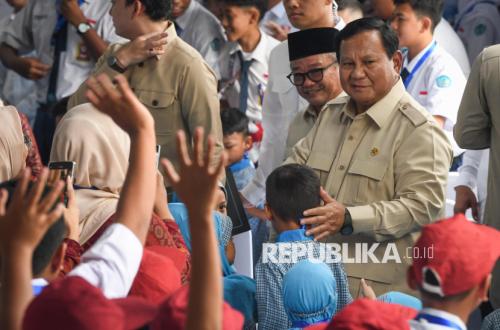
President Prabowo Subianto has repeatedly affirmed that national development is not solely focused on economic achievements but also on enhancing the quality of life for the populace. This includes access to decent education, which serves as the primary key to determining the nation’s future.
The President’s assertion was evident during his speech at the commemoration of National Education Day (Hardiknas) 2025 and the launch of the Quick Best Results Programme (PHTC). He stated, “It is impossible for us to become a prosperous nation, impossible for us to become an advanced country, if our education is not good, if our education fails.”
President Prabowo’s vision and mission for Golden Indonesia 2045 are being realised through eight Asta Cita principles, 17 National Priority Programmes, and the aforementioned PHTC. In public policy studies, the disparity between planning, vision, and mission at the central level on one hand and implementation in the field on the other often represents a weak point in governance.
However, in the education sector since Abdul Mu’ti took the helm at the Ministry of Basic and Secondary Education (Kemendikdasmen) of the Republic of Indonesia, I assess there to be a marked difference. The President’s directives are not merely reduced to documents. By the Minister of Basic and Secondary Education (Mendikdasmen), they are truly grounded down to the grassroots level, including remote areas in eastern Indonesia.
Mendikdasmen Abdul Mu’ti has proven himself as a skilled “implementer minister” adept at translating President Prabowo’s vision and mission into concrete programmes. For instance, the revitalisation programme for educational units. This aligns with President Prabowo’s directive: improve educational infrastructure.
In 2025, the Kemendikdasmen RI had already begun revitalising 16,167 schools. This number surpassed the target of 10,440 schools.
The programme is not only on target but also involves around 28,000 micro, small, and medium enterprises (UMKM) across more than 5,000 sub-districts. Moreover, school revitalisation has absorbed nearly 200,000 workers, according to records from Kemendikdasmen RI and related parties.
Entering 2026, Abdul Mu’ti does not stop there. The Professor of Islamic Education at UIN Syarif Hidayatullah continues to accelerate this programme.
The revitalisation target has been raised to 60,000 educational units. The 2026 education budget reaches Rp52.12 trillion, with the primary priority on the construction and revitalisation of educational units.
The government also plans to build 7,000 integrated school units at the sub-district level across Indonesia. This is an ambitious target that has been promptly followed up since President Prabowo’s directive in the plenary cabinet meeting in October 2025.