
Grocery Traders Fear Seven-Year Jail Terms and Fines: Amran Responds
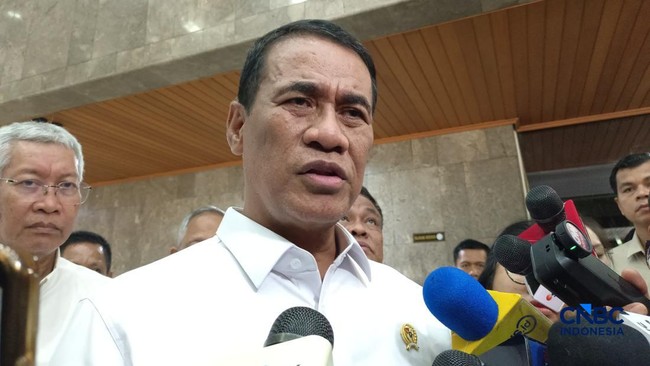
Jakarta, CNBC Indonesia — Agriculture Minister and National Food Agency (Bapanas) chief Amran Sulaiman has responded to market traders’ protests against new government rules on monitoring food prices and penalties for violations.
Amran said controls on maximum retail prices (HET), reference selling prices (HAP) and government purchase prices (HPP) were needed to protect farmers and consumers. The government, he said, could not allow businesses to manipulate subsidised food prices, particularly those for rice.
“Maximum retail prices and government purchase prices must be regulated. Why? Because this is subsidised food, particularly rice, and it must be regulated. We have to be firm,” Amran said at his office in Jakarta on Tuesday (24 November 2026).
He said the policy was needed to ensure farmers earned a reasonable return and were encouraged to keep producing. At the same time, traders should not make excessive profits at the public’s expense.
“Farmers suffer when prices fall. Give them room to make a profit so they keep producing, we achieve self-sufficiency and the country grows stronger. On the other hand, traders must not take unreasonable profits,” he said.
Amran cited fortified rice that, he said, should sell for Rp13,500 per kilogram but had been found selling for as much as Rp56,000 per kilogram. He also referred to premium rice with a broken-grain content of 59 per cent being sold for Rp17,000 per kilogram.
“For example, this has already happened. Rice that should cost Rp13,500 per kilogram was sold for Rp56,000. Fortified rice, and premium rice that previously had a broken-grain content of 59 per cent, was sold for Rp17,000. That is not right either,” he said.
Amran said the government had to treat farmers and consumers fairly. He noted that farmers spent months producing a harvest, yet did not always make much profit.
“We have to be fair to the public and to farmers. Farmers face rain and heat, working day and night for three to four months before they can produce a single harvest. Even then, their profits are modest. We must not hurt them. Their lives are difficult enough; we should not make it worse,” Amran said.
Addressing traders’ protests and misunderstandings about the rules, Amran also discussed the price of maize. He explained that the Rp5,500-per-kilogram figure did not mean the government had cut the price from Rp6,000 to Rp5,500.
Instead, he said, it was the minimum purchase price for maize from farmers, intended to prevent them from making a loss.
“The point is that Rp5,500 is the minimum price: maize must not be bought for less than Rp5,500 per kilogram, because that would make farmers lose money. But the price should not be too high either,” he said.
To balance prices for farmers and livestock breeders, the government is also preparing a Food Supply and Price Stabilisation (SPHP) maize programme to supply breeders.
“That is why there is SPHP maize. We sell it to livestock breeders so that both sides are in a better position,” Amran said.
He said the government would take action against businesses found to have breached price rules, while acting as an intermediary to ensure the interests of both farmers and traders were considered.
“If there are still violations, we will act. We have to be a mediator. The government has to remain in the middle. Those who deviate will be dealt with. We must not leave farmers to fend for themselves,” he said.
Earlier, the Indonesian Market Traders Association (IKAPPI) objected to National Food Agency Chief Circular Letter No. 456 of 2026 on penalties for violations of government purchase prices, maximum retail prices and SPHP prices.
IKAPPI chairman Abdullah Mansuri said the rules could place an additional burden on market traders, who were already under pressure from weaker consumer purchasing power and rising prices for some food commodities.
“We regret the circular. We have to say that traders are not in a good position at the moment, because consumer purchasing power is quite weak and several food commodities have risen in price because of the weather, a prolonged dry season and other recent problems,” Mansuri told CNBC Indonesia.
Mansuri said the government should first tighten oversight of the food distribution chain, from producers to distributors. Market traders, he said, also had to set their selling prices in line with what they paid suppliers.
“I think this needs to be reviewed. It should not be the downstream end of the chain that is put under pressure; the distribution process is what should be monitored,” he said.
National Food Agency Chief Circular Letter No. 456 of 2026, issued on 10 November 2026, sets out penalties for businesses that breach government purchase prices, maximum retail prices and SPHP prices.
The sanctions range from written warnings and administrative fines to recommendations to revoke business licences and the withdrawal of food from circulation. Where there is preliminary evidence of a criminal offence in the food sector, the violation may be reported to law enforcement, with a maximum sentence of seven years in prison and a fine of up to Rp1.5 billion.
Source: jawawa.id (https://jawawa.id/newsitem/grocery-traders-fear-seven-year-jail-terms-and-fines-amran-responds-1795506762)
Originally published by CNBC Indonesia (https://www.cnbcindonesia.com/news/20261124125058-4-787947/pedagang-sembako-teriak-terancam-penjara-7-tahun-denda-ini-kata-amran), translated from Indonesian