
GRIB Jaya Speaks Out on Hercules' Presence at 27 August Unrest
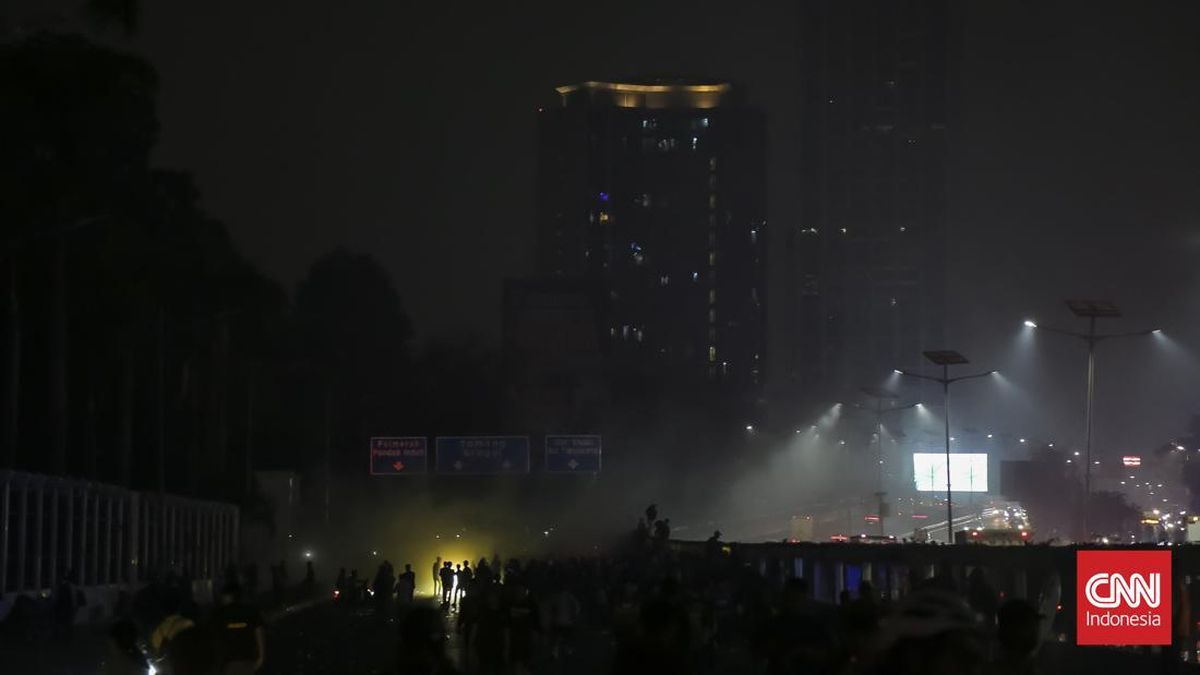
The United Indonesia People’s Movement (GRIB) Jaya has spoken out regarding its leader, Hercules, being in the midst of the unrest on the night of 27 August 2026, when a demonstration took place near the DPR building and its surroundings.
GRIB Jaya’s Legal Division, Wilson Colling, confirmed that Hercules was at the location. However, Wilson asked the public to understand the context of the security situation that night.
“Mr Hercules’ presence together with a group of people at the location on the night after the incident must be seen in the context of the security situation and environmental conditions at that time,” Wilson said in a press statement on Saturday evening (29/8).
This statement was also issued to clarify a number of videos on social media showing the presence of Hercules and his men at a location full of demonstrators.
According to Wilson, clarification is necessary so that the public does not draw conclusions based on visual fragments, one-sided narratives, or unverified information.
“This clarification is conveyed to place the event objectively, based on context, chronology, material facts, and applicable legal principles,” he added.
Wilson said Hercules’ presence on the ground was part of a persuasive effort to monitor the situation and maintain a conducive environment, not to aggravate the situation, carry out provocation, or be involved in physical clashes.
He stated that, organisationally, there was never any instruction to join the demonstration or carry out any activities related to the action.
“The Chairman’s instruction has been conveyed clearly and firmly and has been published through the organisation’s internal media,” Wilson explained.
“Therefore, the presence of certain individuals at a location cannot automatically be interpreted as representing the organisation’s actions, especially without evidence of orders, coordination, or involvement in a criminal act,” he continued.
Wilson also clarified the call of “pulang, pulang” (go home, go home) in the circulating video. He asked the public to understand the context of the statement in full.
According to him, the statement cannot be separated from the time, place, situation, the sequence of events before and after, and the intention of the person who said it.
The call to “go home”, he said, can actually be interpreted as an appeal for the public or the masses to leave the location in an orderly manner when the situation was no longer conducive.
“Especially if the time limit for expressing aspirations has ended and the situation is beginning to have the potential to cause friction, an invitation to disperse peacefully is a preventive action that can rationally be directed at preventing a larger conflict,” he said.
Wilson regretted a number of narratives emerging in the digital space that used video clips to build a framing as if someone’s presence at the location was identical to involvement in the riot.
He hopes that the digital space or social media does not become a “courtroom” that judges someone.
From a legal perspective, Wilson explained, a person’s presence at a place does not in itself prove involvement in a criminal act.
An assessment of an alleged criminal act must be based on facts and valid evidence, including who did what, when it was done, how it was done, with what intention, and whether there is a causal relationship between a person’s actions and the alleged criminal act.
“Thus, it is not appropriate for a video clip to be directly used as a basis for concluding criminal involvement without first examining the entire recording, chronology, witnesses, other evidence, and the concrete actions of each person,” he continued.
Wilson also stressed that there must be a separation between the right to express opinions and criminal acts.
He explained that the right to express opinions in public is part of citizens’ constitutional rights and its implementation is regulated in Law Number 9 of 1998 concerning Freedom to Express Opinions in Public.
However, he continued, this freedom goes hand in hand with the obligation to respect public order, the rights of others, and legal provisions.
Therefore, there is a fundamental difference between peacefully expressing aspirations; appealing for the masses to disperse and maintain order; and acts of violence, vandalism, destruction, or other criminal acts.
“These three things must not be conflated merely based on the similarity of location or someone’s presence in a series of events,” he said.
In this clarification, he also fully handed over to law enforcement officials (APH) to do their work. However, this must be done according to facts, not framing built in the digital space.
“If there is an alleged criminal act, law enforcement officials certainly have the authority to conduct an investigation and inquiry in accordance with legal provisions,” Wilson said.
“However, at the same time, every person also has the right not to be immediately labelled as a perpetrator just because they appear in a video or were at the scene,” he continued.
Previously, Polda Metro Jaya admitted that it was still investigating the alleged involvement of mass organisations (Ormas) in the unrest on Thursday night (27/8).
Polda Metro Jaya’s Head of Public Relations, Commissioner Budi Hermanto, could not yet comment in response to the issue that was going viral on social media. He said officers were still trying to verify its truth.
“Regarding the involvement of mass organisations, we are still conducting further investigation because the facts must be verified. We ask for time,” he said in a press conference on Friday (28/8).
Budi was also reluctant to comment on Hercules’ presence, who was reported to have been at the scene of the unrest.
“We will investigate further, because what? Friends must understand that many social media posts contain disinformation, provocation and hoaxes,” he explained.