
Greenpeace urges adoption of sharia principles in sustainable investment
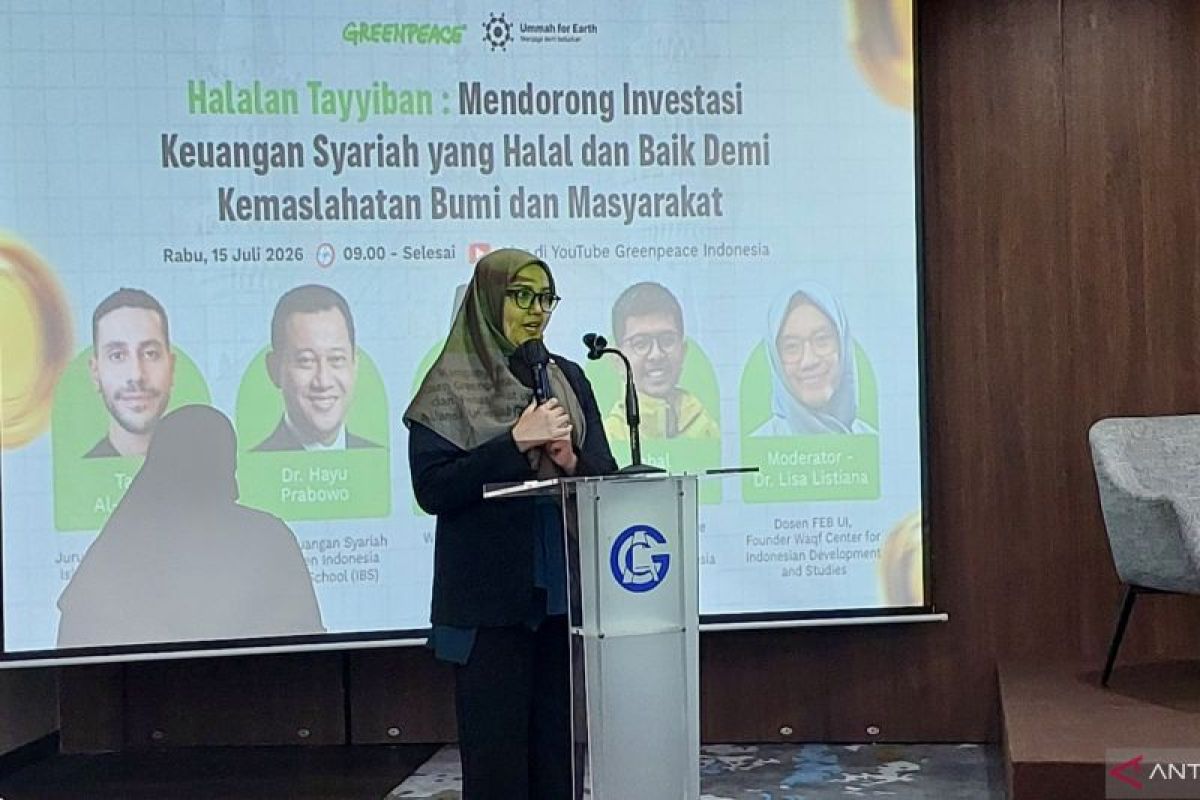
Strengthening sharia-compliant financing that takes sustainability into account will deliver broader benefits.
Jakarta (ANTARA) - Riska Rahman, head of the Ummah For Earth project at Greenpeace Indonesia, is pushing for the application of Islamic finance principles to investments in projects that prioritise environmental conservation and support sustainable economic growth in Indonesia.
According to Rizka, strengthening sharia-compliant financing that considers sustainability aspects will bring wider benefits, not only for the environment but also for public health and economic productivity.
“We see the need to empower Muslim communities to take part in climate and environmental actions whose goals benefit not only Muslims themselves but also societies across the world,” Rizka said during a discussion on sharia financial investment for the well-being of the earth and society, held in Jakarta on Wednesday.
She said Indonesia holds a strategic position to drive this transformation, as the majority of its population is Muslim and it has significant potential for developing the sharia economy.
At the event, Greenpeace Indonesia, together with Greenpeace Middle East and North Africa and the Global Ethical Finance Initiative, also introduced a paper proposing stronger screening of sharia investments by considering not only halal aspects but also the thayyib principle — investments that deliver benefits and do not cause negative impacts on society or the environment.
The paper focuses on evaluating the use of coal in Indonesia as an investment, as well as energy supply projects that, under sharia principles, are contradictory because they harm the environment and public health.
According to Greenpeace Indonesia’s findings, coal accounts for intensive fossil fuel pollution of around 15.33 tonnes of carbon dioxide, equivalent to 41 per cent of total global carbon emissions. Riska also noted that coal impacts not only personal finances, health and the environment, but also causes losses for the state.
“Coal has many negative impacts, yet on the other hand it still appears on the positive list of sharia finance, even though these negative impacts actually contradict the ethical foundations of sharia, which highly uphold sustainability, social responsibility and the preservation of life, the environment and wealth. It also contradicts the principle of preventing harm, or dhoror,” she said.
In addition, the paper introduces the Darurah Scorecard, a guide that can be used by ulama, fatwa councils and sharia financial institutions to evaluate coal use in a transparent and phased manner according to each country’s circumstances.
Rizka expressed hope that innovation in sharia finance could open up more financing opportunities for community-based climate action, clean energy and sustainable development projects.
This step is considered capable of strengthening Indonesia’s economic competitiveness while supporting the achievement of future energy transition and green economy targets.
“The hope is that we can take part in efforts for Indonesia to achieve its climate targets, and drive innovation in fatwas within sharia finance so that we can reach a green future for ourselves and the generations to come,” she added.
Source: jawawa.id (https://jawawa.id/newsitem/greenpeace-urges-adoption-of-sharia-principles-in-sustainable-investment-1784102083)
Originally published by Antara (Indonesian) (https://www.antaranews.com/berita/5650129/greenpeace-dorong-prinsip-syariah-pada-investasi-ekonomi-berkelanjutan), translated from Indonesian