
Greenovate 2026 Cultivates Green Economy Talent, Student Innovations Ready for Market
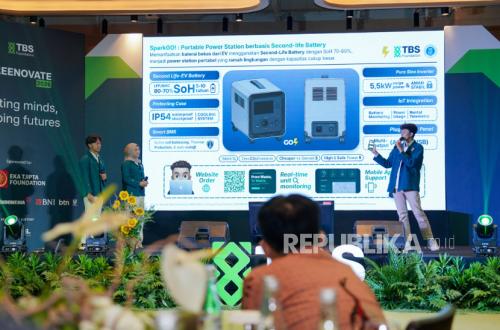
Efforts to accelerate the transition towards a green economy are considered to depend not only on investment and government policy, but also on the emergence of innovations with commercial value. This was reflected in the Greenovate 2026 event organised by TBS Foundation, which successfully attracted hundreds of sustainable business ideas from university students across various regions of Indonesia.
At Greenovate 2026, eight top teams were selected from more than 150 business ideas submitted by over 400 students. Notably, around 66.2 percent of participating teams came from outside Java. The high level of participation demonstrates the growing breadth of the green innovation ecosystem in Indonesia.
In a press release received on Thursday (6/8/2026), TBS Foundation Chairwoman Juli Oktarina said Greenovate is part of efforts to prepare young talent capable of contributing to the development of the green economy through innovation and collaboration.
“We are seeing more and more young people who have a concern for sustainability issues as well as the ability to deliver innovative solutions. Greenovate provides a space for them to develop ideas, obtain feedback from practitioners, and build networks that can support the development of innovations at the next stage,” Juli said at the Greenovate 2026 Grand Final in Jakarta on Wednesday (5/8/2026).
According to her, the development of the green economy requires collaboration between the education sector, industry, investors, and practitioners so that innovations do not stop at research but develop into business models that can be implemented.
Before entering the final round, all participants underwent intensive coaching with mentors from the energy, sustainability, technology, business, and investment sectors. They also had the opportunity to study the implementation of environmental, social, and governance (ESG) principles in the business models of TBS and Electrum.
The competition ultimately named The Triple A team from Institut Teknologi Bandung as the first-place winner for its Spark Go! innovation, a solution that utilises second-life electric vehicle batteries to create portable power stations based on the Energy as a Service (EaaS) concept.
The innovation offers the use of electric vehicle batteries that still have a state of health of 70 to 80 percent as portable energy sources with capacities of 1,500 watts, 3,500 watts, and 5,500 watts. The system is also equipped with Internet of Things (IoT) technology to monitor battery conditions in real time.
In addition to extending the lifespan of electric vehicle batteries, the innovation is considered capable of addressing the potential increase in electric vehicle battery waste in Indonesia, which is projected to reach 35,000 tonnes by 2030. The approach also supports the implementation of a circular economy through the reuse of materials that still have economic value.
Second place was won by the Beanefit team from Universitas Tanjungpura for its innovation in processing coffee grounds into value-added flour as a raw material for cookies. Third place was won by the Powerhart team from Universitas Gadjah Mada, which developed supercapacitor electrode material from empty oil palm fruit bunches.