
Greenland’s melting ice carries warnings far beyond the Arctic
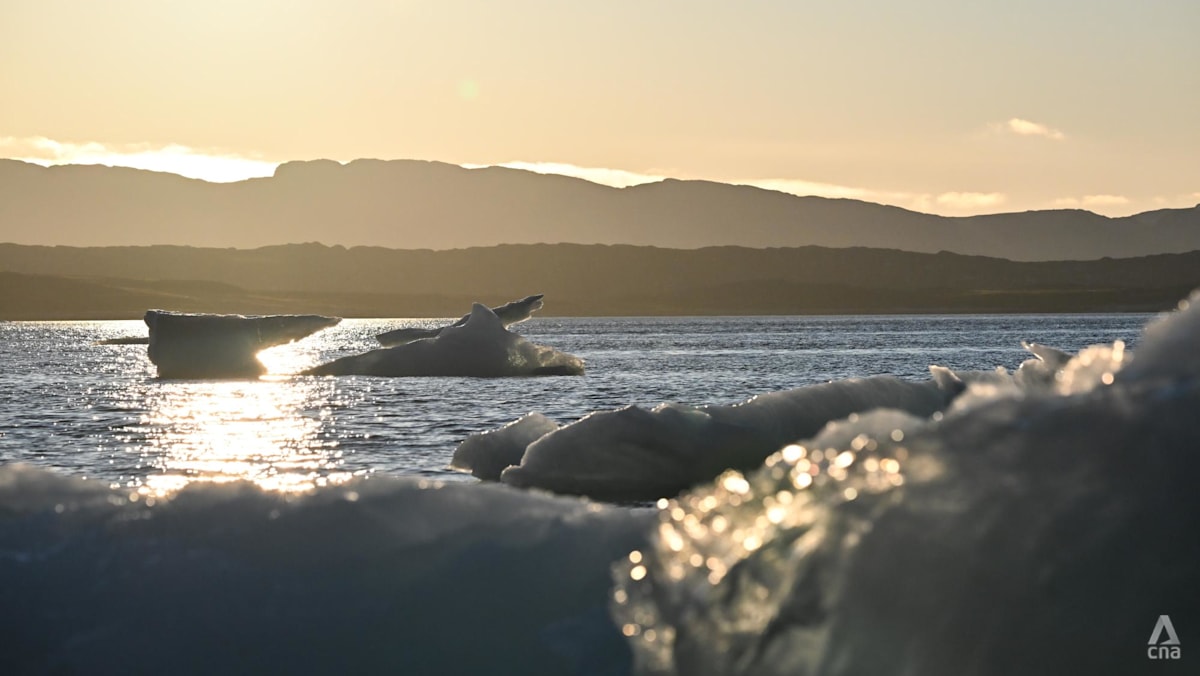
IN FOCUS: Greenland’s melting ice carries warnings far beyond the Arctic
As rising temperatures melt Greenlandic ice sheets, the changes are set to ripple across the planet. The Arctic is also becoming heavily contested, with US President Donald Trump pushing to acquire Greenland.
SISIMIUT, Greenland: From a distance, the village of Sarfannguit looks like a scattering of coloured candy placed upon a shelf.
Hidden deep along a narrow, sheltered inlet, away from the humpback whales and ringed seals that ride the currents of the nutrient-rich Davis Strait, its colourful homes rise against the exposed granite slopes of the area.
This settlement is one of dozens of small communities whose future is increasingly uncertain - caught between a changing climate, decades of population decline and the economic pull of Greenland’s growing towns.
The Arctic is warming around four times faster than the global average, transforming coastlines, ecosystems and weather patterns across the high north.
From the highest vantage point in the settlement of about 100 people, wind whips across this landscape’s bare, smooth curves. Distant patches of Arctic wildflowers, dwarf shrubs and lichen break up the starkness of the rocky peninsula.
An installed artwork of light-fracturing glass and steel called “Qaammat” - Greenlandic for “Moon” - sits here too, a tribute to the unbroken, intangible cultural heritage of the native Inuit people in this landscape.
Hanserak Olsen has spent years of his life looking out across this view, beyond the small cemetery where his ancestors are buried and out to a place that for 4,000 years has been a central meeting place.
For generations, families left Sarfannguit each summer to hunt inland towards Greenland’s remarkable ice sheet. Olsen, a 69-year-old fisherman and boat guide who grew up here, wonders if that tradition will continue.
He worries about the less predictable sea ice, the shifting fish stocks that mean his catch has been poor this year and the young people drawn away for education and employment.
Climate change is accelerating many of the pressures that Greenland’s remote settlements were already facing.
“Of course, we have the internet here, but there’re a lot more interesting possibilities and more modern life in the towns,” he said, referring often to Sisimiut, about an hour’s boat ride away.
Greenland’s ice sheet is melting faster than almost anywhere on Earth and the world’s largest island will be “ground zero for the confluence” of the impacts of a hotter and wetter polar region, said Klaus Dodds, a professor of geopolitics at Middlesex University London and co-author of Unfrozen: The Fight for the Future of the Arctic.
The changes here will ripple across the planet, experts say. Greenland’s ice sheet - which covers over 80 per cent of its total land surface - is now one of the largest contributors to global sea-level rise.
Under the Intergovernmental Panel on Climate Change’s (IPCC) highest emissions scenario, Greenland’s ice sheet is projected to contribute around 13cm to global sea-level rise by 2100, with a likely range of 9cm to 18cm.
That would have profound impacts on the world’s coastal cities.
In Asia, the river deltas of the Mekong, Ayeyarwady and Chao Phraya, the low-lying megalopolises of Jakarta and Manila and vulnerable ports in Hong Kong, Singapore and Malaysia would all be highly exposed.
“The key point is simple: what happens in Greenland does not stay in Greenland. It reaches the waterfronts, transport systems, homes, ports and water supplies of coastal cities across Asia,” said Benjamin Horton, the dean of the School of Energy and Environment at City University of Hong Kong.
Asia is the world’s most exposed region to sea-level rise because of the number of people living in low-elevation coastal zones, according to the IPCC, the United Nations’ scientific body on climate change.
Around 70 per cent of the global population exposed to sea-level rise and land subsidence lives in just eight Asian countries, including Bangladesh, India, Indonesia, Thailand, Vietnam and the Philippines.
Thirteen of the world’s 20 coastal cities projected to suffer the highest flood losses by 2050 are in Asia. Among them are Bangkok, Ho Chi Minh City and Jakarta.
“Greenland may feel remote, but it is directly connected to every coastline on Earth. This is not an abstract Arctic issue,” Horton said.
The risks faced by coastal communities are expected to become at least 10 times greater this century because sea levels will continue to rise, based on the IPCC findings. And population and infrastructure exposure to such threats will continue increasing, especially in Southeast Asia.
The greater global forces feel distant on the shores of Sarfannguit. But they are intimately tied. Olsen and others are living the local consequences of indelible change.
GLOBAL COMPETITION
As the ice melts, the Arctic is also emerging as a more heavily contested zone for the world’s most powerful geopolitical players eyeing new opportunities for critical mineral extraction, military influence and transport routes.
“Greenland and other territories are caught in the crosshairs of great powers and their spherical ambitions,” Dodds said.
United States President Donald Trump’s attention on Greenland has already caused prolonged turbulence in the self-governing territory amid a concerted campaign to bring it under American control since he started his second term in January 2025.
He has maintained a level of pressure on Greenland in recent weeks, telling a radio host in an interview in late July that it would be a safe bet that the US would be controlling Greenland before the end of his term in January 2029.
Trump, a long-time climate sceptic, has also withdrawn the US from the Paris Agreement, leaving the world’s largest historical polluter outside the world’s principal climate pact and unbound by global emissions reduction targets.
As the planet warms and pressure on natural resources grows, Dodds