
Green Transmission, the Backbone Determining Indonesia's Clean Energy Future
In the energy transition, renewable power plants often take centre stage. Solar, geothermal, wind, water, biomass, and new energy technologies frequently become symbols of the shift towards a cleaner energy system. Yet, behind all this, there is one infrastructure that works more quietly but is decisive: transmission.
Without a strong transmission network, clean energy will only remain a potential stored on a map. It may exist in resource-rich regions but cannot necessarily flow to industrial zones, urban areas, data centres, households, and other load centres that require a stable electricity supply.
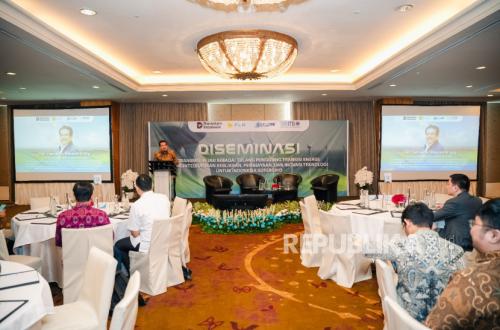
This awareness was the common thread in a dissemination seminar titled ‘Engineering Development Roadmap for Green Transmission in Supporting Accelerated Renewable Energy Development’. The forum brought together the government, PLN, academics, technology providers, and industry players to revisit a fundamental question: is Indonesia’s transmission system ready to support the acceleration of renewable energy?
For the Head of the Green Transmission Engineering Roadmap Study Team, Prof Dermawan Wibisono, this question cannot be answered with enthusiasm alone. Ambitious targets need to be translated into technical scenarios, implementation stages, financing readiness, and human resource strengthening.
‘We signed the Paris Agreement in 2015. Indonesia itself is targeting net zero emissions by 2060. But to get there, we must fix what technology is suitable and must be immediately applied in Indonesia,’ Dermawan said.
According to him, Indonesia cannot merely set a broad direction for the energy transition and then let the process run without a detailed map. A roadmap is needed so that targets do not stop at being statements but transform into actionable steps.
‘We often state our destination. But how do we get there? That is what needs to be formulated,’ he said.
Indonesia’s main problem is not only the availability of renewable energy but also the location of energy sources and their demand centres. Clean energy potential is scattered across many regions, while electricity consumption centres remain concentrated in specific areas.
Dermawan noted that Indonesia’s energy sources are not located in a single, easily accessible place. Solar potential is strong in the eastern regions, geothermal is spread across many areas, while other energy options also require specific development.
‘Our energy is scattered. There is solar from East Nusa Tenggara, there is wave energy, geothermal, and other sources in separate regions. Because of that, we need the right technology,’ he said.
Under such conditions, transmission becomes the bridge between potential and utilisation. It is not enough to simply build renewable power plants at resource locations. The energy produced must be able to flow to load centres efficiently, reliably, and safely.
High Voltage Direct Current (HVDC) technology has emerged as an important option for long-distance transmission and inter-island interconnection. Dermawan believes this technology needs to be studied seriously because Indonesia is an archipelagic nation with a wide distribution of energy sources.
‘We want to improve the efficiency of transmission lines. That requires effort from the government, private companies, technology providers, and also experts from Indonesia,’ Dermawan said.
However, technology is not the only answer. It can only work if supported by adequate financing, regulation, planning, and human capability.
‘The biggest challenges are finance and human resources. Transmission requires large costs and Indonesia cannot do it alone,’ Dermawan stated.
He added that cooperation with other countries and global technology providers is important, not to replace national capability, but to accelerate knowledge transfer and strengthen domestic readiness.