
Green Transmission Becomes the Foundation for Accelerating National Energy Transition
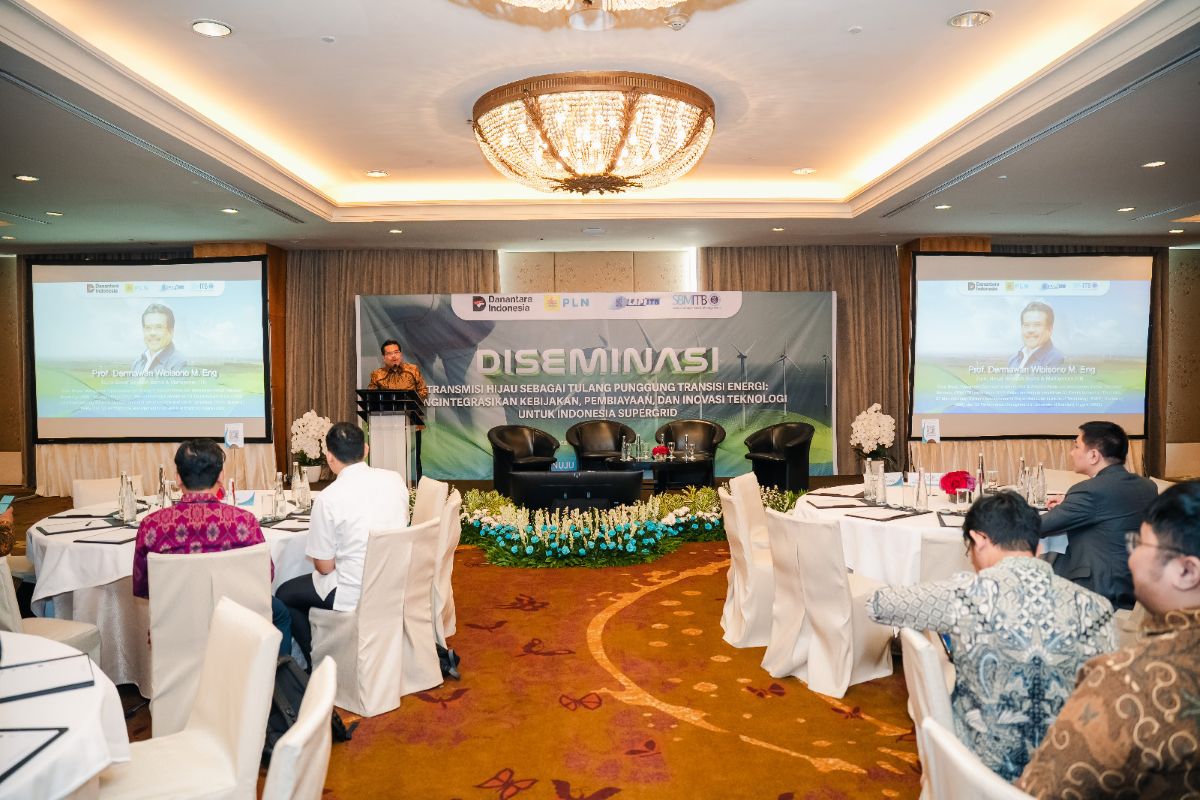
The acceleration of the energy transition towards a cleaner electricity system does not solely depend on the construction of new renewable energy (NRE) power plants, but also requires a transmission network capable of connecting energy sources with centres of electricity demand. Without adequate transmission infrastructure, the potential of clean energy scattered across various regions will be difficult to utilise optimally. This issue was a key focus of a dissemination seminar titled ‘Engineering Development Roadmap for Green Transmission in Supporting Accelerated Renewable Energy Development’. The forum brought together government, academics, PLN, technology providers, and industry players to discuss the readiness of Indonesia’s transmission system to support the accelerated use of renewable energy. Dermawan Wibisono, Head of the Green Transmission Engineering Roadmap Study Team, stated that the ambitious energy transition targets must be translated into a clear roadmap, covering technology choices, implementation stages, investment needs, and human resource capacity building. “We signed the Paris Agreement in 2015 and Indonesia is targeting Net Zero Emission by 2060. However, to get there, we must determine which technologies are most appropriate and need to be implemented immediately,” Dermawan said. According to him, the roadmap is an important instrument to ensure the energy transition targets do not stop at being a commitment but are truly realised through measurable steps. “We often convey grand goals, but how to achieve them is what must be detailed,” he said. Dermawan explained that Indonesia’s challenge lies not only in the magnitude of its renewable energy potential but also in the distribution of its energy sources, which are located far from electricity consumption centres. Solar energy potential is abundant in eastern Indonesia, geothermal is spread across various regions, while other energy sources are also located in different areas. This condition makes the transmission system a very decisive element for the success of the energy transition. “Our energy potential is scattered across various regions. Therefore, transmission technology capable of connecting all these energy sources to load centres is needed,” he said. One technology considered to have great prospects is High Voltage Direct Current (HVDC) for long-distance transmission and inter-island interconnection. According to Dermawan, this technology is worth preparing given Indonesia’s characteristics as an archipelagic nation. “We want to improve the efficiency of the transmission system. This requires collaboration between the government, the private sector, technology providers, and experts in Indonesia,” he said. However, he cautioned that the development of green transmission does not depend solely on technology. The biggest challenges lie in the need for substantial investment and the readiness of human resources. “Transmission requires very large costs and cannot be undertaken alone. Therefore, we need to learn from the best practices of other countries while preparing Indonesian human resources to master the technology,” he said. From PLN’s perspective, the development of green transmission is seen as a main component in building a future electricity system that is more reliable and capable of accommodating the increased use of renewable energy. Buyung Sofiarto Munir, Vice President of Transmission and Distribution Technology and Engineering at PT PLN (Persero), said the transmission network plays a role in connecting regions with renewable energy potential to areas that are centres of electricity consumption. “Green transmission is the link between areas rich in renewable energy sources and electricity load centres,” he said. He added that the electricity system must also be able to anticipate the intermittent nature of renewable energy generators, such as solar and wind power, thus requiring a more flexible network supported by digital technology. “Renewable energy is not always available at all times. The challenge is how the system can still reliably supply electricity to the public,” he said. According to Buyung, the engineering roadmap serves as a strategic guide in determining the direction of transmission technology development, digitalisation, and future smart grid construction. “The engineering roadmap is a compass for PLN in determining the future direction of transmission system development,” he said. He emphasised that transmission system planning must be carried out comprehensively, considering the location of power plants, electricity demand growth, industrial estates, data centres, system reliability, operational security aspects, and investment economics. “With careful planning, the investments made will truly provide benefits for the national electricity system,” he said. In line with the agenda of strengthening the national electricity system, PLN Enjiniring is also entering a new chapter through a change in its board of directors, which is expected to accelerate the company’s transformation. Anita Widyiastuti, Corporate Secretary of PLN Enjiniring, said the leadership change is a strategic momentum to strengthen corporate governance while enhancing PLN Enjiniring’s role as an engineering consulting company in supporting the development of electricity infrastructure and the national energy transition. Based on the shareholders’ decision, the new board of directors consists of Handy Wihartady as President Director, Ardhi Tartahadi as Director of Marketing and Business Development, Warsono as Director of Engineering, and Martono as Director of Finance, Risk Management, and Human Capital. According to Anita, the company will continue to strengthen its position as an Engineering Excellence Centre within the PLN Group by providing engineering solutions.