
Green Paddy Fields in the Heart of Yogyakarta City
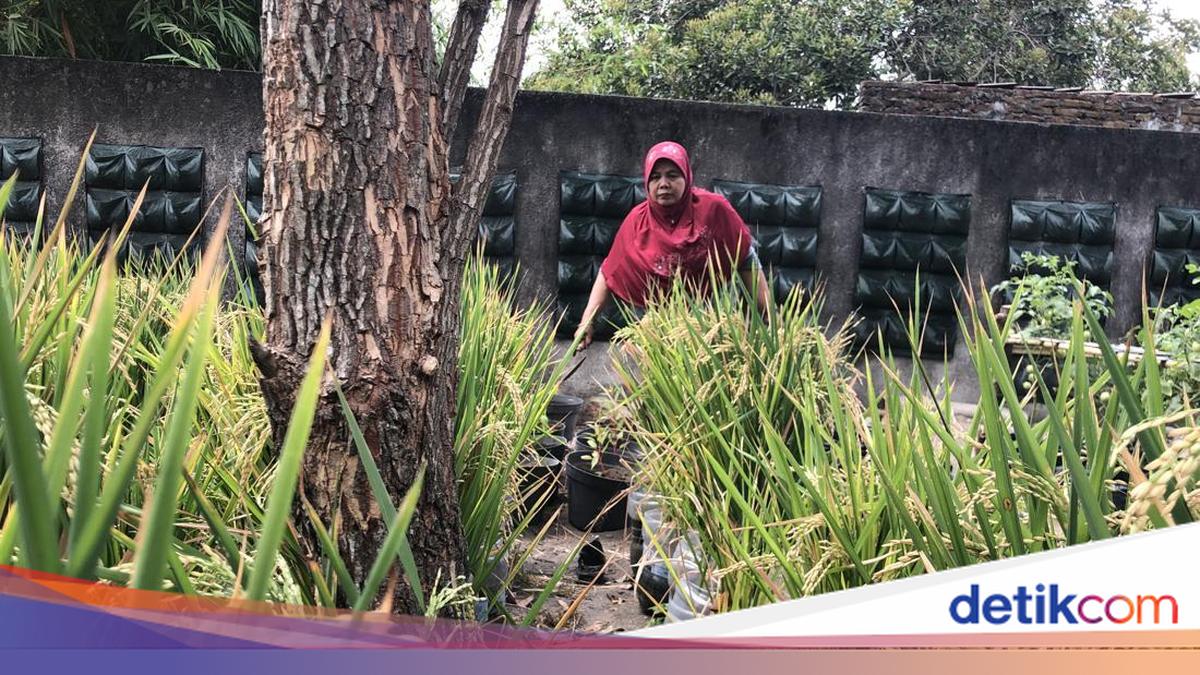
Amidst the dense residential areas of Yogyakarta City, vast expanses of paddy fields are usually a rare sight. However, a different atmosphere can be seen in Wiroblbrajan Village, where rice grows lushly not in traditional fields, but inside recycled plastic gallons.
These gallons are neatly arranged on land owned by the Swa Katon Asri Farmers Group. The rice plants currently around 90 days old have begun to turn yellow, indicating that harvest time is approaching.
The Swa Katon Asri Farmers Group has been developing urban farming for approximately two to three years. The Head of Wirobrajan Village, Budi Sutrisno, stated that the group initially focused on planting various types of vegetables.
Until a few months ago, they faced a new challenge and opportunity through assistance from Universitas Muhammadiyah Yogyakarta (UMY) to attempt rice cultivation using recycled gallons.
“The inspiration for rice farming actually came from UMY, to be fair. It was from Mr Agus, an agricultural lecturer. The initial inspiration from UMY was the suggestion: ‘Let’s do something different, try planting rice using gallons,’” Budi said at the Swa Katon Asri Farmers Group site on Friday (4/9/2026).
“UMY provided not only seeds but also funding, if I recall correctly, around Rp 6 million, because the needs extended to irrigation hoses and pipes. This was part of UMY’s community service programme for the region,” he added.
The Swa Katon Asli Farmers Group began planting rice in recycled gallons about three months ago. During the process, they received guidance from the Yogyakarta City Department of Agriculture and Food (DPP).
A field instructor from the Yogyakarta City DPP, Sugio, noted that this rice planting using gallons is the first project for the Swa Katon Asri Farmers Group. He is tasked with providing guidance and information regarding planting techniques.
“This is the first planting; it is 90 days old, so about 3 months. We use the ‘tabela’ method, which is direct seeding. The medium we prepare consists of soil and manure. The seed is just a single grain, soaked for two nights before being placed in the medium,” he explained.
The rice being planted is the Hybrid 32 variety. According to Sugio, this variety has a harvest period of approximately 110 days. He explained that maintaining rice in gallons is relatively easy, particularly regarding water management.
“Maintenance is very easy. Once planted, the important thing is to keep the water shallow. It doesn’t need to be deep or full,” Sugio explained.
“From planting until 30 to 40 days, the water should be kept at a low level. Since we only plant one seed per gallon, it will develop into multiple shoots. After about 40 days, we then introduce standing water.”
A single seed planted in one gallon will develop into dozens of stalks. Once it reaches maturity, one gallon can contain approximately 30 to 60 rice stalks.
Sugio noted that the cultivation process does not use chemical fertilisers or pesticides. The farmers group utilises manure and water from catfish farming as additional nutrients.
“We use manure, plus catfish water from our own livestock. We take the wastewater from the catfish ponds once it becomes murky and use it for irrigation. This way, nothing goes to waste,” he said.
According to Sugio, using gallons makes water and fertiliser management much easier compared to traditional paddy fields.
“Using gallons is very practical; water and fertiliser can be precisely controlled. With fertiliser, it doesn’t wash away. In a traditional field, during heavy rain or irrigation flow, the fertiliser can be washed away. Here, the nutrients are maximised and fully absorbed by the rice,” he continued.
Gallon-Grown Rice is No Less Than Field-Grown Rice
At 90 days old, Sugio admitted he has yet to find any weaknesses in the gallon planting method. In fact, he noted that the resulting grains are of high quality.
This was even noted by a visitor who owns a traditional paddy field using the same rice variety.
“To be honest, I haven’t seen any weaknesses yet. Even one of the visitors said, ‘Why doesn’t my field look like this?’ It turns out the rice in the gallons is not inferior to that in the fields,” Sugio revealed.
“The gentleman proved it himself, saying, ‘Why is my rice not like this?’ He has one hectare of the same variety, but this is better,” he added.
Currently, there are hundreds of gallons containing rice plants at the Swa Katon Asri Farmers Group site. The crop is expected to be harvested in about 10 days.
However, Sugio admitted he cannot yet confirm exactly how much rice will be produced from this inaugural planting.
“The harvest is at 110 days. We don’t know the exact yield yet. It should be in about 10 days,” Sugio concluded.
Source: jawawa.id (https://jawawa.id/newsitem/green-paddy-fields-in-the-heart-of-yogyakarta-city-1789185141)
Originally published by detikJogja (https://www.detik.com/jogja/berita/d-8659461/hijaunya-hamparan-sawah-di-pusat-kota-jogja), translated from Indonesian