
Green Fiscal for the Future: Optimising Carbon Tax as a Lifeline for National Economic Resilience
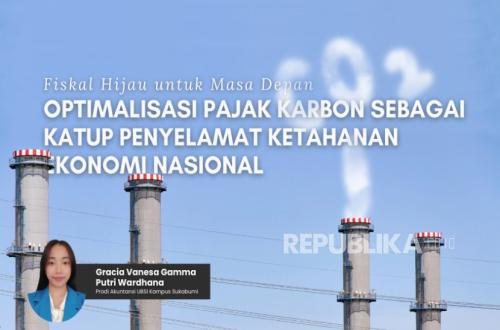
Global dynamics are currently caught in a whirlwind of extraordinary uncertainty. The climate crisis is no longer merely an environmental issue debated at seminars, but has transformed into a real threat to global economic stability, including Indonesia.
Amidst the shadows of a global recession and international market fluctuations, Indonesia is required to embrace economic independence. The primary foundation of that independence lies in the health of the state budget, where fiscal resilience serves as the final line of defence to ensure the domestic economy is not easily shaken by external shocks.
However, maintaining fiscal resilience in the modern era can no longer be achieved through conventional methods. To date, our state revenue structure remains too dependent on a narrow tax base and traditional business sectors that are vulnerable to market shocks.
If the government continues to rely on the same tax objects, the development process will certainly risk slowing down. Therefore, a more progressive concrete step is needed to expand the national tax base.
Through the optimisation of carbon tax instruments, Indonesia not only has the potential to tap into massive new sources of state revenue but also simultaneously addresses the global challenge of creating a sustainable green economic ecosystem.
The initial step in optimising the carbon tax as a new tax base must begin by targeting upstream industrial sectors that are the largest contributors to emissions. In Indonesia, fossil-fuel-based power generation and large-scale manufacturing industries, such as cement and steel, are business lines with massive economic turnover that have so far not been charged for the environmental externalities they produce.
Based on the government’s designed carbon economic value roadmap, the imposition of an initial rate of Rp 30,000 per tonne of carbon dioxide equivalent (CO2e) is a very strategic figure. This taxation sector will not kill commercial industries.
On the contrary, this policy will instead serve as a new incentive for corporations to transition to environmentally friendly technologies, while simultaneously opening the door to state revenues that have remained untouched until now.
Through the expansion of the tax base into this green sector, Indonesia can enjoy a ‘double dividend’ effect that directly impacts the strengthening of fiscal resilience. The first benefit is the regulatory function (regulerend), where the carbon tax acts as a controlling instrument that forces industries to reduce their pollution emissions independently.
The second benefit, which is equally crucial for the state budget, is the revenue function (budgetair). Through this function, fresh revenue collected from the carbon tax can be directly recycled (tax recycling) to fund national strategic projects, such as the development of renewable energy infrastructure or providing incentives for electric public transport.
Thus, the government will no longer need to continuously rely on foreign debt or increase tax rates for the lower class of society to maintain the stability of the State Budget (APBN) amidst global dynamics.
Looking at the international arena, the effectiveness of carbon taxes in strengthening fiscal resilience and controlling emissions has been proven by several neighbouring countries. Singapore, for example, became the first country in Southeast Asia to successfully implement this policy since 2019. The fresh funds collected from that tax are consistently reallocated to support local industries in adopting low-carbon technologies. This success serves as clear evidence for Indonesia that green fiscal policy will not slow down the wheels of the economy if managed with the right strategy.
Conversely, adopting a similar model domestically will provide legal certainty for global investors who are increasingly selective and tend to prioritise countries with a clear commitment to sustainable development.
Although the revenue potential is very promising, the implementation of a carbon tax in Indonesia certainly faces real challenges. One of them is the concern of business players regarding the swelling of production costs, which could reduce the competitiveness of local industries.
To overcome this issue, the government needs to apply the principle of fiscal fairness through inclusive transition policies. The application of rates should indeed be carried out gradually and selectively. The government could provide exemptions or tax incentives for industries that are truly serious about reducing their emissions. Additionally, the integration of a transparent and digital-based emission reporting system is absolutely necessary to minimise loopholes for tax avoidance.
With this measured approach, the expansion of the tax base will not become a frightening burden, but rather a shared strategic investment towards environmentally conscious economic growth.
Ultimately, expanding the tax base through the optimisation of carbon tax is no longer merely an alternative choice, but an urgent necessity to maintain Indonesia’s fiscal resilience amidst global dynamics. Through this green fiscal strategy, the government can address two major challenges simultaneously: securing new, independent sources of state revenue without burdening the small community, and accelerating the transition towards a cleaner economic ecosystem.
Field challenges clearly cannot be avoided. However, if there is transparent collaboration between the government and industry players, this policy will certainly become a solid stepping stone. The future of Indonesia’s economy should no longer be measured solely by how much revenue is successfully collected, but by how sustainable the methods of obtaining that revenue are for the prosperity of future generations.
Source: jawawa.id (https://jawawa.id/newsitem/green-fiscal-for-the-future-optimising-carbon-tax-as-a-lifeline-for-national-economic-resilience-1781178941)
Originally published by Republika (https://news.republika.co.id/berita/tggrq2472/fiskal-hijau-untuk-masa-depan-optimalisasi-pajak-karbon-katup-penyelamat-ketahanan-ekonomi-nasional), translated from Indonesian