
Green Economy Driven by Integration from Agriculture to Carbon Projects
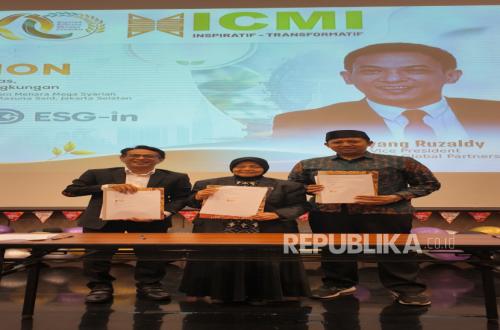
The development of a green economy requires an ecosystem that connects the agricultural sector, supply chains, communities, technology, and financing. Measuring impact is also crucial to ensure that sustainability activities do not merely remain environmental programmes but evolve into economic activities that provide value to society.
Efforts to build this ecosystem are being undertaken through a collaboration between PT ESGIN Global Partners (ESGIN), Koperasi Pangan Cendekia Indonesia (KPCI), and Koperasi Kencana Darma Cendekia (KKDC). The three parties have signed a Memorandum of Understanding (MoU) covering the development of sustainable agriculture, food supply chains, the circular economy, environmental digital technology, green projects, climate projects, and community empowerment.
The collaboration is directed towards building connectivity from upstream to downstream. KPCI will strengthen the network of farmers, farmer groups, cooperatives, regions, and potential agricultural commodities, while KKDC will focus on the supply chain, distribution, marketing, market access, and consumer networks.
ESGIN will support the technological aspect through the ESG-in platform, traceability, environmental impact measurement, and Digital Measurement, Reporting, and Verification (Digital MRNA). This infrastructure can be utilised to identify the potential for green projects, climate projects, and greenhouse gas emission reduction projects.
Vice President of PT ESGIN Global Partners, Yayang Ruzaldy, stated that the transformation towards a green economy must be accompanied by the readiness of talent that understands the link between economic growth and environmental sustainability.
“Future talent must understand that economic growth and environmental sustainability are not two separate agendas. Our children today will become the entrepreneurs, professionals, consumers, leaders, and decision-makers of the future,” said Yayang during the National Green Education Seminar in Jakarta on Thursday.
According to him, green education needs to move from understanding towards measurable action. Activities such as waste and food waste reduction, energy and water efficiency, and participation in the circular economy can become part of ‘Green Action’.
“Green Education must move from knowledge to action. We need to provide space for the younger generation to engage in real activities,” he added.
The agricultural sector is a primary focus as it is directly related to food security as well as the use of land, water, energy, biomass, organic waste, and greenhouse gas emissions. The mapping of farmers, commodities, regions, and agricultural practices will be part of the collaborative development.
The development of contract farming can also be used to strengthen the relationship between farmers, production certainty, cooperatives, supply chains, and markets. For agricultural activities with potential for climate change mitigation or emission reduction, further studies can be conducted to explore opportunities for development as green projects, climate projects, or carbon projects in accordance with applicable regulations.
On the other hand, the circular economy will be developed through community involvement and the Waste Bank Unit (BSU) network. Driven activities include waste sorting, recycling, material reuse, food waste reduction, and other environmental activities.
Developing a green economy also faces the need to ensure that the impact of various programmes can be proven through data. Therefore, Digital MRV is directed to support the recording, monitoring, traceability, measurement, reporting, and verification of environmental activities.
A data-driven approach is necessary because environmental activities cannot simply be claimed to provide benefits. Every activity requires adequate indicators, methodologies, and measurement systems. Specifically for carbon projects, the development process must still meet the requirements for methodology, baseline, additionality, emission calculation, MRV, validation, verification, registration, and applicable regulations.
As a follow-up, the three parties may form a working team to map the potential of farmers, farmer groups, commodities, cooperatives, communities, Waste Banks, supply chains, markets, as well as potential green and climate projects. The results of this mapping will serve as the basis for determining priority programmes and potential pilot projects.
This collaboration is part of the National Green Education Seminar, which also involved Bank Mega Syariah. The event brought together elements of education, cooperatives, industry, communities, the Sharia financial sector, technology, and green economy actors to encourage the implementation of sustainability in real-world activities.