
Green Alms and Charity
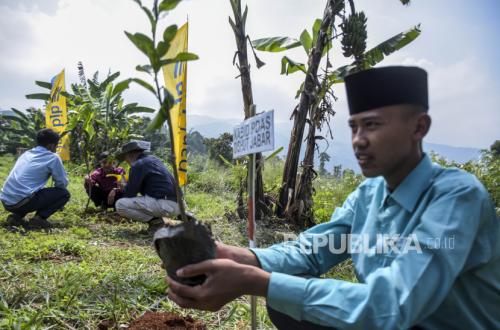
Amidst the intensifying debates regarding climate change, global warming, and the alarming environmental crisis, the world is sending a clear message: the Earth is in distress. Forests are shrinking, rivers are polluted, air quality is deteriorating, and ecological disasters are occurring with increasing frequency across all borders.
Indonesia is no exception to this reality. Forest fires, flash floods, landslides, river pollution, and clean water crises have become increasingly common sights. Ironically, much of this damage is not merely a natural process but the result of human activities that have exceeded sustainable limits.
While various solutions are being offered—such as the development of green technology, stricter environmental regulations, and intensified conservation campaigns—a fundamental question must be asked: is the environmental crisis solely a matter of technology and policy?
Many thinkers argue that the deepest root of the ecological crisis is actually a moral and spiritual crisis. When humans view nature solely as an economic object to be exploited without limit, destruction becomes inevitable.
This is where religion plays a vital role. In the Islamic view, the relationship between humans and nature is never meant to be exploitative. The Qur’an positions humans as ‘khalifah’ (stewards) on Earth—beings entrusted to protect, manage, and prosper the Earth with full responsibility. This concept differs significantly from the modern paradigm that often places humans as absolute masters over nature. Islam teaches that everything in the heavens and the earth belongs to Allah, while humans are merely temporary trustees.
This awareness gives rise to what is known in contemporary studies as Islamic ecotheology—a perspective that links faith in Allah with responsibility towards the environment. From this perspective, protecting the environment is not merely a social activity but a form of worship. Damaging nature is seen as a betrayal of Allah’s trust, whereas preserving it is an act of obedience.
It is time to re-examine the meaning of ‘infaq’ (alms) and ‘sedekah’ (charity). Traditionally, these terms evoke images of helping the poor, building mosques, or supporting orphans. While these are noble, the Qur’an speaks of infaq in a much broader sense: spending wealth in the path of Allah to bring about public welfare. Similarly, sedekah is not limited to material gifts but encompasses any good deed that benefits Allah’s creatures. The Prophet Muhammad (PBUH) even noted that if a Muslim plants a tree or a plant that is eaten by humans, birds, or animals, it serves as charity for them.
This has led to the emerging concept of ‘Eco-Sadaqah’ or ‘Green Charity’—an expansion of Islamic philanthropy directed towards environmental preservation. This can take many forms: planting trees for reforestation, building wells for water-scarce communities, funding mangrove and forest conservation, supporting community-based waste management, or developing renewable energy for Islamic boarding schools (pesantren).
Indonesia possesses immense potential for Islamic philanthropy. The funds collected annually through zakat, infaq, sedekah, and waqf are significant. If even a small portion of these funds were directed towards environmental programmes, the impact on the nation’s future would be profound. Imagine if thousands of mosques in Indonesia implemented tree-planting programmes, or if zakat institutions funded river rehabilitation. Islamic philanthropy could thus move beyond poverty alleviation to actively helping to save the planet.
The greatest challenge is not a lack of Islamic teaching regarding the environment, but rather how to transform that understanding into tangible action. Ecological awareness must become an integral part of Islamic education, preaching, and philanthropic programmes. We must begin to view environmental protection not as an additional agenda, but as a fundamental part of practicing the Islamic faith.