
GREAT Institute: 6 Percent Growth Must Be Underpinned by Productivity and Spending Quality
The 2027 State Budget Draft (RAPBN) is seen as carrying an ambition of 6 percent economic growth with a more controlled deficit. However, the target is considered highly dependent on increased productivity, spending quality, and the government’s ability to execute structural reforms.
GREAT Institute economic researcher Adrian Nalendra Perwira said the 2027 RAPBN shows a shift in approach in positioning the state budget, not only as a state financing instrument but also as a tool to strengthen production capacity, improve spending efficiency, and encourage growth that is more widely felt by the public.
“President Prabowo’s Financial Note speech shows a consistent paradigm. The state must be strong, but that does not mean the market is shut down. In fact, a healthy market requires a state capable of providing good data, clear rules, efficient procurement, basic infrastructure, a credible capital market, and protection for the people,” Adrian said in a statement on Saturday (15/8).
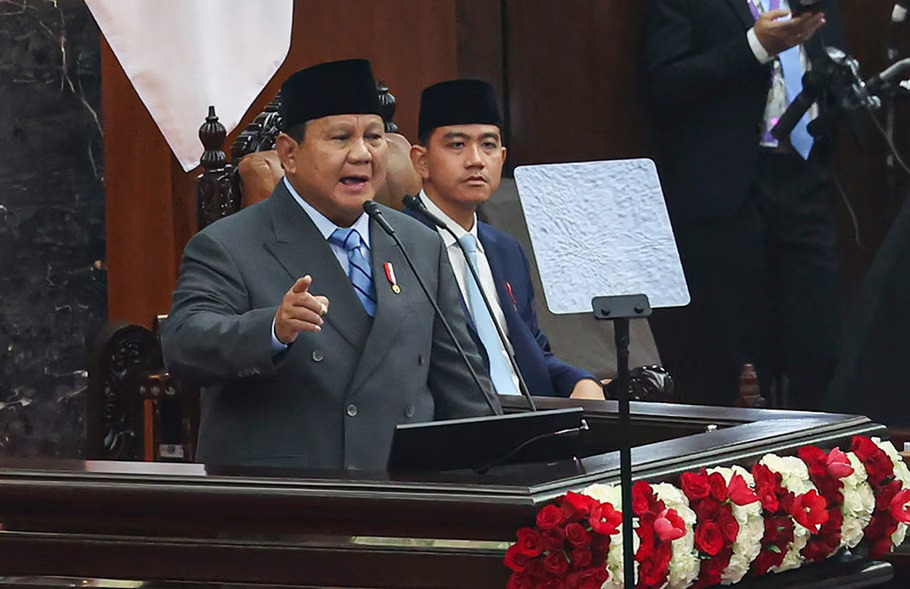
The statement responded to the Government’s Statement on the Draft Law on the 2027 State Budget and the Financial Note delivered by President Prabowo Subianto at the DPR/MPR Building, Senayan, Jakarta, on Friday (14/8).
In the 2027 RAPBN, the government targets state revenue of Rp3,426 trillion and state spending of Rp4,097.2 trillion. Financing is targeted at Rp671.2 trillion with a budget deficit of 2.40 percent of gross domestic product (GDP), lower than the 2026 state budget deficit of 2.68 percent of GDP.
According to Adrian, the combination of a higher growth target, still-expansive spending, and a lower deficit is the main characteristic of the 2027 RAPBN.
“In nominal terms, spending does increase, but the government is not trying to fund 6 percent growth with a larger deficit. Assuming 2027 GDP of around Rp27,987 trillion, state spending is equivalent to around 14.6 percent of GDP, slightly lower than 14.94 percent in the 2026 state budget. So the real bet is higher bang for the buck: spending quality, investment productivity, and the state’s ability to leverage private capital,” Adrian said.
The government targets 2027 economic growth of 6 percent, higher than the 2026 state budget target of 5.4 percent. In addition, the government has set an inflation target of 2.5 percent, a 10-year government bond yield of 6.9 percent, an exchange rate of Rp17,500 per US dollar, an Indonesian crude oil price of US$75 per barrel, oil lifting of 610,000 barrels per day, and gas lifting of 954,000 barrels of oil equivalent per day.
Adrian assessed that the 6 percent growth target can still be achieved, but not through a business-as-usual scenario. He noted that economic growth reached 5.61 percent in the first quarter of 2026 and slowed to around 5.29 percent in the second quarter.
“If ICOR remains high, 6 percent growth will be very expensive because we need more and more capital to produce the same additional output. Therefore, the investment debottlenecking agenda must be expanded into real structural reform: simpler licensing, land certainty, cheaper logistics, reliable energy, synchronised central-regional regulations, and rapid resolution of investment barriers. Debottlenecking working groups or task forces must not only extinguish cases one by one, but must reduce systemic barriers that make investment expensive and output low,” Adrian said.
According to him, increased productivity must also be reflected in the labour market. Investment, Adrian said, needs to be directed not only to create jobs but also to produce formal, productive jobs that provide skills and open opportunities for income improvement.
“With the majority of workers still in the informal sector, 6 percent growth will lose much of its meaning if it does not accelerate the transformation of job quality. Investment must be connected to vocational training, industry-based training, formalisation of MSMEs, and increased labour productivity,” Adrian said.
GREAT Institute also highlighted the development targets in the 2027 RAPBN. The government targets the poverty rate to fall to 6.0-6.5 percent, the open unemployment rate to 4.30-4.87 percent, the Gini ratio to 0.362-0.367, and the human capital index to reach 0.575.
Adrian said these indicators show that the success of the RAPBN cannot be measured solely by high economic growth.
“Good growth must be visible in the labour market. The measure is not only incoming investment, but whether investment creates good jobs, namely formal, productive, decently paid, and protected jobs. If growth rises but job quality does not improve, the benefits of development will not be widely felt,” Adrian explained.
One agenda considered important by GREAT Institute is government procurement reform. President Prabowo conveyed a plan to consolidate the procurement of goods and services and strengthen the Government Goods/Services Procurement Policy Institute (LKPP) into a government procurement agency.
According to Adrian, procurement consolidation can increase the government’s bargaining power as a buyer while creating efficiency through economies of scale.
“The approach has a strong economic basis. Consolidation can produce economies of scale, strengthen buyer bargaining power, reduce price variation for similar specifications, and facilitate transparency and oversight. But savings must be calculated from transactions that are truly comparable in specification, quality and service. Centralisation must also not reduce competition, kill efficient suppliers in the regions, or simply move the bottleneck from many places to one place,” Adrian stressed.
GREAT Institute also assessed that the plan to establish a mineral and strategic commodity exchange can strengthen price transparency and reduce potential leakage of export value.
The President said the exchange is targeted to begin operating on 1 Janu
Source: jawawa.id (https://jawawa.id/newsitem/great-institute-6-percent-growth-must-be-underpinned-by-productivity-and-spending-quality-1786816216)
Originally published by Media Indonesia (https://mediaindonesia.com/ekonomi/922292/great-institute-pertumbuhan-6-persen-harus-ditopang-produktivitas-dan-kualitas-belanja), translated from Indonesian