
Great Ideas Alone Are Not Enough: Businesses Must Live by Execution
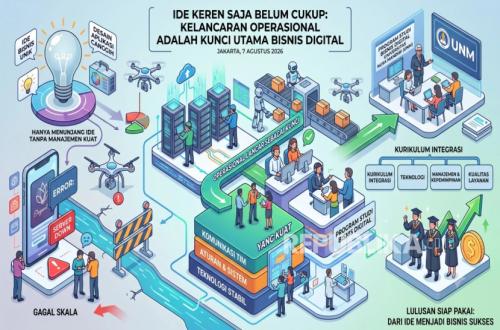
In the midst of digital economy euphoria, we are often too easily captivated by an idea. An application that looks sophisticated, a business concept deemed unique, or a viral digital campaign is frequently seen as a ticket to success. Yet a business does not live from ideas alone. A business lives from execution.
Many ventures are born with promising ideas, but not all are able to survive when customer numbers increase, market demands change, and operational problems begin to emerge. It is at that point that the difference becomes visible between a business that merely has an idea and a business that truly has a system.
In my view, this is one of the important issues that the younger generation needs to understand when entering the digital business world. We must not be too busy creating something that looks impressive while forgetting to ensure how the business runs on a daily basis.
Imagine a digital platform that succeeds in attracting the attention of thousands of users. Its promotion goes viral, its design is attractive, and its product receives a positive response. However, when users begin to flood in, the server is not ready. Orders are processed late. Customer complaints are not handled promptly. Communication among team members does not run well.
In such a situation, impressive technology loses its meaning. Consumers ultimately judge not only what a business promises, but also what they experience when using the product or service. Speed of response, accuracy of service, product availability, system security, and the company’s ability to solve problems all become part of the customer experience.
This means operations are not backstage work that can be underestimated. Operations are the face of the business when dealing with consumers. The larger a business becomes, the greater the need for a structured operational system. When customers increase, products multiply, teams grow, and transactions become more complex, a company can no longer rely on improvisation.
This is where management capability becomes important. There is a tendency to regard technology as the answer to almost all business problems. Artificial intelligence, automation, cloud computing, big data, and various digital technologies can indeed improve efficiency. However, technology remains a tool.
Without people who are able to design processes, make decisions, manage risk, lead teams, and understand customer needs, technology does not automatically produce a healthy business.
A digital business leader must understand how to build workflows, divide responsibilities, measure performance, maintain service quality, manage resources, and ensure every part of the organisation moves towards the same goal. In other words, innovation requires a system so that it does not stop at being an experiment.
This issue is also a challenge for higher education. Digital business education must not stop at the ability to use technology or create digital products. Students need to understand how a product is managed after it is launched.
They need to learn to face problems that may arise as the business grows: how to manage a team, maintain service quality, read operational data, make decisions based on market conditions, and build business processes capable of withstanding change.
Based on this thinking, the Digital Business Study Programme at Universitas Nusa Mandiri (UNM) continues to develop learning that brings together technological capability and management capability. Students are not only directed to become creators of ideas, but are also prepared to become problem solvers, business managers, team leaders, and designers of digital solutions.
I believe that digital business education must be able to answer the real needs of industry. The world of work needs talent who can not only say, ‘I have an idea’, but can also answer the next question: ‘How is that idea executed, developed, measured, and sustained?’ It is this second question that often distinguishes a project from a business.
In the era of digital competition, creating a product is indeed important. However, maintaining product and service quality consistently is far more challenging. A business that is able to run its operations well has a foundation for growth. Conversely, a business with an extraordinary idea but a chaotic system will struggle to maintain customer trust.
For that reason, I would like to invite the younger generation to change their perspective on digital entrepreneurship. Do not only ask, ‘What can I create?’ Start asking, ‘How do I ensure that what I create truly delivers value and is able to endure?’ It is this second question that needs to be taught and practised more widely.
Because the world does not lack people with ideas. The world needs more people who are able to turn ideas into solutions that actually work. As a Digital Business Campus, Universitas Nusa Mandiri (UNM) believes the future generation must possess two strengths at once: the courage to innovate and the ability to execute. Technology provides opportunity, ideas open the way, but it is management and operations that enable a business to run, grow, and endure.
So do not stop at dreaming of building a digital business. Learn how to run it, build its systems, measure its impact, and then dare to develop it. It is time to turn ideas into work, and dreams into achievement.