
GRC Not Just Compliance, TGI Proves Its Impact on Business Performance
As a company that has managed the Grissik–Duri pipeline network since 2002 and the Grissik–Singapore pipeline since 2004, and for more than two decades has maintained the reliability of natural gas transportation infrastructure for both domestic and export needs, PT Transportasi Gas Indonesia (TGI) continues to strengthen that trust by implementing Governance, Risk and Compliance (GRC). GRC is no longer positioned merely as a defensive compliance function.
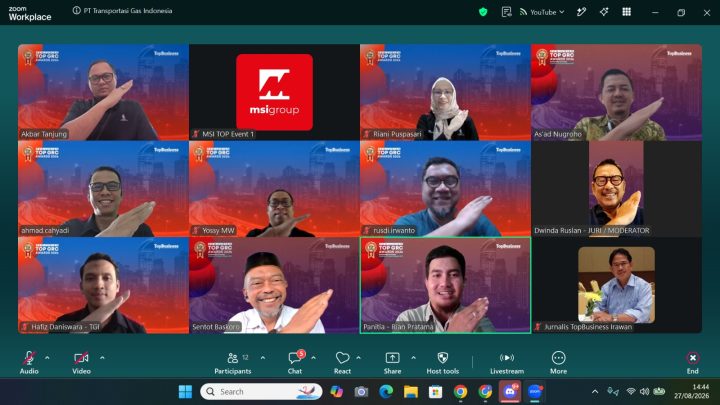
This was conveyed by TGI President Director Ahmad Cahyadi during the judging of the TOP GRC Awards held online in Jakarta on Thursday (27/8/2026). Also present at the judging were DH RMCG Akbar Tanjung, GCG Officer Riani Puspasari, RMCG Assistant Hafiz Daniswara, and CSR SH Relation Officer Yossy Meidi.
According to Ahmad Cahyadi, GRC has developed into a strategic driver that strengthens organisational resilience while creating competitive advantage.
“One of the emphases is cross-sector alignment, namely synergising business development plans with shareholder aspirations and the group’s business portfolio, developing the business through collaboration with strategic partners, and strengthening employee capabilities through an agile mindset, cross-functional collaboration, coaching and feedback,” said Ahmad Cahyadi.
To implement GRC, TGI uses the Three Lines Model. The first line is carried out by each department, which is responsible for ensuring a conducive control environment, implementing GRC policies and risk management, considering risk factors in every decision and action, and executing internal controls effectively.
The second line is carried out by the Corporate Secretary, RMCG, Legal and HSSE, which develop and monitor the overall implementation of Governance, Risk and Compliance. Meanwhile, the third line is carried out by Internal Audit through review and evaluation of the design and implementation of internal controls, while ensuring the first and second lines operate as expected.
In facing risks and supporting the company’s sustainability systematically and innovatively, TGI has built risk management to create a proactive culture. The framework includes the Corporate Risk Management Manual, the HSSE–HEMP Manual, and security risk assessment procedures. In addition, there are ICT Policy and Cyber Security, risk capacity and appetite, a corporate risk management application, HAZOP/HAZID, risk taxonomy, risk maturity measurement, and Risk Based Audit & Budgeting.
The company also integrates this with the technical characteristics of the gas industry through, for example, the Pipeline Integrity Management System (PIMS) and Facility Integrity Management System (FIMS). All of these approaches demonstrate that GRC at TGI is translated into risks that genuinely confront business operations.
Understanding that digital transformation is an important part of supporting GRC, TGI ensures the availability of reliable communication networks. In addition, it provides an internal portal that is easily accessible to employees for company information and documents, ICT equipment, electronic data security, cyber risk mitigation, backup data centre and network storage systems, and officially licensed software. ICT personnel support is also available at both head office and regional levels.
Furthermore, digitalisation has also entered business processes and operational supervision. TGI uses PIMS, FIMS, CGOLS (Compliance & Governance Application), HRIS-Greatday, E-Procurement and SMART as applications for internal and external correspondence. The ICT system has also been developed to support monitoring of project activities through CCTV that can be monitored remotely. The company has even begun developing Agentic AI to assist with risk measurement.
To build awareness and compliance across all levels, from the Board of Commissioners, Board of Directors, employees to other related parties, TGI also implements Good Corporate Governance (GCG). The implementation of GCG is supported by various governance instruments. These include the Board Manual, GCG Manual, Anti-Bribery Management System ISO 37001, procedures for giving and receiving gifts, and a Code of Conduct for employees.
The implementation of GCG is also strengthened through monitoring of the Whistleblowing System, management of reports according to SLA, monitoring of regulatory developments, and GCG assessments. These assessments refer to, among others, the Minister of State-Owned Enterprises Decree SK-16/S.MBU/2012 and the ASEAN Corporate Governance Scorecard (ACGS). In addition, in the area of internal control, TGI implements Internal Control over Financial Reporting (ICOFR).
TGI positions ESG as a strategic investment to maintain long-term business resilience. This commitment is articulated through the Sustainability Focus and Roadmap 2025–2033, formulated with direct leadership from the Board of Directors and Board of Commissioners. This roadmap serves as a guide to achieving clear and measurable sustainability targets.
One reflection of this commitment is the sustainability of low-emission operations. In 2025, TGI recorded operational emissions of 54,274 tonnes of CO₂, or 94% of the estimate. On the future business development side, the company signed a Heads of Agreement for Biomethane with buyers and suppliers on 15 December 2025 and is developing the Bangkanai Pipeline project.
“These initiatives demonstrate TGI’s efforts to prepare the business for entering more environmentally friendly energy developments,” said Ahmad Cahyadi.
Many achievements have been recorded through the implementation of GRC at TGI, covering safety, environment, customers, finance and corporate performance. In 2025, the company recorded zero fatalities with 2,122,094 safe working hours in 2025, or more than 34 million cumulative safe working hours. The customer satisfaction index reached 91.48, which falls into the very satisfied category.
Revenue was recorded at USD143.86 million, up 14.65% from target, while net profit reached USD71.62 million, up 28.99% from target. Across the four Balanced Scorecard perspectives—Shareholder, Customer, Internal Process, and Learning & Growth—TGI achieved a final KPI score of 106.12%.
On the governance side, TGI successfully maintained a ‘Very Good’ rating in the 2025 GCG assessment using SK-16 BUMN, ACGS and PUGKI. The company also maintained ISO 9001:2015, ISO 37001:2016, ISO 45001:2018 and ISO 14001:2015 certifications. In addition, its environmental management commitment received recognition through PROPER Biru for the Jabung Compressor Station and PERCA Biru for the Panaran Station from PT Pertamina (Persero).
“Reflecting on all these achievements, the success of TGI’s GRC is not merely about successfully meeting rules or obtaining certifications, but when governance, risk and compliance are connected to infrastructure reliability, occupational safety, customer satisfaction, efficiency, sustainability and financial results,” concluded Ahmad Cahyadi.