
Grand Dies Natalis 2026: ITB’s HMO Triton and HMME Atmosphaira Host Discussion
BANDUNG — Indonesia has significant maritime potential, from fisheries and seaweed to renewable energy. But these resources will not make the maritime sector an engine of economic growth without support from research, technology and sustainable management.
Deputy Minister of Marine Affairs and Fisheries Irwan Meilano made the remarks at the Grand Summit Dies Natalis event held by ITB’s HMO Triton and HMME Atmosphaira at the university’s East Hall on Saturday (10 October 2026).
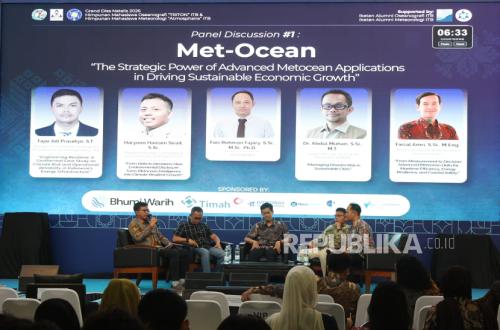
To mark their 2026 anniversary, the two student associations hosted a discussion featuring the deputy minister and experts in their respective fields. Speakers offered views on the challenges facing the meteorology and oceanography (metocean) industry. The discussion was held in two sessions.
“The future of ocean management depends greatly on how intelligently we understand the sea. The ocean is a productive space that sustains our lives. We must therefore be able to anticipate climate change, various threats, production uncertainty and investment risks,” Irwan said.
He said research was key to tracking changing ocean conditions and formulating appropriate policy. The sea holds economic potential, but also presents challenges including climate change, uncertain production and investment risks.
Irwan said conservation was a key element of the blue economy. Maximising the ocean’s potential cannot mean simply increasing resource extraction; it must also involve protecting the sustainability of its ecosystems.
Marine protected areas need to be expanded so the sea can remain a healthy habitat for coral reefs, endangered species and different kinds of fish, he said. “If we want to increase production from the sea, we must ensure that there are conservation areas,” he added.
Echoing Irwan, Faisal Amri, technical director of PT Bhumi Warih Geohydromatics, said comprehensive data management and provision in the maritime and environmental sectors were essential to sustainable development and disaster-risk mitigation in Indonesia. He made the remarks during the first session, titled “The Strategic Power of Advanced Metocean Applications in Driving Sustainable Economic Growth”.
Amri also stressed that young people and academics in oceanography should take an active role in national maritime development. However, he said the industry continued to face a key challenge: limited and uneven availability of meteorological and oceanographic data across regions.
“Not every region has complete data to enable comprehensive analysis of local phenomena. Awareness of the importance of measurement needs to keep growing so we have a strong basis for planning development and accurately simulating disaster risks,” said Amri, as he is commonly known.
In the renewable energy sector, environmental data is also crucial to mitigating operational risks. Fajar Adi Prasetyo, environmental sustainability manager at PT Pertamina Geothermal Energy Tbk (PGE), said the geothermal industry, which is generally located in areas with high rainfall, depended heavily on accurate precipitation and weather data.
“Most of Indonesia’s geothermal potential is located in areas at high risk of landslides. Rainfall and meteorological data help PGE mitigate those risks. In addition, climate-related risk disclosure has become a required standard for publicly listed companies, as demanded by the market,” Fajar said.
Haryono Hansen Sirait, regional manager consultant at the Carbon Disclosure Project (CDP), said global investors were increasingly focused on transparency around environmental impact data. Hundreds of international investors now require companies in their portfolios to report environmental impact data openly and independently.
“Investors want to see how environmental risks and climate change could affect their business assets. Meteorological and oceanographic data provide the fundamental basis for measuring hazards and potential financial losses at project sites,” Hansen said.
The second session, titled “The Strategies Towards Advanced Coastal Development”, focused on coastal erosion. Mohammad Irfan Saleh, deputy for financing and investment development in the maritime sector, said responses to coastal erosion in Central Java had been unable to keep pace with the escalation of the disaster. The government was therefore accelerating its efforts through a combination of technical measures and sustainable investment.
“Our response has been far slower than the pace of the disaster. We have tried to protect the coast with seawalls, but that is much slower than the erosion, which is happening very quickly in Demak,” he said.
Irfan said that, at the President’s direction, the coastal protection project had been designed to accelerate protection along hundreds of kilometres of coastline on Java. In Sayung, the strategy would not rely solely on hard structures, but would combine them with nature-based solutions such as mangrove planting, as well as coastal and sea walls.
Mark van Zanten, president director of PT Haskoning Indonesia, said erosion along Java’s coast was a major problem requiring careful planning and an integrated range of solutions.
“This is a major problem, but I can see that a great deal of planning has already been done. The most important thing is to establish an effective coastal management policy to combat erosion,” Mark said.
He said there could be no single approach to protecting coastlines; technical solutions had to be combined according to local conditions. These could range from nature-based measures such as planting mangroves to physical infrastructure such as sea walls and coastal dikes.
“Sometimes the solution is to plant mangroves; sometimes it is to build a dike. The solutions differ, but what is needed is good planning and funding to address the problem,” he said.
Mark said the government and experts were working together to develop a long-term coastal development plan. The next important steps, he said, were to allocate state budget funding and attract investment to implement the projects.
Source: jawawa.id (https://jawawa.id/newsitem/grand-dies-natalis-2026-itbs-hmo-triton-and-hmme-atmosphaira-host-discussion-1791640272)
Originally published by Republika (https://news.republika.co.id/berita/tmp0rq430/grand-dies-natalis-2026-hmo-triton-dan-hmme-atmosphaira-itb-gelar-diskusi), translated from Indonesian