
Govt, UI Launch Programme to Mobilise Economic Value of Mangroves
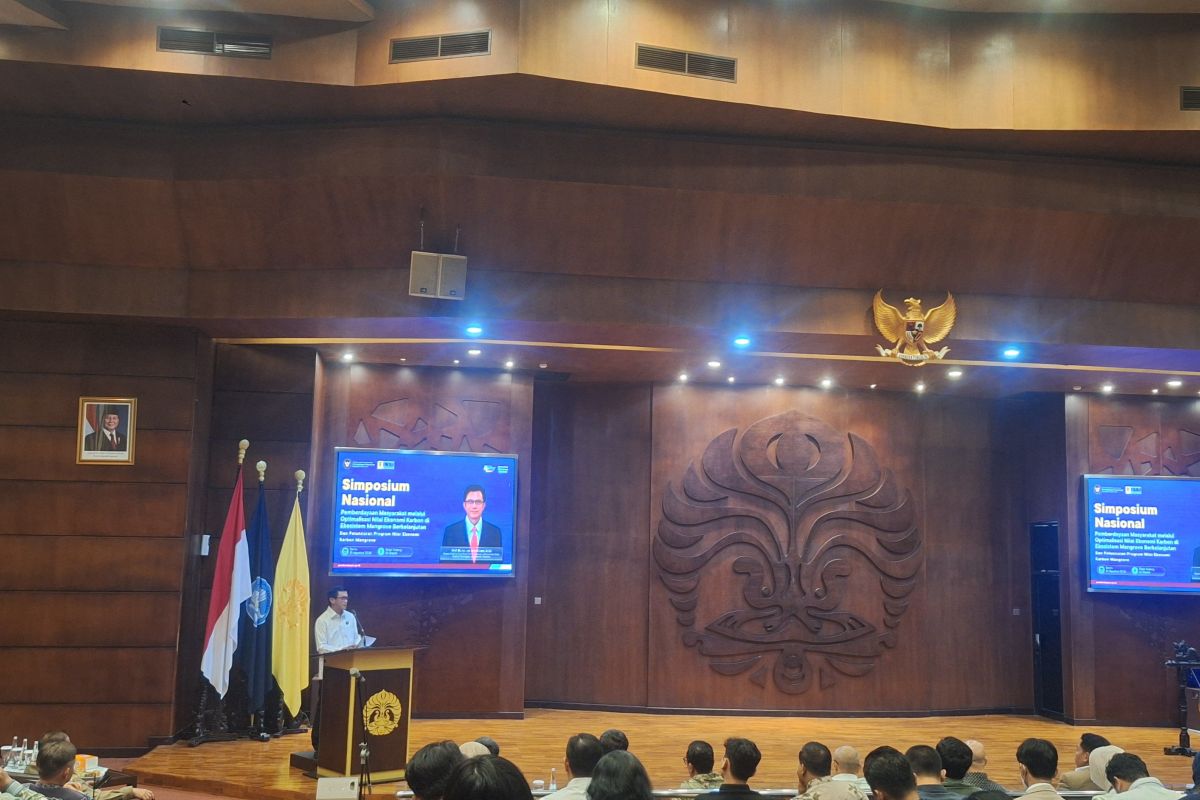
Depok (ANTARA) - The Coordinating Ministry for Community Empowerment (Kemenko PM) and the University of Indonesia (UI) have launched a programme to mobilise the economic value of mangroves, directed at community empowerment.
“Why are mangroves a crucial point? Because it turns out our mangroves account for almost 20 per cent of the world’s total, or nearly 3.4 million hectares,” said Abdul Haris, Deputy for Coordination of Village, Disadvantaged Village, and Special Village Empowerment at Kemenko PM, at the UI Campus Convention Hall in Depok, West Java, on Monday.
According to him, it is important to understand that mangroves can absorb carbon, while our industries along the Java ring are densely packed. These industries emit carbon. He questioned what incentives exist for industries that have caused pollution, while communities and the government work to preserve mangroves.
“There should be incentives. Perhaps we in the government, particularly the coordinating ministry, in cooperation with the technical team, because mangroves fall under the Ministry of Forestry and also the Ministry of Environment, will try to work together. We can issue policies that support the optimisation of empowerment or the utilisation of the economic value of mangroves. Hopefully, after this launch, the UI team and our team will prepare the various instrument requirements,” he said.
For example, he said, if local governments need to issue regional regulations (perda), his party will also help to jointly oversee the process. He noted that this is indeed a task requiring high performance and sustainability.
Furthermore, Abdul Haris stated that this launch is an initial step, particularly with UI, to work on how to utilise the economic value of these mangroves. Along the North Coast of Java, from Cirebon to Probolinggo, there are approximately 33 district/city local governments.
Haris explained that from Tegal, Pemalang, Semarang, to Demak, there are points where mangroves are also hindered. This could be a potential for saving the environment, he said.
“We are targeting that within President Prabowo’s administration, there must be a concrete, tangible form of sustainable work, so there must be a mapping from A to Z, because creating this regulation is not easy,” he added.
Haris admitted he could not yet calculate the value in rupiah, but in practice, industries that emit carbon must provide incentives to the local government for having prepared and maintained the mangroves. “We will determine the conversion rate later. We will cooperate with local governments to determine the pilot project areas and their problems,” he said.