
Govt Builds Safe Spaces for Children, Pesantren Become Model for Violence Prevention
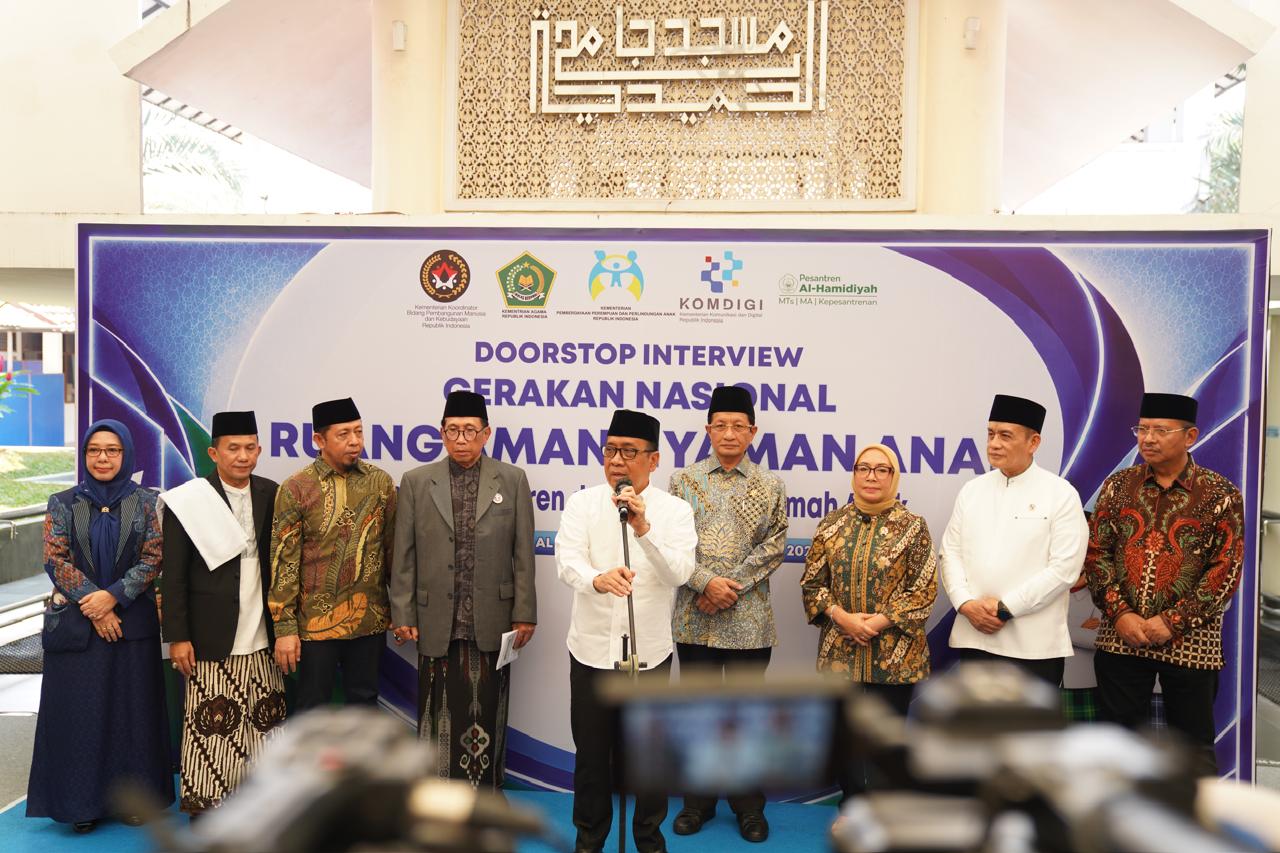
The government is strengthening the national child protection strategy by building a safe ecosystem that not only focuses on the family but also reaches educational units, public spaces, and digital spaces. This step is considered important to address the increasing challenges of violence against children occurring in various living environments today.
Coordinating Minister for Human Development and Cultural Affairs (Menko PMK) Pratikno stated that child protection cannot be borne by a single party alone. The entire ecosystem, from families and schools to local governments and the community, must be involved in creating a safe and comfortable space for children’s growth and development.
“Children must feel safe wherever they are, whether at home, at school, in public spaces, or in digital spaces. Child protection must become a collective movement,” Pratikno said during the launch of the National Movement for Safe and Comfortable Spaces for Children for Child-Friendly Pesantren and Madrasah at Pesantren Al-Hamidiyah, Depok, on Sunday (12/7/2026).
Pratikno explained that the government is currently developing a child protection approach through four main spaces. First, a safe space within the family environment as the first place where children receive care and character education. Second, a safe space in educational units, whether in pesantren, madrasah, public or private schools, from early childhood education to higher education.
Third, a safe space in public areas, so that children can play, exercise, carry out activities, and even walk to school through safe and child-friendly public facilities. Fourth, a safe space in the digital realm, considering that children’s activities are increasingly tied to the use of information technology and digital media.
According to Pratikno, digital transformation is inevitable, so what must be done is not to limit the use of technology, but to build children’s ability to use technology healthily while being protected from various risks in cyberspace. “We must utilise technology, but we must also understand the various risks that accompany it so that children remain protected,” he said.
Pratikno added that the momentum of the new academic year is being used by the government to strengthen a culture of violence-free educational units. This effort is carried out through synergy between the Coordinating Ministry for Human Development and Cultural Affairs, the Ministry of Religious Affairs, and the Ministry of Women’s Empowerment and Child Protection.
As part of strengthening the protection system, the government has also prepared guidebooks for students, teachers, caregivers, and educational staff. The guidebook contains children’s rights, educators’ obligations, and mechanisms for preventing and handling violence in the educational environment. “This guidebook serves as a reference so that children understand their rights, while teachers and caregivers understand their responsibilities in creating a safe learning environment,” he said.
On the occasion, Pratikno appreciated Pesantren Al-Hamidiyah, which he considered to have implemented a comprehensive child protection system. The pesantren has internal regulations, an ethics committee, a complaints mechanism, and various instruments for preventing physical, verbal, sexual, and digital violence.
According to him, these good practices deserve to be a reference for pesantren and madrasah in various regions as a standard for protecting students. “We want all pesantren in Indonesia to have a system like Pesantren Al-Hamidiyah. There are already clear rules to prevent physical, verbal, sexual, and digital violence, complete with a complaints mechanism,” said Pratikno.
He added that the government has also partnered with the Association of Indonesian City Governments (APEKSI) to expand the provision of child-friendly public spaces in various regions.
Pratikno expressed hope that collaboration between the central government, local governments, educational institutions, families, the business world, and the community can build a sustainable child protection ecosystem so that every Indonesian child can grow, learn, and develop in a safe environment in every space of their lives.