
Governors Come and Go, the Bureaucracy Remains: Reading 15 Years of Jakarta from an Insider
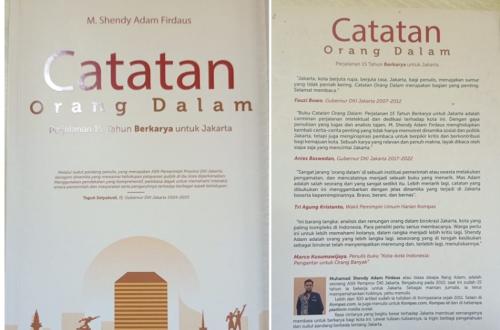
The capital keeps changing its face. Its governors change, its governing slogans change, technology enters the body of the bureaucracy, the MRT runs below and above ground, while debates about flooding, congestion, reclamation, Betawi culture, RT/RW, and the city’s future seem never to end. Over roughly the past 15 years, Jakarta has faced an even greater change than the turnover of governors. The city that for decades was synonymous with the centre of power of the Republic of Indonesia has had to begin imagining itself without its status as the national capital. Amid that change, the book Catatan Orang Dalam: Perjalanan 15 Tahun Berkarya untuk Jakarta by M Shendy Adam Firdaus finds its relevance. This book is not an official history of Jakarta, not a governor’s memoir, and not a local government performance report. It more closely resembles the record of an inhabitant of the government machine who chose to keep observing, recording, and occasionally criticising the machine in which he works. That is where the term ‘insider’ becomes important. Shendy brings experience as a journalist. He was once a reporter at Merdeka. When that media outlet ceased publication on 31 August 2009, his path led him to take the civil service selection and ultimately choose the DKI Jakarta Provincial Government after also being accepted at the KPU. The egalitarian newsroom was replaced by a structural bureaucracy. Yet the habit of writing was apparently not abandoned. One sentence in the preface helps to understand the book’s position. Shendy asserts that becoming a civil servant is not a reason to lose the freedom to think and voice opinions. He continued to channel his passion through Kompasiana. By the time this book was published, he had produced hundreds of articles on themes ranging from politics, government, and socio-culture to sport. After selection and editing, those articles were collected into the book now in hand. The book’s content is an archive of thought. Many pieces were written while the issues discussed were still unfolding, not years after the events ended. Its documentary value lies precisely there. The Politics and Leadership section shows a long span of time. There are Fauzi Bowo, Joko Widodo, Basuki Tjahaja Purnama, Anies Baswedan, Heru Budi Hartono, and Teguh Setyabudi. Each period brought a different governing character. Shendy records it through titles such as ‘Four Years Leading Jakarta: Bang Foke Did Not Fail, He Just Has Not Succeeded Yet’, ‘Do Not Cult-Worship Jokowi’, ‘The Ahok Regime, the Era of Former Subdistrict Heads Thriving’, ‘Homework from Ahok for Anies’, and ‘Civil Servant Whisperings, Heru Budi’s Anger, and Meritocracy’. The choice of titles shows that the author’s closeness to government does not automatically make him always praise it. He still leaves room for assessment, even criticism. Yet reading this book only as a chronicle of governors would diminish its value. For the figure that truly remains present from one period to the next is the bureaucracy. The governor is the face of Jakarta. But a city government with millions of residents does not move only because of one figure at City Hall. Beneath it are agencies, bodies, mayors, subdistrict heads, village heads, and thousands of apparatus who carry out services every day. This is where Shendy’s position as an insider becomes interesting. Titles such as ‘Jokowi-Style Auction of Subdistrict and Village Heads’, ‘Why Did Jokowi Form TGUPP?’, ‘Does Jakarta Still Need Subdistrict and Village Heads?’, ‘CRM, the Capital Bureaucrat’s App of the Present Era’, ‘Stop Suspicion of Civil Servants’, and ‘JAKI, How Jakarta Faces Disruption’ show his attention to parts of government that rarely become main headlines. Outsiders can judge the results of a policy. Insiders have the opportunity to see how policy meets structure, work culture, resistance, and the people who must carry it out. Of course, that position also raises a question: how far can someone keep a distance from the house in which he himself lives? That question is not a reason to doubt all the writings. It is precisely the tension between closeness and objectivity that makes an insider’s perspective interesting to read.
Source: jawawa.id (https://jawawa.id/newsitem/governors-come-and-go-the-bureaucracy-remains-reading-15-years-of-jakarta-from-an-insider-1787126013)
Originally published by Republika (https://republika.co.id/berita//tk07k2451/gubernur-datang-pergi-birokrasi-tetap-membaca-15-tahun-jakarta-dari-orang-dalam), translated from Indonesian