
Governor Mirza Pushes for Lampung to Become National Bioethanol Development Hub
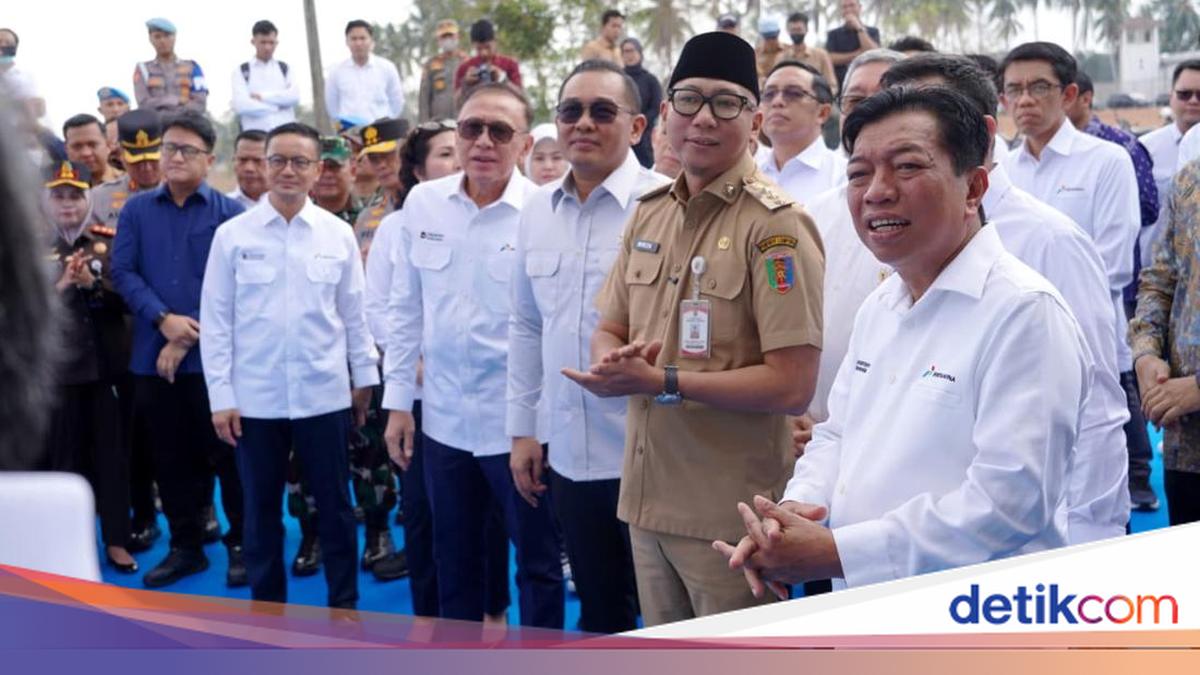
Lampung Governor Rahmat Mirzani Djausal has expressed optimism that Lampung can become the centre of a national bioethanol ecosystem, with the development expected to be a first step in connecting the province’s agricultural potential with biomass-based renewable energy.
He made the remarks while attending the launch of the Lampung Bioethanol Development Center in Kota Agung village, Tegineneng district, Pesawaran Regency, on Monday (14/9).
The development is being carried out through a collaboration between the Ministry of Investment and Downstreaming/BKPM, PT Pertamina New & Renewable Energy, the Toyota Group, the University of Lampung, the regional government and a number of other partners and stakeholders.
Mirza said Lampung is known as an agrarian province and one of the nation’s food baskets. However, he said this potential needs to be developed further so that it produces not only food but also added value through industry and energy.
“Agriculture no longer just produces food, but also energy. It is not just about selling harvests, but creating industry. And it is not only about driving Lampung’s economy, but also helping to strengthen national energy resilience,” Mirza said in a written statement on Tuesday.
According to him, the launch of the Lampung Bioethanol Development Center is not merely the launch of a facility, but a first step in building a new ecosystem that connects the agriculture, research, technology, industry and energy sectors.
Mirza commended the collaboration of all parties involved, noting that the project requires synergy and trust between government, business, universities and strategic partners.
The initiative also aligns with the direction of national policy, including the blending of bioethanol in fuel, moving from E5 towards E10 and E20 in the future.
“What we are starting in Lampung today is part of Indonesia’s great stride towards energy independence,” he said.
Lampung’s agricultural potential
Mirza said Lampung has considerable potential to develop a bioethanol industry. Beyond its available land and agricultural ecosystem, the province also has an agro-industrial sector and resources that can be integrated with biomass-based renewable energy development.
Around 27 per cent of Lampung’s economic structure is supported by agriculture. The province also holds a strategic position as one of the nation’s food baskets, with a number of leading commodities. Cassava is one of its main commodities, with production of around 7.5 million tonnes, ranking first nationally. Rice production stands at around 3.5 million tonnes of dry milled paddy, ranking sixth nationally. Maize production is also sixth nationally at around 1.7 million tonnes, while sugarcane production ranks second with around 724,000 tonnes of white crystal sugar.
According to Mirza, Lampung’s agricultural surplus contributes to meeting national food needs. This potential is also capital for developing bioethanol technology that uses a variety of raw materials, or multi-feedstock, while producing various derivative products through a multi-generation bioethanol concept.
“Agricultural commodities must not stop as raw materials. They must become a source of added value. They must become a source of investment. They must become a source of employment,” he stressed.
Sorghum and the bioethanol ecosystem
Mirza emphasised that developing a bioethanol industry is not enough just by building a factory; it also requires a comprehensive supporting ecosystem. This includes seed development, crop cultivation, agricultural mechanisation, biomass processing, bioethanol production and the utilisation of derivative products.
For this reason, the development of sorghum as a feedstock needs to run in parallel with the construction of the Lampung Bioethanol Development Center. The centre is expected to become a vehicle for driving innovation and research, testing technology, collecting data and drawing up business models that can be applied on an industrial scale.
“If that succeeds, the benefits will be felt not only in Lampung but across Indonesia,” he said.
Opening new economic opportunities
The development of sorghum and bioethanol is seen as opening new economic opportunities for farmers, workers, small and medium enterprises, businesses, researchers and communities around the development area.
Going forward, an integrated value chain is expected to form, from the provision of seeds and cultivation, to agricultural mechanisation, biomass processing, bioethanol production and the utilisation of by-products. In this way, renewable energy development will not only drive technological innovation but can also become a driver of regional economic growth.
“This is the true meaning of downstreaming. Not merely processing raw materials, but creating added value that returns to the people,” he said.
Mirza hopes the entire construction of the Lampung Bioethanol Development Center will be carried out professionally, transparently and measurably, with attention to workplace safety and environmental protection, producing a development model that can be replicated in other regions.
Collaboration for food and energy sovereignty
Mirza expressed appreciation to the Ministry of Investment and Downstreaming/BKPM, PT Pertamina New & Renewable Energy, the Toyota Group, the University of Lampung and all partners who have taken part in developing the bioethanol centre.
He invited all parties to make the launch the beginning of stronger collaboration to bolster agriculture, develop renewable energy and open up economic benefits for the community.
“From the soil of Lampung, we are ready to lead Indonesia towards food sovereignty, energy independence and the sustainable prosperity of the people,” he said.
Meanwhile, Deputy Minister of Investment and Downstreaming Todotua Pasaribu explained that bioethanol development in Lampung rests on four fundamental national pillars: energy resilience, downstreaming, energy transition and mix, and national economic resilience.
Todotua said the government has successfully promoted energy sovereignty through the B50 programme based on crude palm oil (CPO). Bioethanol, meanwhile, is seen as a solution for substituting petrol, of which national consumption reaches 36 million kilolitres per year.
This is considered crucial to easing the burden of energy subsidies on the state budget, which currently runs to hundreds of trillions of rupiah per year due to fluctuating global crude oil prices.
The selection of Lampung as the location for the national bioethanol hub originated from research into biomass technology in Fukushima, Japan. That visit revealed the remarkable fact that the enzyme research and superior sorghum seeds used by Japan’s automotive industry actually came from Lampung.
“When I saw the plant in Japan with a capacity of 60,000, I met the researchers and they knew Lampung. ‘The enzymes we use here, we research in Lampung. The sorghum we plant here, the seeds are from Lampung, we researched it in Lampung, we brought it over.’ I thought, how remarkable. If Japan can do this, why can’t my country?” he said.
Beyond drawing on Japanese technology, Todotua also cited Brazil’s success in producing 38 million kilolitres of bioethanol per year from cassava, maize and sorghum, at a selling price almost half that of petrol. That success is also integrated with a giant-scale cattle industry, through the use of bioethanol distillation residue as high-quality cattle feed and the use of waste as biomethane gas and organic fertiliser, forming a zero-waste circular economy.
To realise this model in Lampung, the Tegineneng Bioethanol Development Center facility is targeted to begin production in December 2026 as a pilot project on a scale of 60 kilolitres, with a 10-hectare cultivation demonstration plot. The facility will test and validate the economics of first-generation bioethanol production (based on cassava and sorghum) as well as second-generation production (based on horticultural biomass waste and sugarcane bagasse).
“We are building this development centre to measure its commercial viability, to find out what competitive cost we can achieve. Because with energy transition, the biggest challenge is price, cost. Next year, our target is to push into a commercial scale of 60,000 kilolitres,” he stressed.
Todotua also commended Rahmat Mirzani Djausal for his responsive and accelerated leadership in preparing land to support the green energy downstreaming project, expanding it from 2 hectares to 10 hectares. Going forward, the scheme will be developed inclusively by involving local farmer groups and cooperatives as raw material providers, or feedstock hubs.
“The hope is that we can also absorb cassava from the community. There is added value, not only for crisps or flour. The cooperative concept can also be run as a hub to collect feedstock, with the factory as the offtaker. So the ecosystem is extraordinary and very well connected,” he concluded.
At the event, a cooperation agreement on agribusiness development for energy and food resilience was signed between PT Pertamina New and Renewable Energy (Pertamina NRE) and the Lampung Provincial Government. A memorandum of understanding (MoU) was also signed regarding a technical and commercial assessment of sustainable bioethanol production and utilisation in Indonesia.
To mark the start of construction of the research and production facility, Todotua Pasaribu, together with Rahmat Mirzani Djausal, members of the board of commissioners of PT Pertamina (Persero) and leaders of the Japanese automotive consortium, carried out a symbolic first cement pouring for the Bioethanol Development Center. The event continued with the first planting of superior sorghum seeds on the 10-hectare demonstration plot.