
Governor Khofifah encourages East Java schools to develop food security
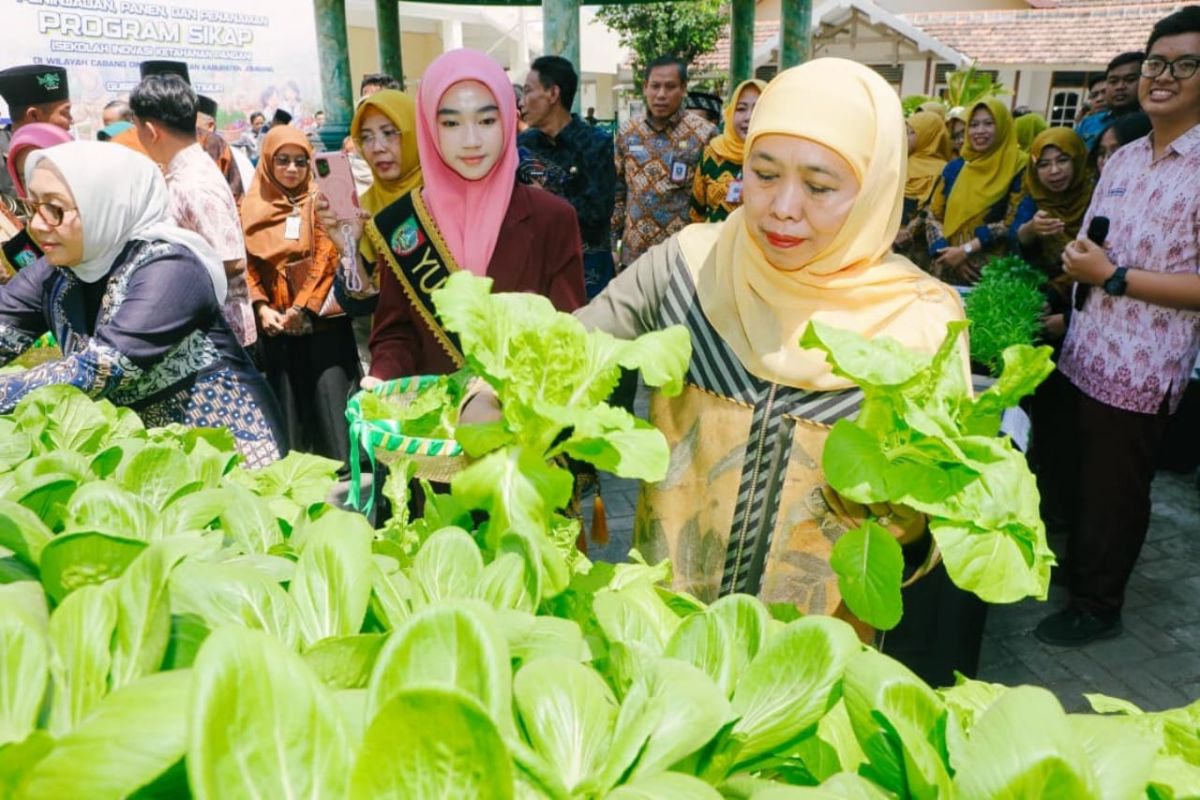
East Java Governor Khofifah Indar Parawansa is encouraging all schools in the region to develop food security innovations by utilising available land within school grounds productively and sustainably.
Khofifah said food security does not have to be built by using land on a large scale, because various spaces available around homes and institutions, including schools, can be used to produce food.
“In fact, we cannot rely on the size of the land, how many hectares of land, so in every area around our institutions, homes, and even schools, it is very possible to prepare a food security format,” she said in a statement received in Jombang on Saturday.
She also reviewed the product exhibition of the School Food Security Innovation (SIKAP) programme for senior high schools, vocational high schools, and special needs schools throughout Jombang Regency at SMA Negeri 2 Jombang together with Minister of Women’s Empowerment and Child Protection, Arifah Fauzi.
According to her, the provincial government has created a programme to encourage food security through the SIKAP programme. This initiative of the East Java Provincial Education Office is built on the productive and sustainable use of school land.
She harvested tilapia fish and pakcoy vegetables and inspected the cultivation of samhong mustard greens that were 31 days old and ready for harvest.
The SIKAP programme is integrated into the Creative Products and Entrepreneurship (PKWU) learning, particularly for grade XI students. Students are involved in the cultivation stages from seeding, care, harvesting, to packaging and product labelling.
“Not only learning to plant, children also learn to package cultivation products attractively with the SIKAP programme label, as part of learning about added value and entrepreneurship,” she said.
Khofifah hopes the programme can build independence, creativity, skills, and an entrepreneurial spirit among students through direct experience from the production process to processing the results.
“The hope is that children who are directly involved in the production process from upstream to downstream will not only have knowledge, but also experience and skills that can be a provision for facing the future,” she said.