
Governor Dedi aims for West Java to become Indonesia's largest electricity-producing province
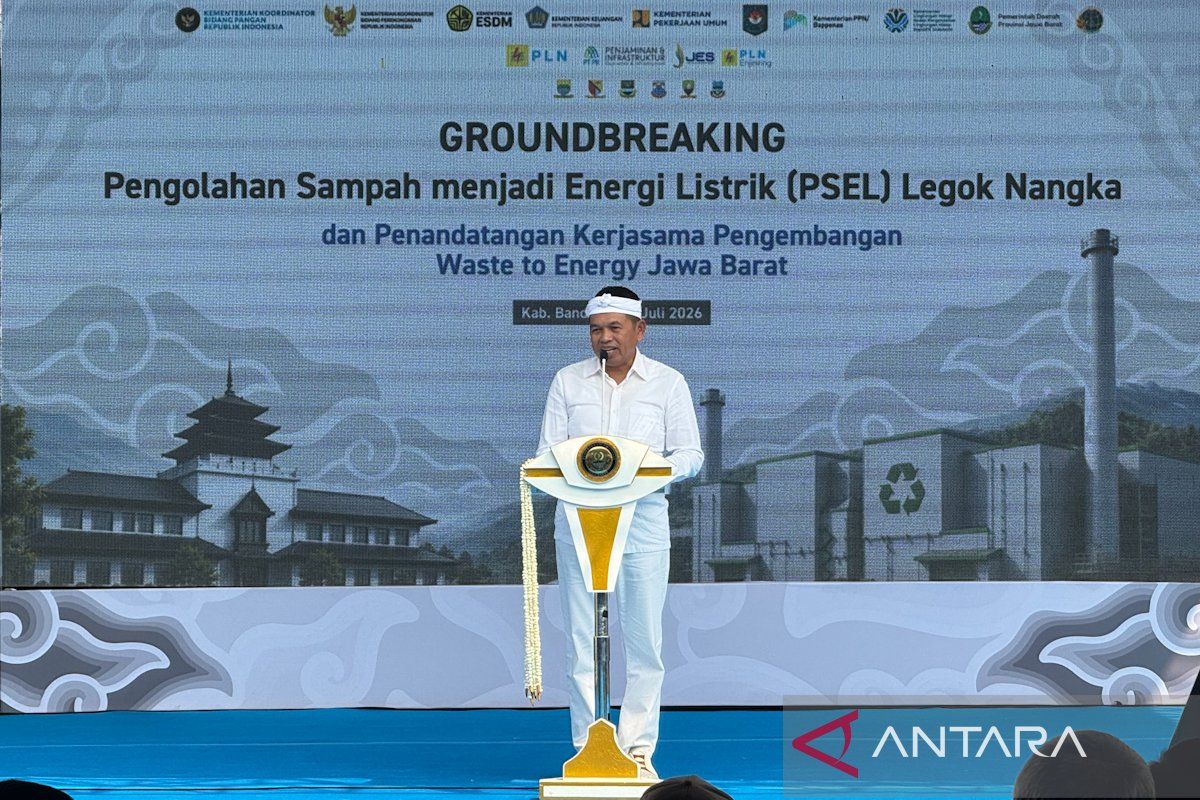
West Java already has various power generation sources such as solar and geothermal plants, which will be further strengthened through the construction of waste-to-energy facilities (PSEL) in a number of regions.
Bandung Regency, West Java (ANTARA) — West Java Governor Dedi Mulyadi is targeting his province to become the largest electricity producer in Indonesia through the accelerated development of various renewable energy power plants, including Waste-to-Energy (PSEL) facilities.
“This Legok Nangka Waste-to-Energy facility will become one of the triggers for building a modern waste processing system,” said Dedi at the groundbreaking of the Legok Nangka PSEL and the signing of a waste-to-energy development cooperation agreement for West Java in Bandung Regency on Wednesday.
Dedi believes the Legok Nangka facility will catalyse the development of a modern waste management system capable of resolving environmental problems whilst sustainably producing clean energy in West Java.
“It will also educate people to be disciplined and live cleanly, which will then improve air quality and environmental quality. And next, West Java will become the largest electricity-producing province in Indonesia,” said Dedi.
Dedi said the construction of the Legok Nangka PSEL is the continuation of an initiative by the provincial government since the previous governor’s administration, which has now entered the implementation stage after all requirements were met.
According to him, the project finally materialised because it secured investment, investors, and certainty of implementation after obtaining a recommendation from the Ministry of Energy and Mineral Resources (ESDM).
He added that an agreement on the electricity selling price was also an important factor providing investment certainty, allowing construction of the Legok Nangka PSEL to begin promptly in line with government plans.
Dedi noted that West Java already has various power generation sources such as solar and geothermal plants, which will be further strengthened through the construction of PSEL facilities in a number of regions.
“How many power plants are there? How many solar power plants? How many geothermal plants, plus waste-to-energy plants, which will later be the most numerous in West Java,” he said.
According to him, PSEL construction will be developed in Greater Bandung including Garut, then Bogor, Bogor City, Depok, Bekasi and Bekasi Regency to strengthen regional waste management.
Dedi added that the government will also encourage PSEL construction in the Cirebon area and its surroundings as a step to address the high volume of waste whilst expanding renewable energy capacity in West Java.
“Going forward, there is one more area we must push, which is the Cirebon region and its surroundings. That is also a problem; the volume of waste is very large,” said Dedi.
At the same event, Deputy Minister of Energy and Mineral Resources Yuliot Tanjung said the Legok Nangka PSEL is designed with a generation capacity of 40.79 megawatts and an investment value of US$400 million, or around Rp7.2 trillion.
The construction period will last approximately 41 months, with commercial operation scheduled for 2029, and during construction the project is expected to absorb around 1,565 workers.
Beyond serving as a solution to urban waste problems and producing clean energy, the project is also projected to reduce greenhouse gas emissions by 311,874 tonnes of CO₂ equivalent.
The government has strengthened regulations to accelerate waste-to-energy development through Presidential Regulation Number 109 of 2025 on Urban Waste Management Through Processing Waste into Environmentally Friendly Technology-Based Renewable Energy.
The regulation replaces Presidential Regulation Number 35 of 2018 on the Acceleration of Construction of Environmentally Friendly Technology-Based Waste-to-Electricity Processing Facilities.
The Ministry of ESDM followed up the regulation by simplifying business licensing for PSEL facilities, waste processing into bioenergy, and renewable liquid fuels under a single business field classification.
Then, the Electricity Supply Business Plan (RUPTL) was determined, containing plans for PSEL development with a total capacity of 452.7 MW, along with flexibility for PSEL capacity development outside the RUPTL quota.