
Government’s Rice Price Caps Fail to Work as Market Prices Soar
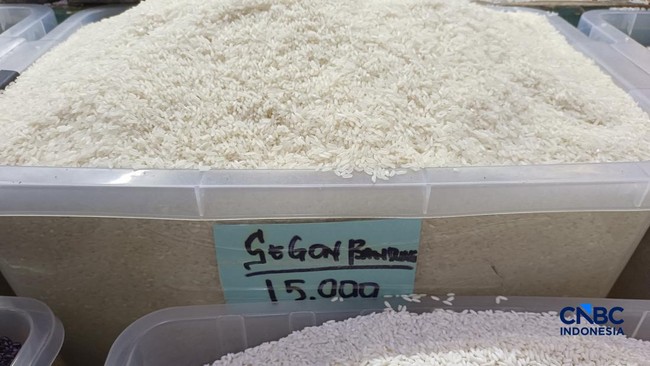
Rice traders at Pasar Rumput in South Jakarta have complained that the government’s highest retail prices (HET) for rice do not reflect prices on the ground. They say the cost of buying rice from suppliers, combined with distribution expenses, makes it difficult to sell at the regulated prices.
CNBC Indonesia observed on Friday (16 October 2026) that medium-grade rice was selling for as much as Rp15,500 per kilogram at Pasar Rumput. Premium rice prices varied, reaching Rp18,000-Rp19,000 per kg.
The HET for medium-grade rice in Zone 1, which includes Java, Lampung and South Sumatra, is Rp13,500 per kg. The cap for premium rice in the zone is Rp14,900 per kg.
Bayu, a rice trader, said retailers should not be held solely responsible for the prices. He said rice is already expensive in its area of origin, before transport costs are added to bring it to Jakarta.
“I’m also confused. The government’s HET is Rp13,500 for medium-grade rice and Rp14,900 per kg for premium. But in the area of origin alone, the price for rice fit for consumption is already above Rp14,000 per kg. That is for the cheapest premium rice,” Bayu told CNBC Indonesia.
He said transport and operating expenses from the area of origin to Jakarta must also be added. Bayu estimated these costs at Rp500-Rp700 per kg.
“Say the price of premium rice at the mill is Rp14,900. Bringing it to Jakarta requires transport and operating expenses. On average, that costs around Rp500 to Rp700 per kg,” he said.
Bayu said traders struggle to comply with the HET when their purchase prices are already high. They must account for their capital costs to keep their businesses running.
“If the government insists that we sell at the highest HET, who is going to cover the shortfall? The government does not know the operational costs of bringing it from the regions to here,” he said.
Another rice trader, Dedi, made a similar complaint. He said rice bought at the Cipinang Rice Main Market (PIBC) was already expensive, even before additional transport and handling costs.
“Yes, because we already buy at high prices from the main market (PIBC). Then there are transport costs and porter fees. It’s difficult for us to sell at the HET when our capital costs are already high,” Dedi said.
Dedi currently sells medium-grade rice for at least Rp15,500 per kg. Premium rice sells for around Rp16,500-Rp18,000 per kg, depending on quality.
Another trader, Rena, said rice prices had remained high for several months. She sells medium-grade rice for around Rp15,000-Rp15,500 per kg and premium rice for around Rp16,000-Rp18,500 per kg, depending on the variety.
“Prices have gone up a little. But they’ve been more or less stable at these levels for several months — it’s just that the stable level is quite high,” Rena said.
Bayu said the government should review rice price formation further up the supply chain, including paddy and milling prices, so that the HET does not conflict with the costs traders have to bear.
“Basically, the upstream part needs fixing, at the milling level. Those of us downstream just follow the prices from upstream,” Bayu said.
He also urged the government to adjust the HET to reflect actual market conditions, so that price-control policies do not place the burden solely on retailers.